The
Pyramid Texts of UNAS
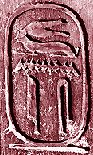
Cartouche of
King Unas ("wnis").
(ca. 2378 - 2348 BCE)
The Royal
Ritual of
Rebirth & Illumination
the regeneration of the divine king and
the transformation of his Ba into an Akh
by Wim
van den Dungen
|
 |
King Unas was the first to include hieroglyphic
inscriptions in his tomb, namely on the walls of the corridor, antechamber,
passage-way and burial-chamber, as well as on the four gables. These
earliest 'Pyramid Texts' were found by Maspero in 1881. The tomb had been
sealed ca. 2348 BCE and so the texts unaltered for over 4200 years ! Besides
an intro on how to approach Egyptian texts, involving epistemological,
anthropological and egyptological considerations, and a complete new
translation, this 2019 book includes a commentary pointing to two salvic
strategies put into evidence : renewal (in the Duat of Osiris) and ascension
(on/in the horizon, headed towards the sky of Re), mediated by
'Horus-consciousness', the power of majesty. These salvic perspectives
return in Hermetism, monotheism and Hermeticism. |
|
|
GENERAL INTRODUCTION

"O You, the
great god, whose name is unknown."
King Unas (Utt.254 - West Wall of Antechamber)
01
From
Predynastic graves & mounds to royal tombs.
02
The rise of henotheism.
03 The ritual complex of King Unas.
04 The interpretation of the Pyramid Texts.
05 An integration of perpectives.
06 The role of Osiris in the Unas
text.
07
Greek versus Egyptian Initiation
The Complete Text
l
Central Plan of the Hieroglyphs
l
Commentary
l
Bibliography
by Wim
van den Dungen
Antwerp, 2006 - 2009.
Burial-Chamber l
Passage-way
l
Antechamber
l
Corridor l
Serdab
HIEROGLYPHS
Burial-chamber or Sarcophagusroom (I,
II,
III,
IV,
V)
l Passage-way (VI)
Antechamber (VII,
VIII,
IX,
X,
XI,
XII)
l Northern Corridor (XIII)
l Serdab (XIV)
Remark :
The use of capitals in words
as "Absolute", "God" or "Divine", points to a rational context (i.e.
how these appear in a theology conducted in
the rational mode of thought). Hence, when these words are used in the context of
Ancient
Egyptian ante-rational thought (which, as a cultural form, was
mythical, pre-rational & proto-rational), this restriction is lifted. Hence,
words such as "god", "the god", "gods", "goddesses", "pantheon" or "divine" are
not capitalized.
1.
From Predynastic graves & mounds
to royal tombs.
►
Predynastic burials
In Egyptian funerary rituals, the tomb was a dark, underground structure, dug
out in desert sand or rock and completed with offerings accompanying the dead.
In the Predynastic millennium (ca. 4000 - 3000 BCE) preceding the Pharaonic Period (ca. 3000 - 30 BCE), the tombs
were simple holes in the ground, with wooden walls and mats. Little is known of
what was on top of them, and so scholars hesitate to categorize these
constructions as funerary architecture. On the outside, a mound of sand or
gravel or perhaps a simple wooden construction may have served as a marker. Most
Predynastic corpses were completely dried out because of the desert sand. Was
this a prefiguration of the Pharaonic practice of removing bodily fluids with
natron (during mummification) ?
From Naqada II onwards, highly differentiated burials are
found in cemeteries in Upper Egypt (cf. Gerzean, ca. 3600 - 3300 BCE). These élite burials contained large
quantities of grave goods, with exotic materials such as gold and lapis lazuli.
These burials point to an increasing hierarchical society and the wish of the
deceased to keep their status in the afterlife, of prime important in the
funerary theology under the Pharaohs. In short, the royals had access to the sky
of Re, whereas commoners were spirits unable to leave the kingdom of
Osiris.
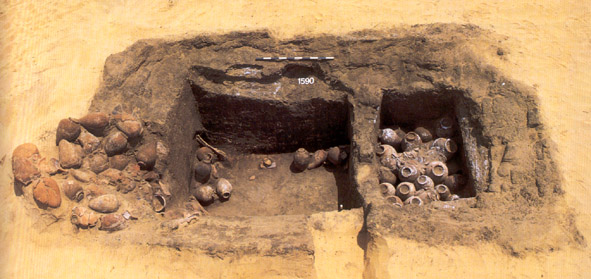
Naqada III tomb
- Minsjat Abu Omar - Eastern Delta - ca. 3300 BCE.
First seen in Amratian culture (Naqada I, 4000 - 3600 BCE), there was, during the second phase of
the Gerzean culture, a distinct acceleration of the funerary trend, whereby a few individuals were buried in larger,
elaborate tombs, containing richer and more abundant offerings (cf. the Painted
Tomb at Naqada).
These Gerzean cemeteries develop a wide range of grave types, ranging from small
oval or round pits, poorly provided, to burials in pottery vessels and
rectangular pits subdivided in partitions (to put the funerary offerings). There
were coffins of wood or airdried pottery, and indications of the wrapping of the
body in strips of (expensive) linen (cf. the Double Tomb at Adaïma near
Hierakonpolis). Various burial-sites appear, and also the richer tombs of the
chieftains, the predecessors of the "Followers of Horus", the first divine
kings.
"In the Neolithic period the dead were desposited in oval
graves in foetal position, with the head at the south. In Lower Egypt the
deceased was placed on his right side, his face turned towards the east, while
in Upper Egypt, as all along the upper Nile, the dead person was placed on his
left side, looking west. Often the body was wrapped in a cloth or an animal
skin, the head resting on a cushion." -
Lamy,
1981, p.27.
On the treshold of the First Dynasty (ca. 3000 - 2900 BCE), the graves of the
rulers and the élite consisted of neat mudbrick boxes, sunk in the desert and
divided, like a house or an imitation palace, into several rooms. The tombs of
the first kings followed this pattern, but with increased complexity.
Situated far out in the desert near the cliffs at Abydos, they were marked by a
pair of large stelæ and covered by a mound. These mounds of sand and gravel can
be traced back to the modest pit graves. The pyramid form is deemed an
elaboration of this architecture, itself rooted in the myth of the primordial
hill emerging out of the eternal "zep tepi", the Golden Age. This "risen land"
("ta-tenen") was the "first land" to come into being (in phenomenal time - cf.
Nun).
►
the advent of
dual kingship & sacred language
At Naqada, Abydos and Hierakonpolis, the end of the Naqada II phase brings
separate political centres to the fore. At the end of Naqada III, we witness a
new style of "royal" burial. Also at this time, the first hieroglyphs appear.
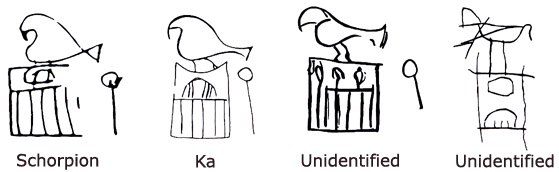
Predynastic
names of kings - Names not to same scale -
Wilkinson (1999), p.53.
From the very early start,
Egyptian kingship expressed a unique feature :
realizing
the harmony or equilibrium of opposites by using sacred language & its
ritual. The dual nature of the
monarchy was all-comprehensive and reflected in the regalia, in the
royal titulary, in the royal rituals and festivals, building-projects, etc.
Frankfort (1948)
called the presence of the divine king and his institution of
"transcendent
significance".
Divine kingship or theocratic statemanship was a unique phenomenon in the region, if not in the
world. Contemporary civilizations were often fragmented and
political unity was difficult, short-lived or foreign to them. By absence
of natural buffers, centuries of political
centralization, stability, sacrality, administration & economy were unknown to them.
The Eastern & Western Deserts of Egypt surrounded the narrow strip of
green land bordering the Nile. It was not an easy to attack Egypt from the
South or the North. Its culture flourished on the surplus economy of the
yearly inundation. Without a "good Nile", Egypt perished. Add to this the
power of the divine, sacred kingship of the Great Word (cf.
power &
magic of words), creating the world (cf.
Memphis theology), and Egyptian divine kingship is unique in
Antiquity. Its direct influence on
Greek philosophy and
monotheism are unmistaken.
The first
outstanding feature of the Egyptian solution was to institutionalize
the
king's dual nature : he was the Lord of Upper and Lower Egypt, as well
as human and divine. At first, in the Early Dynastic or Archaic Period
(ca. 3000 - 2670 BCE), when the "Followers of Horus" ruled, the
Falcon-principle inherent in Horus (the sky-god) was deemed to incarnate in each king.
Later, in the Old Kingdom (ca. 2670 - 2205 BCE), the divine king or "nesut" was
deemed the son of Re, i.e. the
sole divine being abiding on Earth (the Akhu or deities
remained in the sky and only sent their Kas -doubles- and Bas -souls-, not
their spirit).
This crucial witnessing quality of the "great house" ("pr-Aa",
much later Hellenized as "Pharaoh"), associated with the images of (a) the watchful, surging Falcon
and (b) the mighty and fertile Bull (cf. the Predynastic consort of the great goddess), help to explain the
importance of the
institution of divine kingship in Egyptian culture, as well as the
longevity and endurance of the Pharaonic canon. In the actual
transmission of the standards of the Ancient Egyptian mindset, hieroglyphs
played a crucial role.
Kingship implied the end of the fragmentation of
Prehistory, terminating the "chaos" to which no return was possible.
Thanks to the second crucial feature, the advent of
sacred language
(cf.
magic and the
power of the word), the new political
ideology could be "eternalized" for millennia : the divine king, overseeing the "Two Lands"
as its sole Lord, speaks Maat, thus keeping Upper & Lower Egypt
together & united by way of this Great Word. Incarnating the Great
Word (cf.
Memphis theology), the royal
ritual balances the scales of Maat, allowing for
communication between the divine and the mundane, maintaining creation and causing a "good Nile"
(not too much and not too little flooding).
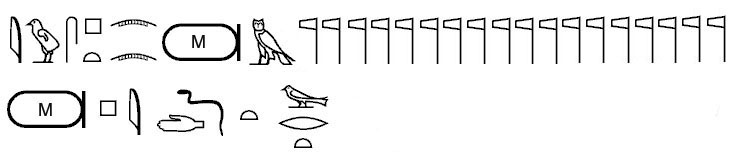
"Indeed,
the lips of King Merenre are as the Two Enneads.
This King Merenre is the Great Speech."
The
Egyptian symmetry or play of equilibria, verbal, visual and written, utilizes the duality
of opposites as part of a careful strategy to master the whole. The power
of pairing lies in the combination demarcating and underlining a greater
unity. Opposites are not contradictions, but complementarities. A kind of
"organic" patchwork-thinking of great delicacy emerges.
Thanks to the presence of the divine king, the eternal cycle of the natural
order ("neheh") initiated by Atum in the First Time, is transcended
by a witnessing consciousness characterized by :
-
the overseeing capacities of the son of Re, keeping dynamical divisions united
;
-
the wholesome, fertilizing power of the regenerated Osiris who is king of
the Duat and
-
the strong, creative output as Horus on Earth, engaging others in community-building activities
and securing one's return to the stellar light-fields of father Re. These works made the natural
order and its dynamical equilibria endure for "millions of years".
► the royal tombs
With the arrival of the institution of kingship & sacred language, the royal ritual and its funerary cult came
into existence.
The kings of the First Dynasty were buried at Abydos (the
cult place of Osiris), an indication of the Upper Egyptian origin of the
Egyptian state (cf. the "Followers of Horus" first uniting Upper Egypt before
settling in Memphis). The institution of kingship was already strong &
powerful. The central element of the later Osiris myth, the pairing of Horus and
Seth, is attested from the middle of this First Dynasty (cf. the two ivory
djed-pillars found in the First Dynasty tomb at Helwan). Osiris, not attested by
name until the Unas texts, is very likely "Khentiamentiu", or "the Foremost of
the Westerners", the god of Abydos, most likely of Predynastic origin.
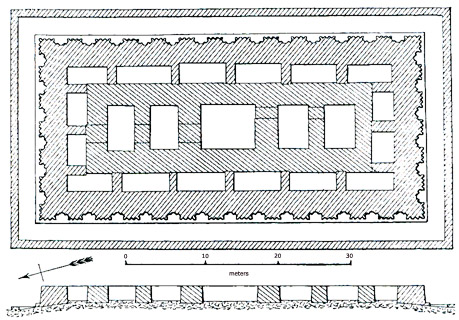
Palace façade
style mud-brick tomb - Queen Neithhotep - First Dynasty - ca. 3000 BCE.
The burial-chambers were incorparated at ground level.
The superstructures of the first royal tombs at Abydos were simple mounds of
sand held in place by a mudbrick revetment. Scholars conjecture the burial mound
recalls the primeval mound which emerged from the waters at the time of
creation. The mound is Solar, and refers to the first ray of Re shining on the
first day after the waters receded. In the tombs of kings Den and Adjib
(First Dynasty, ca. 3000 - 2800 BCE), the entrance stairway approaches the
burial-chamber from the East and the rising Sun. The symbolism speaks for
itself. Like the rising Sun, the king rose to the sky.
In the tomb of King Qaa, who closes this dynasty, a change to a northerly
orientation is effectuated (and maintained thereafter). The entrance corridor is
a large ramp pointing northwards toward the circumpolar stars ("ixmw-sk" or "the
ones that know not destruction"). Funerary ideology became stellar. The pyramids
reflect a stellar ideology made possible by the local horizon delimiting the
cycle of the Sun. They are made to assist the divine king on his celestial voyage to the
stars. This is effectuated in two stages : Osirian regeneration, Solar
ascension and luminous existence in heaven.
In these theological considerations, the change from mastaba to step pyramid,
from primordial mound (of the Sun) to celestial ladder (to the stars), reflects
the increased importance of the celestial, stellar terminus of the
divine king. The influence of Re rose and a pre-rational and Heliopolitan
henotheism saw the light. The royals were
divine beings, and so bound to the sky, whereas commoners hid beneath the Earth,
in the dark kingdom of Osiris. This Lunar fertility god would eventually
represent the "regenerative" part of the royal ritual, but his kingdom had to be
escaped. It represented an "order" created by Re but outside his reach (cf.
Heavenly Cow), making humans & deities alike fear Osiris and
make sure his judgement was favourable.
In this pre-rational henotheism, Re and his divine son rule
the pantheon & creation. By the end of the Vth Dynasty (ca. 2487 - 2348
BCE), Osiris became "second best" in royal theology, creating the
unsettling tension between the "Duat", the Netherworld, and "pet", the
sky, left unresolved in the texts. Horizontal (fertility - rebirth) & vertical
(illumination - transformation) layers are not integrated in the text (yet), but
in the architecture. This movement away from the strong architectonic message of
gigantic hieroglyphic monuments for all to see, to the use of written
hieroglyphs to make the magic work in splendid secure tombs, is another evidence
of the growing importance of the magical power of hieroglyphs, lasting for ever.
"The sun's apparent path across the sky throughout the
year follows a 12°-wide arc from east to west, known as the Winding Canal. The
region of the sky to its south was known as the Marsh of Reeds and that to its
north the Marsh of Rest or Marsh of Offerings. These names reflect the
Egyptian's experience of their own country, where the marshes of the Delta
gradually gave way to the Mediterranean Sea. Features within both regions were
sees as islands, some inhabited by the 'Imperishable Stars', in the north, and
the 'Unwearying Stars' in the south, and others known as the Mounds of Horus,
Seth and Osiris." -
Allen,
2005, p.9.
In some mysterious way, Osiris' Southern "Field of Reeds" and
Re's Northern "Field of Offering" or "Field of Peace" were adjacent salvic conditions with conflicting
ontological features. They reflect the dual spiritual economy at hand, and
represent the Solar (dry) and Lunar (wet) "mechanics" of the high magic of
rebirth (as the Lunar Osiris) and enlightenment (as the Solar Re). Very likely,
divine kingship (as Re) assimilated the Lunar power of the Predynastic "great
goddess", represented by Osiris, the "fertile bull" slain & risen. The earliest
hieroglyphs evidence these two theologies, and their distribution in the tomb
points to a sequence involving Lunar purification (rebirth) and Solar
illumination (transformation).
Although the tombs left by the kings of the Early Dynastic Period are monumental
in size, they do not approach the scale suddenly reached in the IIIth Dynasty
(ca. 2670 - 2600 BCE), in particular under King Netjerikhet or "Djoser" (ca. 2654 - 2635
BCE) and his grand architect Imhotep.
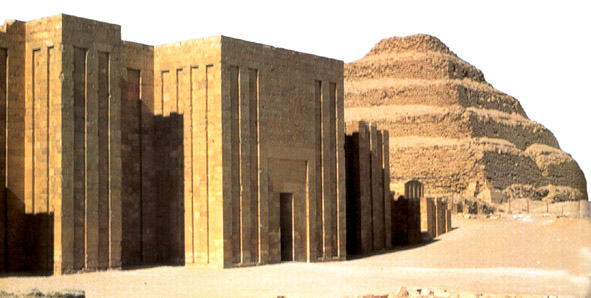
Pyramid of
Djoser and part of its surrounding enclosure wall.
"The Step Pyramid
of Djoser heralded the classic pyramid age, the 4th to 6th dynasties, also known
as the Old Kingdom. During these centuries the Egyptians built pyramids for
their god-kings in a 72-km (45-mile) span of desert, between Abu Roash,
northwest of Giza, to Meidum in the south, near the entrance of the Fayum.
Excluding the pyramids of Djedefre at Abu Roash and Sneferu at Meidum as
outliers, the 21 major Old Kingdom pyramids stand like sentinels in a 20-km
(12-mile) stretch west of the capital the 'White Walls', later known as Memphis,
clustering at Giza, Zawiyet el-Aryan, Abusir, Saqqara and Dahshur." -
Lehner,
2001, pp.14-15.
The Step Pyramid represents a significant leap in architectural size and
sophistication. A limestone wall, 10.5 m high and 1.644 m long, contained an
area of 15 ha (then the size of a large town). This is the barrier between the
outer world and the domain of the divine king. The complex, with functional and
dummy buildings, large terraces, façades, columns, stairways, platforms, shrines
and life-seized statues, reflected the dual nature of the afterlife : the
half-submerging dummy buildings "must have signified the
chthonic, underworld aspect of existence after death" (Lehner, 2001, p. 84), while the Step Pyramid itself, rising in six steps to
a height of ca. 60 m, reflects the route of celestial (stellar)
ascension/descension taken by the Solar King after he was mummified and
entombed. Even after death, the king was still "at work" in his tomb,
which acted as a stairway to and fro the sky. This depicted the fundamental duality of the
afterlife : on the one hand, the Lunar underworld ("Dwt", "Duat") and, on the other
hand, the Solar sky ("pt", "pet") of the "imperishable" circumpolar stars
(Alpha Draconis rather than Alpha Polaris), about 26° to
30° above the northern horizon in the area of the pyramids.
Lehner,
2001, p.19 |
older DJOSER type |
new MEIDUM TYPE |
|
Orientation |
North - South |
East - West |
|
Parts |
N - S sequence |
E - W axial
symmetry |
|
Enclosure wall |
niched,
no inner wall |
smooth outer
wall,
at times niched inner wall |
|
Entrance |
South end of
East side |
Centre East side |
|
Ka tomb |
South tomb
no
Satellite Pyramid |
Satellite
Pyramid |
|
Temple |
N or S temple |
E temple, N
entrance chapel |
In the reign of King Sneferu (ca.
2600 - 2571 BCE), the first king of the IVth Dynasty, radical changes in the
overall plan of the Pyramid complex happened. A new form was sought. The royal
tomb changed into a true pyramid. A new orientation was applied (the main axis of
the complex was now from East to West instead as the previously North - South
direction), and the mortuary temple was built against the Eastern face of the
Pyramid (Djoser's is to the North). It was linked by a causeway to a valley
temple, close to the edge of the cultivated area further to the East, which
provided a monumental entrance to the complex as a whole ...
This new standard,
so-called Meidum-type arrangement, was amplified by the gigantic Giza complex of
King Khufu (ca. 2571 - 2548 BCE), and remained unchanged throughout the Old Kingdom. Only in
the Middle Kingdom (ca. 1938 - 1759 BCE), when the earliest Meidum-type were fading into ruin, did
pyramid builders return to the basic elements of Djoser's complex, with a long
North - South rectangular enclosure, defined by a decorated wall with a single
entrance at the far South end of the East side.
During his reign, Pharaoh Sneferu
finished in half a century three giant pyramids at Meidum and Dahshur. But the
largest pyramid, 146.59 m high, would be built by his son Khnum-khuf ("Khnum is
his protector"). The only known figure of him is a tiny figurine around 7.6 cm
high with his name on its throne !
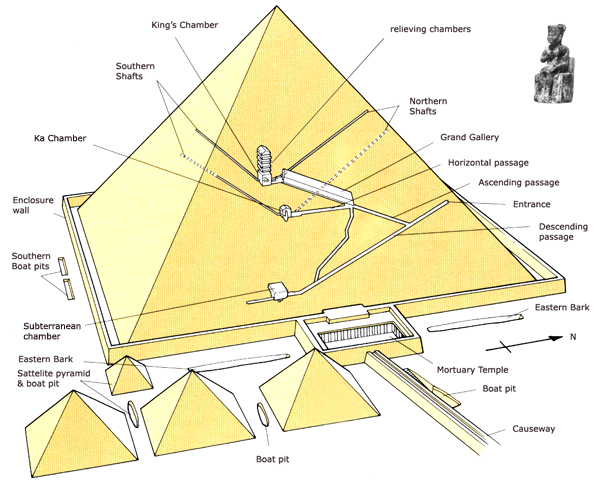
Plan of the
Pyramid-complex of Pharaoh Khufu (ca. 2571 - 2548 BCE). The northern ventilation
shaft pointed directly to Alpha Draconis, the Pole Star. But once every 24
hours, the three stars in Orion's belt passed at culmination above the southern
ventilation shaft of the burial-chamber ; a combination of the myths of Re and
Osiris ?
Even if we allow Pharaoh Khufu a reign of 30 to 32 years, his workers and
builders would had to set in place 230 m³ of stone per day, i.e. a rate of 1
average-size block of 2.5 tons every 4 or 6 minutes (working in day and night
shifts), to finish his pyramid, causeway, two temples, satellite pyramids, three
queens' pyramids and official's mastabas (a combined mass of ca. 2.700.000 m³).
Although this king did not equal his father's total mass of monuments, he
surpassed his pyramids in sheer size and accuracy. After a few failures, the
principle of pyramid-building had been mastered and the building of the king's
royal pyramid-complex (also containing his tomb) become state policy.
The base of the Great Pyramid (containing about 2.300.000 blocks of stone
weighing on average ca 2.5 tons) is level within 2.5 cm (290.33 m) with an angle
of slope of 51°50'40", the average deviation of the sides from the cardinal
points is 0°03'06" degrees of arc and the greatest difference in length of the
sides is 4.4 cm. The pyramid alone covers 5.3 ha. The finished pyramid was
surrounded by an 8m high Tura limestone wall !
The Great Pyramid has three chambers : a King's Chamber with the
sarcophagus near the western wall ; a Ka chamber with the
statue of the king, the so-called "Queen's Chamber", never intended for the
burial of the queen and the Subterranean Chamber, 30 m below the plateau
surface, reached by a Descending Passage cut straight into the natural rock of
the plateau. Some
think the lower chambers were "mistakes", while this seems unlikely (in view of
the triune architecture of royal tombs, with burial-chamber, antechamber and
Ka-chamber). What is typical for these "Stellar" pyramids of Sneferu (Bent Pyramid
as well as North Pyramid) and Khufu is the elevated position of the King's
Chamber. In both, the funerary symbolism is clearly celestial. The expanse of
the sky was the celestial Nile, with banks on the West and on the East.
The Milky Way was called "the beaten path of stars" and paradise was invisioned
as the Nile Valley at inundation : the Field of Reeds (Osiris) on the eastern edge
(i.e. the culminating moment in the movement from dusk to dawn) and
the Field of Offering (Re) further North.
By elevating the King's Chamber, the architects of the Great Pyramid underlined
the celestial goals of Solar Kingship, and, by doing so, also made it possible for
the "son of Re" to unite with the celestial, stellar corpse of Osiris,
associated with the Orion constellation and the star Sirius (the Southern
shafts). By the bright appearance of the Dog-star in the dawn sky of July, the
annual Nile inundation was heralded. This star, associated with Isis, was called
"the Bringer of the New Year and the Nile flood".
Osiris,
the brother and husband of Isis, was identified with Orion : the announced
renewal of life by the heliacal rising of Sirius, entailing the blessing of Osiris, the vegetation
god. Moreover, the Ba of King Khufu, son of Re, could rise in its "sah"
("sAH", "noble") and
be transformed into an "Akh" ("spirit") helped by Osiris and Isis in their stellar,
celestial form (in the South). Thus he reached his final destiny : the
Imperishable Stars in the North.
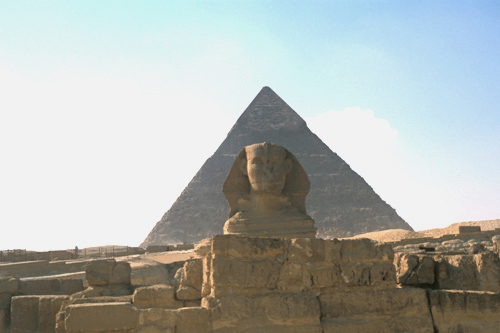
Pyramid with Sphinx
In this remarkable architecture, we may "read" the same
ambiguity, apparent in the Pyramid Texts, between, on the one hand, the sky of Re ("pet"),
creator of the deities and the universe, and, on the other hand, the Netherworld ("Duat") of Osiris,
its king hidden in the darkness of the subterranean
world, i.e. between, on the one hand, the royal Solar/Stellar prerogative and, on the other hand,
the influence of the popular (Lunar and Predynastic ?)
Osiris, with whom
eventually (in the Middle Kingdom), every deceased would identify. The kings
of the IVth Dynasty (ca. 2600 - 2487 BCE) emphasized the Solar component of
divine kingship, the direct manifestation of the supreme deity on Earth.
Nevertheless, Heliopolitan
theology incorporated Osirian thematics, but only insofar Osiris assisted the
celestial terminus of the deceased king, i.e. the son of Re returning to
his father, and escaping the darkness of the Duat, thematized in the New Kingdom
Amduat.
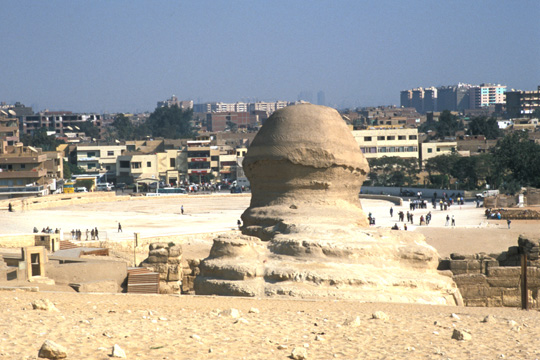
Cairo taken from
behind the Sphinx
2.
The rise of henotheism.

"Men hide, the gods fly away."
King Unas (Utt.302 -
antechamber, North Wall)
At the start of Dynastic times
(ca. 3000 BCE), the religious beliefs of the Egyptians were contextual,
local & relative to social class. Hither and thither, a variety of gods and goddesses were
worshipped. Each and every local deity was "great" ("wr") and polytheism
reigned. At the level of state, Horus (Lower Egypt) & Seth (Upper Egypt)
represented the balance of the Two Lands, realized by the institution of
divine kingship (his Great Word) and the powers of state (cf. the royal palace or "great
house", the temples, the economy, the seats of learning, the
administration, health-care, the military, etc). The (Predynastic ?)
identity of the anarchic Seth seems obvious enough, but the identity of Horus is less so,
appearing as a fusion of (a) Horus the Elder and (b) Horus, son of Osiris.
From
the IIIth Dynasty (ca. 2670 BCE), initiating the Old Kingdom (ca. 2670 -
2205 BCE), the royal ritual issued a new emphasis on the single, Solar
creator-god Re, replacing the traditional balance between Horus
and Seth. The original battle was reorchestrated as a smaller part within
the scheme of a single, universal, all-powerful creator : Atum-Re. The
latter did not assimilate or reject the other deities (as in monotheism,
stressing the singular),
but became their original point of departure, the self-created initiator
of the "first time" (zep tepi) of them all (cf. the Heliopolitan Ennead,
or
henotheism), the operative principle (ba)
of
Nun, the primordial ocean of unending potential outside
creation.
The architectural wonders of Pharaohs Djoser (ca. 2654 - 2635 BCE), Snofru
(ca. 2600 - 2571 BCE) and Khufu (ca. 2571 - 2548 BCE) evidence this new
royal theology, focusing on the divine king while in power (cf. as Osiris
& Horus in the
Sed-festival) and as Son of Re in the afterlife. The latter is two-tiered : first the
Duat is confronted (the king becomes Osiris), then, in the horizon, the Ba
of the king is transformed into a spirit rejoining the Imperishables.
The pyramid is a stairway to heaven, a
rising as given by  ,
041, the double stairway, a determinative indicating "ascent" and "high
place" (cf. the Step Pyramid of Djoser). The names given to the earliest
edifices imply the transformation (happening in the Akhet or "horizon") of
the royal soul (ba) of the king into a spirit (akh) rejoining the stars :
"Sneferu Endures" (Sneferu"), "The Southern Shining Pyramid" (Sneferu),
"The Shining Pyramid" (Sneferu), "Akhet Khufu" (Khufu), "Djedefre is a
Sehed-star" (Djedefre), "Great is Khafre" (Khafre), "Menkaure is Divine"
(Menkaure), "The Purified Pyramid" (Shepseskaf), "Pure are the Places of
Userkaf" (Userkaf), "The Rising of the Ba Spirit" (Sahure), "Pyramid of
the Ba of Neferirkare" (Neferirkare), "The Places of Niuserre Endure"
(Niuserre), "Beautiful is Isesi" (Djedkare-Isesi). ,
041, the double stairway, a determinative indicating "ascent" and "high
place" (cf. the Step Pyramid of Djoser). The names given to the earliest
edifices imply the transformation (happening in the Akhet or "horizon") of
the royal soul (ba) of the king into a spirit (akh) rejoining the stars :
"Sneferu Endures" (Sneferu"), "The Southern Shining Pyramid" (Sneferu),
"The Shining Pyramid" (Sneferu), "Akhet Khufu" (Khufu), "Djedefre is a
Sehed-star" (Djedefre), "Great is Khafre" (Khafre), "Menkaure is Divine"
(Menkaure), "The Purified Pyramid" (Shepseskaf), "Pure are the Places of
Userkaf" (Userkaf), "The Rising of the Ba Spirit" (Sahure), "Pyramid of
the Ba of Neferirkare" (Neferirkare), "The Places of Niuserre Endure"
(Niuserre), "Beautiful is Isesi" (Djedkare-Isesi).
By the IVth Dynasty (ca. 2600 - 2487 BCE), when King Khephren (ca. 2540 -
2514 BCE) added the title "son of
Re" to his royal titulary, Ancient Egyptian culture had reached its pinnacle. Canonical
attainments in science, engineering, mathematics, medicine, magic, ritual
and sapiental teachings had been realized, and we have to wait until the
New Kingdom (ca. 1539 - 1075 BCE) to witness new developments (cf. Amduat,
Atenism and
Amonism). However, in all periods,
especially in the Late Period (664 - 332 BCE), Egypt would return to the
canon initiated by King Djoser and
his "Leonardo da Vinci", the vizier, scribe, doctor and architect Imhotep,
"the one that comes in peace". In architecture (cf. Giza
pyramids), religion (cf. the Pyramid Texts) and
wisdom-teaching, to name but a few areas of interest, these
Old Kingdom rules became sanctosanct.
►
the henotheist religion of Re
As Papyrus Westcar puts into evidence, the
beginning of the Vth Dynasty saw major changes in Egyptian religion.
The powerful influence of Re made the first
Pharaoh of the Vth Dynasty (King Userkaf - ca. 2487 - 2480 BCE)
highpriest of Re and begotten by Re himself. Re had visited the wife of
Userra, a highpriest of Re. The result was the birth of a divine child.
"From the 3th Dynasty we have the evidence for a new
emphasis on a single creator, eclipsing the balance between the good Horus
and the anarchic Seth. The battles of Horus and Seth do no disappear in
the new, classical Egyptian arrangement of divine powers, but they become
a smaller part within the general scheme of a single all-powerful
creator." -
Quirke, 2001, p.83.
The popular Osiris and the crucial battle between
his son Horus and Seth, were apparently not ousted from the royal mindset.
On the contrary, his divine family-drama became part of the cycle of the
"Great Re", the overarching & overseeing deity. Osiris became the "Sun of
the night", although an essential tension between both myths continued to
exist throughout the Old Kingdom.
"In the royal and state temple theology, Osiris is lifted to
the sky, and while he is there Solarized, we have just shown how he also
tinctures the Solar teaching of the celestial kingdom of the dead with
Osirian doctrines. The result was thus inevitable confusion, as the two
faiths interpenetrated." -
Breasted,
1972, p.160.
The pyramid of Userkaf was built at North Saqqara, close to the
north-eastern corner of Djoser's enclosure. It evidences a truly
substantial re-evaluation of the rigid monumentality of the previous
Dynasty (cf. its small size : side = 73.5m and height = 49m) and less
painstaking methods of construction.
The main surviving architectural achievement of Pharaoh Userkaf was his
temple dedicated to Re, the Sun-god. Six of the seven kings of this
Vth Dynasty, King Unas included, would do the same in the next eighty years. Re became a state
god and Pharaoh the son of Re. These temples were personal monuments to
each king's continued relationship with Re during life and in the
afterlife.
The funerary ritual was also elaborated, and in the Vth Dynasty, the
Lector-priest, or "Kheri-Heb" appears in scenes. He was a specialist, and
master of the mortuary rituals for the royals. He was attended by the
"Heri-Shesheta", the "Head of Mysteries".
These developments evidence an increased interiority. Sacred
writing realizes its first internal structure : words joined together in simple sentences. Internalization led to the
formation of pre-concepts, i.e. word-images created through imagination
and the interplay of meaningful objective relational contexts.
Subjectivity was expressed as a function of an objective state. The
actions of the "I"-form are objective states which are not yet (self)
reflective. The opacity of the material side of presence prevailed. The
subject has no transparancy of its own, but functions as a "collective
Self" walking the Lunar and Solar paths.
However, in the royal cult, three central natural types
emerge : on the one hand, the divine king, his residence and magical power to
assure a "good Nile", and, on the other
hand, his father, the creator-god Re, "father of the gods" and giver of
life. This is Atum, the
"Ba of Nun", the potential to autogenerate floating in
the inert
waters of chaos. In-between there is Osiris, the prototype of
the regeneration brought by darkness and silence.
Pharaoh, being the son of Re, returns the "right order" to his
father (as the sole god on Earth, he is the only one able to do so). Because he worships his father
properly (effectively), he is blessed by the latter and
receives a "good Nile". Thanks to the tomb, his father may descend from
the sky and assist his son. The dead would thus continue to rule and Egypt
would last for millions of years ...
Because of this emphasis on Re, a constellational
henotheism ensued. To
evidence unity, multiplicity is not eliminated. To operate the multiple,
the original unity of the divine is not eclipsed. The various natural
types work together under the overarching order of Re, who is their
beginning and end. The deities are so many appearances of the creator. Every night they are reborn with him. Likewise, his son
Pharaoh is present in more than hundred temples simultaneously and he
alone effectuates the necessary rituals to make the god find his shrine
pleasant and become united with his statue. Deities only communicate with
other deities. A human coming face to face with the god dies.
►
the royal titulary
Changes in the royal funerary rituals had
already been monumentally expressed by Kings Sneferu and Khufu, but under
Khufu's son, Pharaoh Radjedef (ca. 2548 - 2540 BCE), the signs of
far-reaching religious change become institutional. Re surpassed all other deities,
even Horus, the sky god and emblem of the "Followers of Horus". Pharaoh
Radjedef, who provided himself with the name "belongs to the firmament",
is the first to bear the name "son of Re" ("sA Ra").
His brother or half brother King Khephren (ca. 2540 - 2514 BCE)
incorporated the royal title "son of Re" in his official, royal titulary.
This titulary ("nxb.t") consisted of 5 titles or "rn wr", "great
names". Each of these express a specific view-point on
kingship. As the
name of someone was crucial and all-important for his or her
survival and effectiveness, the royal name was the "name of names". To
know and understand Pharaoh's names revealed his power in life and to have
one's own name written next to his, guaranteed success in the afterlife.
As the "son of Re", King Khephren added a fifth name to his four other
titulary names, thereby expressing the idea of the divine king being the human form
of Re at birth, i.e. Re begets the king, who rules over
Egypt in the former's name.
"From this time onward every king of Egypt, whether
of Egyptian origin or not, called himself the 'son of Râ'. In later days,
when Amen, or Amen-Râ, became the King of the Gods, it was asserted by his
priesthood that the god assumed the human form of a man and begot
the king of Egypt." -
Budge, 1989, p.33, my italics.
The definitive form of the royal titulary was
attained : it began with the Horus Name of the Early Dynastic Period and
ended with the name of the king at birth (as a prince), preceded by "son of
Re". When enthroned, the king received a "prenomen", a divine name referring
to Re. Both names were enclosed by an oval ring (suggestive of the Solar
cycle), a cartouche. The "nomen" name is phenomenal. The "prenomen" name
is for all of eternity. This enclosure may be compared with the wall
surrounding the temple. Thus it reflects the Solar horizon of the Sun-disk
and assures the clear distinction between the divine and the profane.
Just as the "sah" is the result of "senetjer" or ritual consecration,
the king becomes the "son of Re" in actu exercito only after having
received his throne-name. As a prince, he was the son of a divine father,
as divine king he is a Lone Star, the son of the unique creator-god and god of light, Re,
the star of stars. By adding "son of Re" to the birth name, the divine
birth (not yet divine right) of the royal prince was underlined. At his
coronation, he received the "form" of kingship ritually (cf. the
royal Ka), but his divine
nature was already present at birth (cf. the royal placenta), for he was conceived by Re himself.
The five names of the royal titulary, a temporal as well as a spiritual
declaration of divine rule, are :
-
the Horus name, Banner name or Ka-name :
designating the king as the manifestation of Horus, the elder sky god
(Horus in the palace, not yet Horus, son of Osiris, although both were
confused), the divine prototype and patron
of the Egyptian kings. The
earliest divine kings, the "Followers of Horus", ruled with this Horus
name alone. In the Early Dynastic Period,
the perched falcon of Horus was part of the name of the king. King Aha, for
instance, was "Horus-Aha", or "Horus who fights".
In the New Kingdom, "Mighty Bull" was added at the beginning of the
name, but it was usually quite variable. Although it would continue to be used throughout the entire Ancient
Egyptian history, it lost its importance to the prenomen en nomen from
the end of the Old Kingdom on. This name was not the birth name of the
king, but it was given to him when he ascended the throne. During the
Early Dynastic Period and the early Old Kingdom, it was the king’s
official name. His name of birth would not appear in official
documents.
This name is often written within a rectangular frame, at the bottom
of which is seen a design of recessed panelling, such as we find in
the facades of early tombs and in the false doors of many private
tombs. The Ancient Egyptian name for this facade was "serekh".
When speaking of the (palace) facade, this
name is often used in modern texts as well. On top of this "serekh" is perched the falcon of Horus,
hence the appellation "Horus-name". In more elaborate New Kingdom
examples, Horus is wearing the double crown and is accompanied by the
Sun and an Uraeus ;
-
the Nebti name or "Two Ladies" title :
first met in the reign of Pharaoh Aha, Nekhbet and Uadjit ("wADiit") were the protective goddesses of
Upper and Lower Egypt respectively (a vulture & a cobra, each atop the
basket for "Lady"). These two refer to the dual kingdom the
king unites
as "Lord of the Two Lands". The "Two Ladies" correspond to these "Two
Lords", and to the royal gods Horus and Seth (Lower and Upper Egypt
respectively). The concept of the king
embodying both goddesses, highlights the reconciliation of opposites to
maintain the balance, here on a geographical level ;
-
the Gold name,
Golden Horus name or Falcon of Gold name : this name of gold, a
falcon atop a beaded collar (meaning "gold"), is first attested in the
IVth Dynasty and is represented by a Horus falcon atop a beaded collar
("nbw" - gold). The name might refer to the wealth and splendour of Pharaoh's
divinity,
as well as to his enduring qualities (gold was considered to be the
untarnished "flesh" of the deities). The Papyrus of Ani
(chapter 77) makes the Falcon of Gold refer to the Sekhet
Hetep, the Field of Peace.
The notion of "gold" may thus be linked to
neheh-time & its eternal repetition. The burial-chamber in the royal tombs of the
New Kingdom was often called the "golden room", not (only) because of
the presence of actual gold, but because it was there for all of
eternity. The gold name may convey the same notion of eternity,
expressing the wish that the king may be an eternal Horus, i.e. he and
his kingdom endure ;
-
the Throne name (prenomen) : is preceded
by the "nswt-bitii" title, which translates as "he of the sedge and
bee", "King of Upper and Lower Egypt" or "Dual Kingdom" and is
enclosed (in a cartouche). The first
known example of this title is dated to the reign of Pharaoh Den, when
it was often combined with the Nebti-name. It would take until the end
of the IIIth Dynasty before it came into use and eventually replaced
the Horus-name as the most important official royal name. The
systematic presence of the name of Re in the prenomen (starting with
Pharaoh Khephren) indicates it was given to the king when he ascended
the throne. It put him in a narrow relationship with the universal
Solar god Re. More recent
scholarship conjectures the name to be a statement regarding Pharaoh
and his policies (instead of a theological statement concerning the
god). It was compounded with the name of the Sun god Re (including the
hieroglyph of the disk of the Sun), written first (cf. honorific
transposition) ;
-
the personal name of Pharaoh (nomen - our
family-name) : always preceded by the epithet "son of Re". It
is the name given to the prince at birth. After coronation, it was
also enclosed in a cartouche. It affirmed Pharaoh was by
birthright a god. A "cartouche" or "royal
ring" depicts a loop formed by a rope, the ends tied together. This
conveys the notions of "eternity" and "encompassing the entire
creation". The loop can be seen as the cycle of the Sun itself, the
celestial ecliptic (in reality, the elliptical movement of the Earth
around the Sun). The crucial role of "Tail-in-Mouth" in the VIth Hour
of the
Amduat
refers to this "encircling of creation".
On a single royal
monument, all five names
seldom appear together. When only one name was used,
the Throne name was the most common. Usually, it was also used when the
king had died, avoiding the necessity to add numbers to the personal
names, a method in vogue since the time of Manetho, an Egyptian priest of
the third century BCE, who wrote a history of the Dynasties (of which only
fragments have survived). For example, by his contemporaries, King
Amenhotep III was named "Nebmaatre", his Throne name, or "Re is the Lord
of Maat" and not "Amenhotep", or "Amun is pleased", the name given to the
royal prince at birth (indicative of his family lineage).
The kings of old were named by their Horus name, suggestive of the
overseeing qualities of the Falcon flying over the "Two Lands". After the
theological changes brought about by the Old Kingdom Heliopolitans, the Throne name was preferred.
The complexity of the titulary and the use of these names, tries to encompass the supernatural
effectivity of the presence of the divine king on Earth. His "name of names"
conveys his extraordinary nature in the order of things. The king is
"divine" because he is an incarnated Akh, which is truly exceptional, and
also the only living being possessing a "Ba" or principle of
transformation (dynamism, change, movement). He is a human being with a
personal name, but also a divine being, with a Ba becoming an Akh (soul
becoming spirit). The nomen of the prince underlines his divine
origination and vocation, but without the "royal Ka". Although in the
titulary, the nomen is preceded by "the son of Re", he does not use this
epithet as long as his father rules. Once crowned, the king is no longer called by his
princely nomen name. Whenever used,
it is preceded by "son of Re". As a king, only his Throne name is
heard.
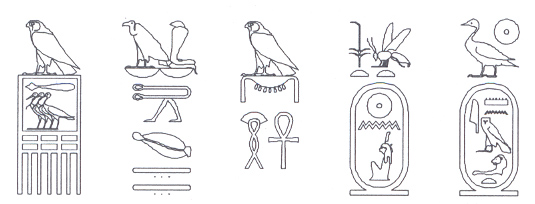
the complete
titulary of Pharaoh Amenemhet III (ca. 1818 - 1773 BCE)
Middle Kingdom, XIIth (Theban) Dynasty :
Mighty Horus
Great of Might
He of the Two Ladies
Taking possession of the inheritance of the Two Lands
Horus of Gold
Permanent of Life
King of Upper and Lower Egypt
Maat of Re (Nimaatre).
Son of Re
Amun at the Head
► the theology of
Heliopolis
In the
theology of Heliopolis (the "On" of the Bible and
today the
Coptic suburb of Cairo), the divine king of Egypt, as the sole son of Re, ascends to the realm of
Atum, the unique supreme deity (cf.
Hornung, 1986). There, in the Sun's
domain, the First Time, the king is ensured of an ongoing increase in spirituality (an
efficiency due to
the transformation of his Ba into an Akh, a spirit of
light) and a union with the only true source of life and youth, projected
near the Northern Circumpolar Stars ; he arrives there as an awesome god
(cf.
Cannibal Hymn). He sails on Re's Bark of
Millions of Years, ascends with a ladder or flies as a bird, a grasshopper
or sacred smoke ... He escapes the realm of Geb (the Earth) and
the Duat
of Osiris (the land of the dead).
The lightland of Re, fountain of rejuvenation and endless
power, is a continuing cycle of renewal (in neheh-time), a perpetuum
mobile at the core of (stellar) light. Here, the powerful Sa-energy of the
universal Heka-field can be harvested. The latter is due to the
autogenic activity of the sole creator-god Atum.
-
"Nun"
: the unmanifested sameness of everything that is
not light ;
-
"Atum"
: unmanifested light diffused in Nun ;
-
"Atum-Kheprer" : the
unmanifested, first occurrence of eternally recurrent light ;
-
"Re" : the manifest presence of Atum as light on the primordial "hill".
Grosso modo, this Heliopolitan ideology of the divine king was
Solar, stellar & national, complementing the contextual, regional and
variable Lunar spirituality of the common Egyptians. In the latter, shared
by the majority of Egyptians, the role of Osiris was as crucial as the
yearly inundation (cf. the agrarian, Sothic calendar) and the monthly
cycle of fertility (cf. Isis & Osiris as Moon deities).
|
The four compass points
and the Heliopolitan ritual.
|
WEST
dusk
|
Re at dusk and his entry
into the Netherworld to regenerate. Thanks to the magic of Isis and Thoth,
Osiris rose in the realm of the dead. When Pharaoh Horus brought his
restored eye to his father, Osiris was pulled out of his slumber and
became the king of the "beautiful West" ;
|
NORTH
nadir
|
During the twelve hours
of the night of the Netherworld, Re travels (and countless Bas with him)
on his Bark of Millions of Years. At midnight, the darkest point is
reached. The stars shining in Osiris' Netherworld are in the upper sky,
the abode of the Imperishable Stars, the spirits of Re, the pantheon, the
sons of Horus and Pharaoh.
|
EAST
dawn
|
The rise of Re's rebirth
at dawn, the place of light, rebirth and the Ka-statue (the false door).
"Khepri", the end result of the nocturnal regeneration of the deities
thanks to Re and his (re)union with Osiris - Horus as a child ; |
SOUTH
zenith
|
The culmination of Re at noon, the heat of
Seth, the place of birth of the Egyptian state, the inundation given by
Osiris (Sothis), the slaying of Osiris, the
mourning of Isis, the fierce battle between Horus and Seth and the
justification of the former as the "avenger of his father" - Horus as king
;
|
For good reasons,
Kemp (1989) and
Lesko (1999) doubt whether, in the
Predynastic and the historical periods, Heliopolitan henotheism was shared
by the vast majority of unlettered Egyptians. The opposite seems to be
true, associating Heliopolitanism with elitism and Osirian faith with
populism.
"Kemp has suggested that Egyptian religion, as we
know it from the formal, state-approved written texts, is an
intellectually manipulated construction of the historic period, most
likely of the middle or late Old Kingdom (...) to promote the divinity of
the king of Egypt." -
Lesko,
1999, p.31.
3.
The ritual complex of King Unas
►
the architecture
King Unas, Unis or Wenis (ca. 2378 - 2348 BCE) was the last
Pharaoh of the Vth Dynasty. His pyramid
at Saqqara, called "Perfect are the Placed of Unas", is at the
South-western corner of Djoser's enclosure and the smallest of all known
Old Kingdom pyramids. The
complex, a model for subsequent rulers, is almost diagionally opposed to
the pyramid of Userkaf (ca. 2487 - 2480 BCE), the founder of this
Heliopolitan Dynasty. Located between the enclosures of Djoser's pyramid
and Sekhemkhet's, King Unas completed "a historical
and architectural symmetry" (Lehner,
1997, p.154). The pyramid temple was erected directly over the
substructure of the IInd Dynasty tomb assigned to King Hetepsekhemwy. The
entrance of the pyramid proper, in the middle of its North side, opens at
ground level in the pavement of the pyramid court (and not in the face of
the pyramid). There are remnants of a small entrance chapel.
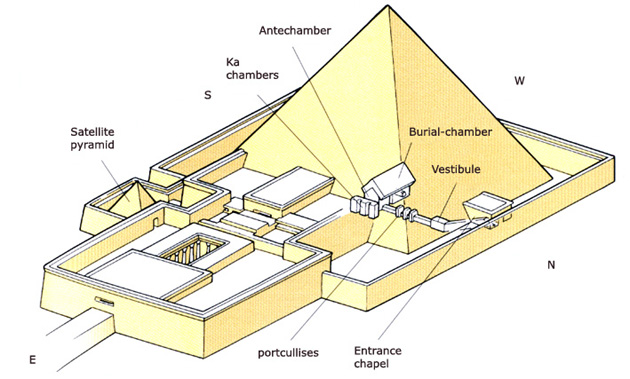
Plan of the
Pyramid-complex of Unas (ca. 2378 - 2348 BCE).
The Pyramid was 57.75 m², 43 m high, with a slope of 56°.
(after Lehner,
1997, p.155)
Like most Old Kingdom pyramids,
the complex of Unas included a pyramid-complex, a causeway and a valley
temple below, adjacent to a canal. Coming in by boat, preparatory rituals
took place in the valley temple. One then proceeded uphill along a
causeway, a long corridor with high walls and an insulating roof. The
processional causeway to the pyramid of
Unas is 750m long and equal to Pharaoh Khufu's. Most causeways have been
destroyed, but that of King Unas at Saqqara is in a good condition and
hand been restored in modern times. In its roof, a slit
is left open, so a shaft of light illuminates the gallery of
brightly painted reliefs, of which only fragments survive. A wide array
of scenes once covered the wall : boats transporting granite palm columns,
granite cornices or lintels,
craftsmen working gold & copper, harvesting scenes (grain, figs & honey),
deer hunted by greyhounds, archers, woman bearing offerings, battles with enemies, bearded "Aziatics",
scenes of starving people, prisoners begging for mercy ... The causeway
had two changes of angle, and South of the second bend lay two boat
pits (each 45m long). By the New Kingdom,
the complex had fallen into ruins. More than 1000 years after King Unas
died, Khaemwaset, son of Ramessess II and
high priest at Memphis, restored it, causing the famous name of Unas to
live again ...
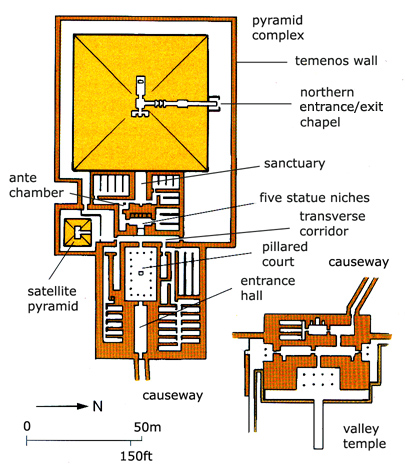
Plan of the
Valley temple and Pyramid-complex of Unas
(after Lehner,
1997, p.154)
The pyramid-complex of Unas
consisted of two parts separated by a long, transverse corridor : the
foretemple had an entrance hall and a pillared court and the secret, inner
temple included a hall with five statue niches, an antechamber (a high
square room with in the middle a single granite pillar) and a sanctuary. A
network of storerooms enclosed these elements. There the offerings and
sacred objects for the royal ritual were kept. A temenos wall surrounded
the complex. Today it is in ruin, and the pyramid reduced to a
small heap of debris. The temple design itself is also lost.
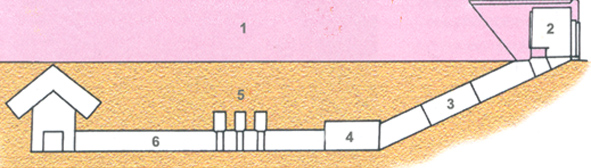
Plan of
the royal tomb underneath the pyramid of Unas.
If the
pyramid-complex of Unas became the model for the later pyramid temples,
then the purpose of certain parts of the temple may be inferred by
studying later examples, like Pepi II's pyramid temple. In the latter, the
transverse corridor was adorned with reliefs illustrating the Sed
festival, the this-life ritual of regeneration of the divine king.
The West end of the sanctuary abutted the East wall of the pyramid. This
West wall against the pyramid was covered by a granite stela, serving as
point of contact between the world of the living and the realm of the
dead (the tomb below). At its foot an altar was set up and offerings were brought by
priests.
Entering the pyramid from the North, it is necessary to bend over in order to move
down the passage. The slope is deliberate and varies between 28° (Khufu),
26° (Khafre), 25° (Pepi II) or 22° in the case of the pyramid of Unas. The
passage is oriented to specific northern stars. It slopes down to a corridor-chamber or
vestibule, followed by the usual horizontal passage with three granite
portcullis slabs. It is not possible to stand upright. Once this barrier
passed, the first hieroglyphs appear, to be read from the inside of the
pyramid out.

Plan of
the royal tomb underneath the pyramid of Unas.
This entrance/exit corridor then opens into the antechamber, directly
under the pyramid's centre axis. Standing up, one is surrounded on all
sides by blue-tinted hieroglyphs. On the ceiling of the tomb, golden,
pentagram-like stars were carved in relief on a sky-blue background. The
North and South walls of the antechamber and the burial-chamber stop short
of the ceiling, forming a kind of shelf below it (cf. left picture).
In the East of the antechamber (on the left hand side when entering the
tomb), a doorway opens to the undecorated and uninscribed tomb-chapel with
three recesses. The middle recess of this possible tomb-chapel lies lower
but aligned with the false door of the sanctuary above. Egyptologists are
not sure about the role of this triple chamber, the so-called "serdab" or
"cellar".
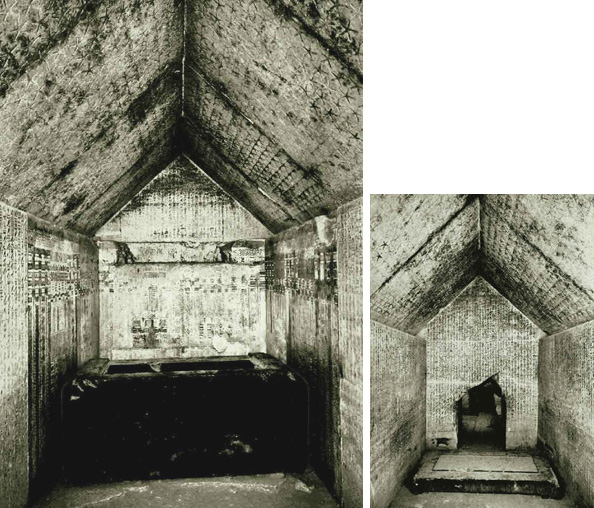
© Piankoff, A. : The Pyramid of Unas,
Princeton University Press - Princeton, 1968.
Burial-chamber
- pyramid of King Unas.
Sarcophagus West, western half of North & South walls in alabaster.
On the West of the antechamber (at the right hand side
when entering the tomb and precisely opposite the Ka-chapel), a
passage-way leads to the burial-chamber. This has a black granite
sarcophagus at its West end. In its immediate vincinity,
there are no texts. Instead, we see a palace-façade design, with reed-mats
and a wood-frame enclosure, an iconography derived from the royal mastaba tombs of the
First Dynasty. Together with the icon of two lotus flowers back to back,
these motifs recur, possibly because the lotus represents dawn, the
emergence of light as Nefertem, the son of dawn. This would make the royal
ritual a ceremony of life, merging the finite life of the king (both alife
& deceased ?) with the infinite life, viewed as "djedet", everlasting (as
Osiris, through darkness) and "neheh", eternal recurrent (as Re, through
light).
"All of these considerations may lead us to
conclude that in the highly sensitive space surrounding the sarcophagus,
certain ritual events took place that were -in the pyramid of Unas-
regarded as too delicate to reveal in words. But in later times, after the
reign of King Teti, the immediate vincinity of the sarcophagus -especially
the West wall- was freed from this stricture, and what was only implied by
the symbolic designs in the Unas pyramid was now openly expressed in
words. It is of for this reason that the pyramid of Unas contains so
little textual reference to the Osirian re-memberment : It was considered
too delicate a matter to put into words." -
Naydler,
2005, p.164.
In the West, the place of regeneration, the mummy is in the total darkness
of Osiris, allowing it to be reborn, ascending to illumination. The
walls around the sarcophagus, on which these designs were carved, are made
of polished
alabaster, whereas all the other walls of the tomb are in Tura limestone.
Alabaster is soft and translucent. It was referred to as "ankh", or "life"
and had a milky color (milk was also called "ankh was", "the sap of
life"). Sunk in the floor to the left (South) of the foot of the
sarcophagus was the canopic chest, meant to protect the four "ritual"
elements of the physical body, represented by the "sons of Horus", or
lords of the four pillars of the physical world the deceased (or the high
priest) has left. Taken together, these spiritual symbols learn us a lot
suggesting the sacredness of this uninscribed area of the tomb,
overtowered by the West Gable hieroglyphs, acting as magical protection
devices, and initiating oration.
"One of the recurrent motifs is that of two lotus
flowers with their stems but no leaves, represented back to back. This is
a motif that occurs in many Old Kingdom tombs and on tomb artifacts, but
especially on sarcophagi and around false doors. The significance of this
is that the sarcophagus was a place of transition between the physical and
spiritual worlds, while the falso door was a place of communication
between realms. The lotus, whose manner of growth involves passing out of
the water element in order to flower in the air, touched by the rays of
the sun, was preeminently a symbols of breakthrough from one world to
another."
Naydler,
2005, p.162.
► the eternalization of the divine kings
In the Old Kingdom, temples for the cult of the deities were usually made
out of brick, a perishable material. The tombs of the divine kings were
petrified, precisely because in this way he became the sole guardian of the magical keys
of the kingdom : a "good" Nile. Only the king was the son of Re on Earth
(cf.
Heavenly Cow). The plateau being full,
the kings of the Vth Dynasty, in order to erect their pyramid complex, had
to leave Giza. In doing so, they lost their sight-line to Iunu
(Heliopolis). Adding a Solar temple to the pyramid complex (cf. King
Userkaf) compensated for the distance, assuring the royal cult was
directly associated with the son of Re on Earth. These "Heliopolitan"
Dynasties (Djoser - Unas ?), were exceptional & foundational.
The royal cult also served this-life purposes (of which the
celebration of the Sed festival is an outstanding example, but there must
have been more). Service to the father of the king, and creator of all
deities, was also part of it. To represent the link with the Sun, a
massive stone mound shaped like a squat obelisk was used. It stood at the
back of an open court (the best example is King Neuserre's at Abu Ghurab,
following the model of the pyramid complex, and situated riverside). As a
result, both the royal cult and the cult of the deities (in casu
Atum-Re) took place in temples made out of lasting materials. Later cult
temples, even disconnected from the royal cult, remained stone edifices.
Thanks to Re the deities endured.
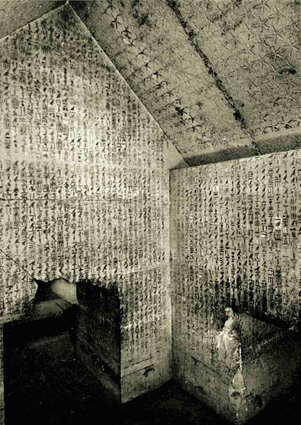
© Piankoff, A. : The Pyramid of Unas,
Princeton University Press - Princeton, 1968.
Antechamber
- pyramid of King Unas
passage-way West to Burial-chamber, corridor North
The royal cult is origin and goal of the traditional theologies of the Old
Kingdom (Heliopolitan, Hermopolitan, Memphite & Osirian). Without the
king, there is no Maat and the created world returns to chaos, as light to
darkness. The ideal of divine kingship, a unity of temporal and spiritual
activities, is crucial to understand the "canon" of the Old Kingdom
mentality and way of life. Especially in the IIIth, IVth & Vth Dynasties,
a fairly unmixed, pristine strand of this culture is revealed.
The Unas
text is a literary masterpiece summarizing the best theology of the
moment. It is not a loose set of funerary spells, but a composition to be
viewed as an integrated whole, albeit in early ante-rational thinking. No
doubt, the intellectual elite produced concrete concepts, as in
proto-rational cognition, but the culture at large was still steeped in
myth and pre-rational pre-concepts, remaining very situational and with
limited functionality.
"But one cannot help suspecting that a fundamental
revision of the ritual coincided with the decision to immortalize these
spells, previously handed down on perishable papyrus, by carving them in
stone and thereby also endowing them with greater magical power. The
decision on Wenis's part has provided for us the earliest collection of
religious texts, not only of Egypt, but of all humankind." -
Hornung,
1999, p.36.
The
divine nature of the king is the core myth holding Ancient Egyptian society
together. It explains royal magic (effectiveness), Great Speech and Maat,
truth & justice. In the "ideal" of the Heliopolitan priests, the living
Horus-king guarantees a "good Nile" and his united administration creates
economic surplus. The Nile records his magic, while the "pacification" of
the "two lands" is his control & power, the brilliance of his Great
Mansion. Centuries before Unas, this state ideology was already fully in
place (cf. the great building projects).
►
the texts
King Unas was the first to include hieroglyphic
inscriptions in his royal tomb, namely in its corridor, antechamber,
passage-way & burial-chamber. The area around the sarcophagus and the
serdab are left uninscribed.
This coincides with a general increase of writing in general in the later
Vth Dynasty. The Unas text, carved and filled with blue pigment, contains,
in 228 of the 759 (Faulkner,
1969) known "utterances", the first historical account of the (Heliopolitan)
religion of the Old Kingdom, in particular its royal cult. It
precedes the textualization of the Vedas, reckoned at ca. 1900 BCE
(Unas died ca. 2348 BCE).
"The Pyramid Texts reflect not only an Egyptian vision of the afterlife
but also the entire background of Old Kingdom religious and social
structures, and they incorporate an ancient worldview much different from
that of more familiar cultures." -
Allen,
2005, p.13.
Technically, the Pyramid Texts are a corpus consisting of "utterances" or "spells", so
called because the expression "Dd mdw" ("Dd" = "word" ; "mdw" = "speech"),
"to say" or "to say the words", i.e. the sacred words to be recited is, as a rule,
atop most texts, allowing for a classification. The one introduced by
Sethe
(1910, with 714 utterances),
is an inventory of all texts,
irrespective of the kind of text or its placement in the tombs.
Integrating both variables underlines the effort to bring out the dramatic
& ritualistic features of these texts.
"The actual inscription of text on the walls of the
Pyramid of Unas shows considerable redactional care, with a significant
number of corrections, both to the original ink draft and to the carved
signs, in ways that seem to imply copying and then collation from a more
cursive original. There can indeed be no reasonable doubt that
inscriptions themselves were copied immediately from papyrus text." -
Eyre,
2002, p.12, my italics.
Discovered by Maspero in 1881, the Unas text had been buried and left undisturbed for ca.
4200 years. An untainted primary religious source ! Together with the texts found in
the tombs of King Unas' successors, Pharaohs Teti, Pepi I, Merenre & Pepi II (ca.
2270 - 2205 BCE) of the VIth Dynasty, these compositions form the first known religious
corpus in world literature, as well as the earliest example of
extended writing worldwide (including a rich pallet of various styles,
forms & intentions). The small pyramids of the three wives of King
Pepi II (Neith, Ipwet and Oudjebeten) are also inscribed, as is that of
King Iby (VIIIth Dynasty).
The quality of these inscriptions is however
relatively crude and they are not part of the inventory realized by
Sethe
(1908), the "standard edition" of the Pyramid Texts,
later translated
into German.
In 1952, Mercer published the first English version and in 1968,
Piankoff translated the text in his The
Pyramid of Unas. Finally in
1969,
Faulkner published his The Ancient Egyptian
Pyramid Texts, the acclaimed standard English translation, with new &
refreshing grammatical & semantic perspectives. For him, Sethe's work was bulky, incomplete and never
revised by its author. Meanwhile, more material had come to light, enabling him
to restore many lacunae, whereas in the last half of the previous century great
advances in Ancient Egyptian had been made.
The list of tombs containing
Pyramid Texts is apparently never final, nor has our knowledge of Ancient Egyptian stopped
advancing.
In 2005,
Allen published The Ancient Egyptian Pyramid Texts, containing
the texts found in 10 tombs (besides the canonical five, he also includes
Ankhesenpepi II, Neith, Iput II, Wedjebetni & Ibi). This clear translation of the
Unas text is in many ways remarkable and most welcome, in particular regarding the use of verbal forms,
as well as offering translations of passages beforehand deemed
untranslatable, calling for revision. No
doubt, this translation by Allen excells Faulkner's and is a humbling
experience for anyone studying these texts for years.
The Unas text was copied in the Middle Kingdom (ca. 1938 - 1759 BCE) tomb
of the official Senwosret-Ankh, high priest of Ptah, suggesting the
presence of a separate corpus (on papyrus ?), i.e. a continuous
manuscript tradition and an underlying archival tradition.
This is also the best preserved body of text
representing a complete set, providing the standard approach to the
theology of the Old Kingdom, dominated by Re-Atum of Heliopolis (Pepi II has the most complete
surviving texts of the later pyramids, but suffering damage).
"... the Unas texts
were evidently regarded as an integral work in their own right, and seem
to have acquired 'canonical' status ..." -
Naydler,
2005, p.149.
Maspero (1884, p.3) assumed these texts
were exclusively funerary and divided them in ritual texts, prayers and magical
spells. In the previous century, authors realized they include drama, hymns, litanies, glorifications,
magical texts, offering rituals, prayers, charms, divine offerings, the
ascension of Pharaoh, his arrival & settling in heaven, etc. They
offer a glimpse of an African, anterational perspective on death, rebirth
& illumination.
4.
The interpretation of the Pyramid Texts
"They include very ancient
texts among those which were nearly contemporary with the pyramids in
which they were inscribed, imposing on the modern reader problems of
grammar and vocabulary ; the orthography is apt to be unusual ; and there
are many mythological and other allusions of which the purport is obscure
to the translator of today." -
Faulkner,
1969, p.v.
For
Sethe (1908), the
Pyramid Texts were a free collection of magical
utterances, which, by virtue of their presence, assisted the divine
king in
his resurrection & ascension de
opere operato, dispensing with
the need for daily priestly offerings to his Ka (in the pyramid temple
above) as well as elaborate monumental buildings. He himself uttered the words of power to regenerate himself and
rise up. The sarcophagus chamber texts have to be read first. This is the standard funerary interpretation.
"Food offerings alone, however, even when they conformed
to the prescriptions regarding purity and dietary taboos (e.g. no pork, no
fish), did not suffice to maintain the divine forces. These forces were nothing
without ritual and efficacious speech." -
Traunecker, 2001, p.40, my italics.
The presence of offering-texts feeds the subtle bodies of the deceased. Sacred words
or hieroglyphs not only describe objects, but embody their double (cf. the Lascaux
pictures and the Eastern desert petroglyphs). Hence, once properly
recited (by the dead and/or the living, the so-called
"voice-offerings"), they become efficient (for all of eternity). The hidden, secret, dark potential of hieroglyphs
is
evidenced by the sacrificial rituals found in the extended mortuary literature.
Words made these rituals work. The
Ba of the deceased reads the words and the latter manifest their meaning, guaranteeing a safe passage to the afterlife.
"We have already pointed out that the spells of
the so-called sacrificial ritual, i.e. the texts used in the provision
of supplies, were inscribed in a prominent place where they could be
seen by the dead person resting in his sarcophagus. (...) In other
words, texts were written down so that the dead themselves could
'proclaim the provision of supplies' ("nis dbHt-Htp") instead of this
being done by unreliable priests. This was the nucleus around which
the texts crystallized." -
Morenz,
1996, p.229.
Schott (1945) &
Ricke (1950)
advanced the thesis that at the time of the funeral, these texts were
recited in the various chambers, corridors and courts through which
the procession passed on its way to the pyramid. The valley temple
corresponded to the vestibule, the causeway to the entrance corridor, the
outer pyramid temple to the antechamber and the sanctuary to the
burial-chamber. But it was not easy
to identify where each spell was recited.
This view was challenged by
Arnold (1977), who tried to discover the
function of the pyramid complex by examining the wall reliefs, statues,
inscriptions and architectural features of the complex itself. These refer
little to funerary rituals ! Schott discovered three literary forms : (a)
dramatic texts recited by the participants in a ritual drama, (b) hymns
assisting the ritual drama and (c) transfiguration spells, in which the
scene happens in the spirit worlds while the king speaks through the reciting
priest. As for Scott the funerary procession terminated in the inner
pyramid temple (corresponding with the sarcophagus room), we have to read
the texts in the burialchamber last !
For
Spiegel (1953 & 1971) the texts are
an integral part of the funerary ritual performed in the tomb and hence
recited in the area were they were inscribed. They reflect the royal
burial ritual taking place solely in the tomb underneath the pyramid.
Their placement reflects the entry of the funerary procession into the
tomb. Hence, the text begins on the West wall of the entrance corridor,
continue in the burial-chamber and re-enter the antechamber on its South
wall, ending on the East wall of the entrance corridor ... Again a
different order from that of Sethe, Scott and Ricke ! Spiegel is the first
to claim the sarcophagus chamber represents the Duat and the antechamber
the Akhet.
These conjectures were
criticized. In 1960, Morenz wrote :
"This bold, learned and ingenious interpretation
can properly be accessed only by one who has examined it in terms of
the vast and diverse material. When this is done, it appears that
quite serious objections may be levelled against numerous points in
the argumentation and thus against the thesis as such." -
Morenz,
1996, p.228-229, my italics.
According to
Mercer (1952), only the offering liturgy
(on the North wall of the burial-chamber) belongs to the funerary ritual
proper.
The purpose of the magical & mythical formulae, prayers, hymns and
petitions was to guarantee the king's resurrection and new birth,
involving transfiguration and deification, the king being immortal like
the other deities. In his translation, Mercer follows Sethe's
classification.
Likewise, for
Piankoff (1968) the texts describe a
postmortem mystical journey, culminating in union with the godhead,
Re-Atum. It entails rebirth, ascent, traveling in the Solar Barque,
absorption of the substance of the deities and exaltation in the embrace
of Re-Atum. Like Schott, Piankoff begins to read the text in the corridor
leading into the tomb, moves to the antechamber for the king's ascension
and projects his final deification in the burial-chamber.
For
Faulkner
(1969), the Pyramid Texts are to be regarded as religious and
funerary literature. They describe the king's postmortem journey to
the stars and transformation into one (Faulkner,
1966). His translation again follows Sethe's classification.
Altenmüller
(1972) agrees with Schott & Ricke that these texts were recited in the
pyramid temple, as well as in the tomb, involving priests assuming
the god-forms of Re, Horus, Seth and Thoth.
In the Unas text, he isolates three main
sections : (a) the funerary procession and actions on the
mummy (censing, libation, opening of the mouth), (b) the offering ritual
and (c) the burial ritual on the West wall of the antechamber. He attempts
to explain every utterance in terms of the mortuary rituals, relying
mostly on mythological references and worldplay to determine which text
corresponds to which representation. He based his order of the text on (a)
the sequencing found in the tomb of Senwosret-Ankh and (b) his conjectured
order of the royal funerary ritual as portrayed in the later Middle and
New Kingdom private tombs.
"Schott, Spiegel, and Altenmüller all see the key to
understanding the Pyramid Texts as lying outside the texts themselves."
-
Naydler,
2005, p.180.
Barta (1981) doubts whether the
Pyramid Texts belong to the funerary ritual at all. The goal of these
texts extended beyond the short duration of the actual funerary ritual.
They serve the king in the afterlife. Barta returns to the interpretation
of Sethe. The texts are used by the king in the afterlife, providing him
knowledge and magical power, assisting him in the process of his
deification. Barta accepts that the Duat might be accessible to the king
while he is still living, but the texts themselves are intended to help
the deceased king ...
Osing (1986) &
Allen
(1988) compared the
location of the texts within the
tomb of Unas with
other Old Kingdom pyramids and the tomb of Senwosret-Ankh at Lisht.
Allen was able to establish a coherent model describing the funerary
ideology of these royal tombs without reference to conjectured stages of a
funerary ritual. The
position of particular groups of texts within Unas' pyramid corresponds with the
placement of the same texts in other pyramids. Spells recited during the burial ritual
were thus
eternalized as
divine words
on the walls, further complementing
the importance of symbolism in the general layout of the mortuary complex in general
and the royal tomb in particular. The order is determined by the
thematic relationship of the texts to the architectural symbolism of the
two chambers and their four quarters. There is a spatial semantic at work.
"Allen's analysis of the sequence of spells in the pyramid
of Wenis defines the architecture as a material representation of the passage of
the king through death to resurrection, exploiting themes familiar in the
Underworld Books of the New Kingdom. From the darkness of the earth he passes to
life in the light of the sky, progressing from the burial chamber as underworld
(duat) through the antechamber as horizon (akht) where he becomes Akh, through
the doorway leading to the corridor -ascending by ladder- to heaven (pet), or
passing like the setting sun from the west to his rising from the mouth of the
horizon in the east, or exploiting the image of the king passing from his
sarcophagus -the womb of Nut- through her vulva to birth at the door of the
horizon. (...) Allen's analysis focuses on the principle whereby the position of
discrete units of ritual text asserts a functional identity between the theology
of the text and the architectural symbolism of the pyramid substructure, and so
the reality of the king's passage to resurrection". -
Eyre,
2002, p.44-45 & 47.
The direction of the texts
was thus identical with
the soul's path through the tomb, moving from the innermost parts of the
burial-chamber
(the "Duat" in the West), through the
antechamber
(the Eastern horizon or "Akhet"),
to the outside of the pyramid via the
second northern
tunnel, flying to the Northern, circumpolar (imperishable) Stars, reaching the Field of Offering.
-
the Duat
(burial-chamber) : though a part of the world (Earth), but neither Nun or sky,
the Netherworld is inaccessible to the living and outside normal human
experience. It is separate from the sky and reached prior to it. The Field of
Reeds is the realm of the deceased and the deities and the mystery of Osiris.
The Horus-king has perpetuated offerings, and stands at the door of the horizon to
emerge from the Duat and start his spiritualization ;
-
the Horizon
(antechamber) : "Axt" ("Akhet"), translated as "horizon", is both the
junction of sky and Earth and a place in the sky underneath this point (before
eastern dawn and after western dusk), a secret interstitial zone reached and
crossed by boat. It is a zone of
transition and a "radiant place", the "land of the blessed".
The horizon is the place of becoming effective, the locus of the becoming "Ax"
("Akh"), an effective spirit. Note (as did
Allen,
1988), that the
Cannibal Hymn, thematically belongs
in its place (the East Gable). It summarized the king's passage through the night
sky to the Sun at dawn. The process of spiritualization ends with the emergence
of the new light ;
-
the Imperishable
sky
(northern corridor) : the process of transfiguration (ultimate
spiritualization) being completed, the Akh-spirit leaves the tomb and ascends to
the northern stars, becoming an Imperishable One.
Eyre (2002) suggests the training and
initiation of the funerary priests points to this-life rituals.
Perhaps the king rehearsed his forthcoming burial during life ?
"The promise of divine assistance, resurrection, and safe
passage to the afterlife is not, however, a concern purely of funerary
ritual, and the markedly initiatory form of parts of the mortuary
literature must be taken as a pointer to contemporary 'this-life'
ritual that is otherwise lost from the archaeological record." -
Eyre,
2002, p.72.
Recently,
Naydler (2005), by suspending the
funerary interpretation, evidenced that the Pyramid Texts in
general and the Unas texts in particular, reveal an experiential
dimension, and so also represent this-life initiatic experiences
consciously sought by the divine king (cf.
Egyptian initiation). These may be
classified in two categories : Osirian rejuvenation (cf. the texts of the
burial-chamber), already at work in the Sed festival, and Heliopolitan
ascension (cf. the texts in the antechamber). Apparently the former
was celebrated regularly, whereas the latter is foremost funerary.
According to Allen (2005), the Pyramid Texts :
"are largely concerned with the deceased's relationship to two gods,
Osiris and the Sun. Egyptologists once considered these two themes as
independent views of the afterlife that had become fused in the
Pyramid Texts, but more recent research has shown that both belong to
a single concept of the deceased's eternal existence after death - a
view of the afterlife that remained remarkably consistent throughout
ancient Egyptian history." -
Allen,
2005, p.7.
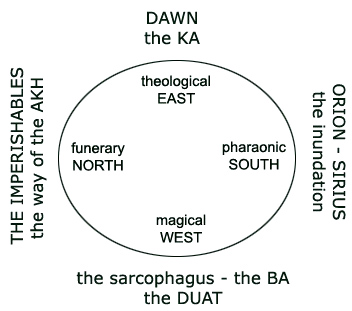
conjectured
symbolism of the compass points
Many variations regarding the reading direction of the
pyramid texts of Unas prevail. Allen's interpretation of Spiegler's
conjecture (identifying the burial-chamber with the Duat and the
antechamber with the Akhet) seems very interesting and has been adapted.
However, my sequencing of the texts differs from both Allen & Naydler, and
this for variant reasons.
For example, Allen (2005) is not impressed that in the sacropagusroom,
PT 219 on the South Wall continues on the East Wall, nor that in the
antechamber PT 260 on the West Wall continues on the South Wall.
For Naydler (2005), this points to the Solar & regenerative movement from
West to East, as seen in the tomb, confirmed by what he sees as examples
of inverse quioning, used in architecture to avoid making the joint
between two blocks in the corner.
5.
An integration of perspectives.
► the mind & magic
of Re
Let us try to integrate these various perspectives, taking into
consideration the
cognitive texture of the ante-rational mind
as well as the dramatic, ritualistic interpretation of these ancient magical texts.
If we understand these texts as magical devices, and realize each
monarch had his own political and theological preferences, then it seems likely each
divine king, to define his own royal cult, made his own, titulary choice out of
the available body of religious literature (available on papyrus), maybe adding
a few spells of his own. By doing so, he left to posterity an elaborated
theo-literary testament with magical effectivity. If so, it became exemplary. This was his magical
Great
Speech,
serving Pharaoh's welfare in the afterlife, elevating him above all possible beings and making him rise
even above most
deities (cf. the
Cannibal Hymn). But also during life on Earth,
his royal cult was active and assured his renewal (as the Sed festivals
testify).
This magic is part of the logic of the Great Speech, which involved
a return to the First Time ("zep tepi") of Atum-Khepri, the self-created essence
of Re. This going back to the Golden Age lay at the core of both this-life and
afterlife rituals. In the
books of the Netherworld, they are represented near Re
on his Sacred Barque ; Re with his functions :
-
"sia"
(understanding) : often wrongly associated with "wisdom" ("saa"), "sia"
is related to "knowledge", "perception", "intelligent plan", and might be
equated with the mind of Re, or "understanding". In the Old Kingdom, Sia is the divine
functionary at the right side of Re, holding the god's sacred papyrus scroll. He
is mostly depicted or mentioned together with "Hu". For the
Memphites, the mind of Re was the heart of Ptah (cf. Late New
Kingdom) ;
-
"hu" (authorative
utterance) : the creative word of the supreme creator-god is uttered by
his tongue. To speak words of power is immediate and carries conviction,
strength and weight. "Hu" is also deified, and is always depicted together with
Sia. Both represent the basic functions of the divine mind : overarching
understanding (overviewing the Two Lands) hand in hand with authority, weight &
power of command. Both concepts pre-figurate the omiscience & omnipotence of the
Judeo-Christian God ;
-
"heka" (magic) :
the creative power contained in the divine word of Atum. "Heka" is
used to denote (a) the "primordial Sa", the ever-dynamical energy of creation,
issued from the word of Atum when he created himself as Atum-Kheprer, and (b)
the "primordial field" underpinning creation. Sa-energy was present from the
beginning, when Atum-Kheprer hatched out of the primordial egg floating in Nun.
Not only does the king's Great Speech know it all and carry the power of
conviction & authority, but it has immediate effectiveness and causal power. The
king is such a powerful cause that creation bows before the son of the Creator ;
-
"maat" (truth &
justice) : daughter of Re, and spouse of both Heka and Thoth (deities of
magic), Maat represents the impersonal idea of cosmic order, embodied by the
divine king, who offers "truth" to his
father Re. Maat is the plummet of the balance of justice. In Middle Egyptian,
the word "maat" ("mAat") is used for "truth" and "justice". Truth is an
equilibrium (a bringing together hand in hand with a keeping apart), measurable
as the state of affairs given by the image, form or representation of the
balance :
|

U38 "mxAt", balance |
"Pay attention to the decision of
truth
and the plummet of the balance, according to its stance."
Papyrus of Ani
18th Dynasty -
Chap.30B, pl.3
Anubis measures & represents this precise attention of the divine
guardian & psychopomp, while the input of sensation is recorded
(mind) by Thoth. |
This New Kingdom exhortation by Anubis,
the Witness of the Balance, summarizes the Egyptian
practice of wisdom and pursuit
of justice & truth. By it, their "practical
method of truth" springs to the fore : serenity, concentration,
observation, quantification (analysis, spatiotemporal flow, measurements)
& recording (fixating), with the sole purpose of rebalancing,
reequilibrating & correcting concrete states of affairs, using the
plumb-line of the various equilibria in which these actual aggregates of
events are dynamically -scale-wise- involved. Responding likewise, but always
from two different angles : on the one hand, the "common" view of "the heart",
namely the end result of the activities of the living person, on the other
hand, the divine view of truth & justice, the truth of the cosmic order of the
world, represented by a feather (H6).
The activities of the divine king cause :
(a) Maat to be done for
them and their environments and
(b) the proper "Ka",
or vital energy, at peace with itself, to flow between all parts of creation
(truth and justice are personified as the daughter of Re, equivalent with the
Greek Themis, daughter of Zeus - cf. "maati" as the Greek "dike").
The "logic" behind the
operation of the balance involves four rules :
-
inversion
: when a concept is introduced, its opposite is also invoked (the
two scale of the balance) ;
-
asymmetry
: flow is the outcome of inequality (the feather-scale of the
balance is a priori correct) ;
-
reciprocity
: the two sides of everything interact and are interdependent (the
beam of the balance) ;
-
multiplicity-in-oneness
: the possibilities between every pair are measured by one standard
(the plummet)
-
witnessing consciousness :
the operation of measuring the whole balance is witnessed
with precise and concentrated attention and recorded for further
comparison and retuning.
Parapsychology, comparative religions
and mysticology allow us to distinguish
between psi-events (parapsychology), occultism (knowledge of the
invisible worlds between heaven and Earth) and
mysticism (direct, radical experience of
the
Divine, the "totaliter aliter"). Although in immature instances of meta-nominal experience
(i.e. those falling outside empirico-formal consciousness - cf.
Clearings, 2006), these phenomena
cannot be distinguished, I avoid adjectives as "shamanic" or "shamanistic" (cf.
Naydler, J.
: Shamanic Wisdom in the Pyramid Texts, 2005), and prefer "ecstatic",
which is more neutral and devoid of the historical connotations implied by
historical Shamanism (the art & science of controlled trance). The word
"ecstatic" comes from the Greek "ex", "out" + "stasis", "standstill" or
"statikè", "art of weighing", and refers to an extraordinary, unmeasurable,
radical experience, clearly out of the ordinary. In my opinion, the Heliopolitan
priesthood was too well organized to be called "Shamanistic", although this does
preclude shamanistic components in the sacred spells (compare this with the
presence of trance oracles & dagger-liberations in Tibetan Buddhism today).
Can one do otherwise but disagree
with a most rewarding sources of inspiration and learning, Erik Hornung, who
wrote about the Egyptians :
"... any sort of ecstasy appears quite alien to
their attitudes." -
Hornung,
1986.
In Ancient Egypt, the variety of ecstatic experiences may be classified as
personal piety (offerings, prayers, festivals, mystery plays), magic
(psi-events), the occult (initiation, entering and leaving the Duat) and
mysticism proper. The latter is found in the spirituality of the divine king and
his high priests, meeting the deity "face to face" in their temples or
transforming into one during life (as a living Osiris during the Sed festival).
►
the royal cult
In order to understand the Pyramid Texts, the ecstatic, magical, occult &
funerary elements should be combined. The pyramid-complex may well have been the place of the
royal cult, both during and after the king's life. He was the "Great House" or
"Great Mansion" of the
Old Kingdom (Memphis), and he alone uttered the Great Speech. All areas of the
temple complex may have
been used in this magico-religious empowerment of the divine king, who was the
sole reference-point here, in the invisible Duat as well as in the afterlife.
Much later, with king
Akhenaten, we witness the return of this royal
Solar cult.
"In each instance Maat is in concrete forms undoubtedly
the divinely-established pattern of government, and the pharaoh, by virtue of
his divine nature, receives it substantially like a sacrament. It will at once
be clear that in this process the king is not regarded as an individual person
but as the bearer of the royal office. One must assume that the Maat at work in
the ruler was thought to be of benefit to each individual Egyptian." -
Morenz,
1996, p.121.
So
the "djed medu" or the recitative use of these texts should not be
surprising. With the tomb as cosmos, the material image of the texts magically
assist the process of the Pharaonic rite of passage, transforming the king
into a spirit efficient enough to bless his son with a "good Nile", guarantee of
the unity of Egypt. But the royal cult was much more. During life, it was a
means to continuously regenerate the powers of the divine king to perform his
office efficiently, i.e. ti was accompanied by great magic & divine protection.
The overall Egyptian mentality seems to favour
an enduring canon of broad schemes adaptable to immediate
circumstances. As each divine king had his own titulary, or political
statement, so he, as supreme High Priest, had his
own regeneration-ritual & burial ritual, of course influenced by
the prevailing dynastic theology, each Temple being the home of the "supreme"
god of each system, one of the five local gods promoted to national deities
: Osiris of Abydos, Re of Heliopolis, Ptah of Memphis, Thoth of Hermopolis or
Amun of Thebes.
The royal cult was both
regenerative as mortuary, reflecting a variety of local
(nomic) traditions at work around the divine king and soliciting his favours.
Of course, some compositions were considered more sacred than others, and the
texts carved in Unas' tomb were and/or became canonical.
The Egyptians existed by the grace of
the "good Nile" the king alone, being divine, could guarantee. His death was
thus a major calamity, and could perturbate the agricultural cycle,
leading to famine, conflicts and death. His burial provided him with a
ladder between heaven and Earth, and so the first thing the glorified
(spiritualized) king would do
arriving in the sky (pet, heaven), was to provide Egypt with a new
king and a "good Nile". The latter was the magical proof of
the king being blessed by the spirit of his father ...
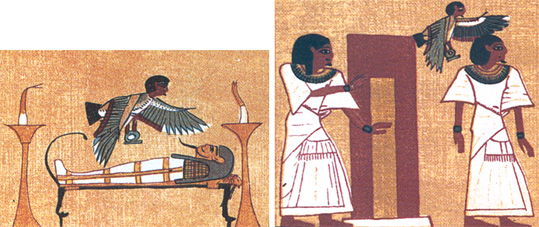
Ba of Ani rejoining the mummy - Ba leaving the tomb
Papyrus of Ani - ca. 1250 BCE - New Kingdom.
This reciprocal function of the tomb has to be emphasized. The Ba
could return with its Ka. The liberated "Akh" has
freedom of movement and time. It is bright, light, radiant and
efficient. While
they stay in the sky, the spirits make their souls and doubles come
down and unite with their statues. Through them, they were present to
the priests. The destruction of a tomb or a temple, implied
the end of its role as "interphase" with "the other side" of the false
door.
►
the language of the texts
In the ca. 650 years between ca. 3000 BCE (the beginning of the Dynastic
Period) and ca. 2348 BCE (the death of king Unas), the written language
had considerably developed. But although words could be joined together in
simple sentences and the latter in pragmatical groups (dealing with honors
& gifts, offices, legacies, inventories, testaments, transfers,
endowments, etc.), the additive, archaic quality of the literary style was
pronounced and remains.
The Pyramid Texts pose their own particular problems & difficulties.
Most, if not all, founding fathers of Egyptology accepted Maspero's
funerary interpretation, in which these texts form a set of symbolical "heraldic" utterances (great
speeches) dealing with the
promotion of the welfare of the divine king in the afterlife. But, enjoying a broader
perspective, conjecture these utterances were part of the ceremonies
of the royal cult, especially those relating to the
coronation, rebirth (Sed festival), death, resurrection (in the Duat or
Netherworld) and ascension of the divine king (via Akhet, horizon,
to Pet, sky).
These texts are to a large
extent a composition, a compilation and joining of earlier texts which
must have circulated orally or have been recorded on papyrus many centuries
earlier. Certain registers go back to the oral tradition of the Predynastic Period,
for they suggest the political context of Egypt before its final unification (as
Sethe pointed out). Others, although the archeological record is limited, were
used in this-life rituals (Naydler,
2005), and must have had
initiatoric connotations.
"The Pyramid Texts were not the work of a single man or of a single age.
They are entirely anonymous and of uncertain date. And they are religious
literature which reflect more or less clearly the conditions of religious
thought in ancient Egypt previous to the Seventh Dynasty - more like the
Psalms than any other book of the Old Testament." -
Mercer, 1956, p.2.
In the Old Egyptian of the Pyramid Texts, the composition between
semantic groups is
loose. Subjectivity is still objectified. Pre-operatoric activity is
limited to the immediate material context. Older structures were mingled with
new ones and many traces of earlier periods were left over. The language of
these compositions, which has the style of the "records" of the Old
Kingdom, is often additive and offers little self-reflection (which starts with
the
literature of the First Intermediate Period).
Didactic poetry (precepts)
and lyrics in which
personal emotions & experiences
are highlighted are nearly absent. Although proto-rationality is most of
the time lingering,
the overall framework of the composition is pre-rational (cf.
cognition and
epistemology). The tensions are not
resolved but stratified, allowing for several registers to be identified :
Predynastic, Heliopolitan, Hermopolitan, Osirian, royal, funerary, ecstatic, magical,
occult, funerary, etc. The blend itself is most interesting, if not very
difficult to understand.
Various types of parallelism occur : synonymous (doubling or by
repetition), symmetrical, combined, grammatical, antithetic, of contrast,
of constraint, of analogy, of purpose and of identity. Metrical schemes of
two, three, four, five, six, seven or eight lines occur (the fourfold
being the most popular). The play of words is the commonest literary
feature, depending on the consonantal roots. Alliteration, metathesis,
metaphors, ellipses, anthropomorphisms and picturesque expressions and
puns are also found. Not surprising a thorough
understanding of these texts is lacking.
Translating Ancient Egyptian literature calls for special considerations,
which may be summarized as follows :
-
semantic
circumscription (Gardiner) : to those unaware of the semantical problem in
mythical, pre-rational and proto-rational thought and its literary products,
the differences between various translations may be disconcerting. Ancient
Egyptian literature is a treasure-house of this ante-rational cognitive
activity, and its "logic" is entirely contextual, pictoral,
artistic and practical. The meaning or conception of the sense of certain
words, especially in sophisticated literary context, is prone to large
discrepancies. Gardiner spoke of "interpretative preferences" (Gardiner,
1946).
Furthermore, despite major grammatical discoveries, Egyptian writing
is ambiguous qua grammatical form. Some of its defects can not be overcome
and so a "consensus omnium" among all sign-interpreters is
unlikely. The notion of "semantic circumscription" was derived
from this quote by Gardiner :
"If the uncertainty involved in such
tenuous distinctions awake despondency in the minds of some students, to
them I would reply that our translations, though very liable to error in
detail, nevertheless at the worst give a roughly adequate idea of what the
ancient author intended ; we may not grasp his exact thought, indeed at
times we may go seriously astray, but at least we shall have
circumscribed the area within which his meaning lay, and with that
achievement we must rest content."
Gardiner,
1946, pp.72-73, my italics.
To the latter, more attention to lexicography
(a discussion of individual words) and the rule that at least one certain
example of the sense of a word must be given were considered as crucial.
Personally, I would add the rule that one has to take into consideration all
hieroglyphs (also the determinatives) and try to circumscribe the meaning by
assessing the context in which words and sentences appears ;
-
the benefit
of the doubt (Zába) : amendments should be introduced with great caution
and for very good reasons. Indeed, some egyptologists change the original
text with great ease, and consider that Egyptian scribes were careless and
prone to mistakes. This is not the correct attitude. We all make mistakes.
Zába prompted us to respect the original text and made it his
principle. He wrote :
"Pour ce qui est la traduction d'un texte
égyptien dans une langue moderne, l'étude de divers textes (...) m'a amené
au principe dont je me suis fait une règle, à savoir de considérer a
priori un texte égyptien comme correct et de m'en expliquer chaque
difficulté tout d'abord par l'aveu de ne pas connaître la grammaire ou le
vocabulaire égyptien aussi bien qu'un Egyptien. (...) et ce n'est donc
qu'après avoir longement, mais en vain, consulté d'autres textes et ne
pouvant expliquer la difficulté autrement, que je suis enclin à croire que
le texte est altéré."
Zába,
1956, p.11.
-
multiple
approaches (Frankfort) : one has to assimilate the Egyptian way of thinking before engaging in explaining anything. Their
"method" being not linear, axiomatic (definitions & theorema)
or linea recta.
Frankfort (1961, pp.16-20)
explains : "... the coexistence of different correlation of
problems and phenomena presents no difficulties. It is in the concrete
imagery of the Egyptian texts and designs that they become disturbing to us
; there lies the main source of the inconsistencies which have baffled and
exasperated modern students of Egyptian religion. (...) Here then we find an
abrupt juxtaposition of views which we should consider mutually exclusive.
This is what I have called a multiplicity of approaches : the avenue of
preoccupation with life and death leads to one imaginative conception, that
with the origin of the existing world to another. Each image, each concept
was valid within its own context. (...) And yet such quasi-conflicting
images, whether encountered in paintaings or in texts, should not be
dismissed in the usual derogatory manner. They display a meaningful
inconsistency, and not poverty but superabundance of imagination. (...) This
discussion of the multiplicity of approaches to a single cosmic god requires
a complement ; we must consider the converse situation in which one single
problem is correlated with several natural phenomena. We might call it a
'multiplicity of answers'."
-
integral
acceptation (Zimmer) : in his study of Eastern religions and exegesis of
Hindu thought, the German scholar Heinrich Zimmer introduced a principle
which implies that before one studies a culture one has to accept that it
exists or existed as it does and claims. One should approach and interprete
its cultural forms as little as possible using standards which does not fit
in, which focus on subjects which were of no interest to it (like the colour
of the hair of royal mummies) or which reduces it to what is already known.
This means that one, as does comparative cultural anthropology with its
methodology of participant observation, accepts the culture at hand without
prejudices and projections.
Zimmer (1972,
p.3) explains himself :
"La méthode -ou, plutôt, l'habitude- qui
consists à ramener ce qui n'est pas familier à ce que l'on connaît bien,
a de tout temps mené à la frustration intellectuelle. (....) Faute d'avoir
adopté une attitude d'acceptation, nous ne recevons rien ; nous nous voyons
refuser la faveur d'un entretien avec les dieux. Ce n'est point notre sort
d'être submergés, comme le sol d'Egypte, par les eaux divines et fécondantes
du Nil. C'est parce qu'elles sont vivantes, possédant le pouvoir de faire
revivre, capables d'exercer une influence effective, toujours revouvelée,
indéfinissable et pourtant logique avec elle-même, sur le plan de la
destinée humaine, que les images du folklore et du mythe défient toute
tentative de systématisation. Elles ne sont pas des cadavres, mais bien des
esprits possesseurs. Avec un rire soudain, et un brusque saut de côté,
elles se jouent du spécialiste qui s'imagine les avoir épinglées sur son
tableau synoptique. Ce qu'elles exigent de nous ce n'est pas de monologue
d'un officier de police judiciaire, mais le dialogue d'une conversation
vivante."
-
non-abstraction
: egyptologists are aware that the cognitive abilities of the Ancient Egyptians were not the same as the Greeks. Thanks to Piaget's description of
the genesis of cognition, we can assess the Egyptian heritage with the
standards of ante-rational thought, to wit : the mythical, pre-rational and
proto-rational modes of thoughts, which each have their specific modus
operandi. Hence, when we try to interprete a text, the question before us is
: in what mode or modes of thought was this written (which kind of text is
this) ? Indeed, because of the multiplicity of approaches, the Ancient
Egyptians left old strands of thought intact, with an amalgam of approaches
placed next to each other without interference ;
-
spatial
semantics : Ancient Egyptian hieroglyphic writing was more than a way to
convey well-formed meaning (i.e. language), but tried to invoke the magic of
the "numen praesens", involving the use of artistic space (a contemporary
equivalent is the Zen garden) as a additional element in the composition of
meaning. The
Shabaka Stone,
discussed earlier, is only one (late) example of the principles of spatial
organization which governed Egyptian from the start (besides honorific or
graphic transpositions). Unsightly gaps and disharmonious distributions were
rejected. Groupings always involved the use of imaginary squares or
rectangles ensuring the proportioned arrangement. This allowed for slight
imperfections. Symmetry-breaks bring the importance of an item to the fore. Furthermore, important hieroglyphs were given their
architectonic, monumental or ornamental equivalent. Spatial semantics was at
work in large monumental constructions as well as in small stela or tiny
juwelery and important tools (for Maat is at work in both the big and the
small) ... Besides
Schwaller
de Lubicz, egyptologists have not given this
aspect of Egyptian "sacred geometry" the attention it deserve leaving the
horizon wide opened to wild stellar, historical & anthropological
speculations ;
-
metaphorical
inclination : Ancient Egyptians "spoke in images". This holds true in
a linguistic sense (namely their use of pictograms), but also with regard to
their literary inclinations. When somebody grabbed his meat violently, the
Egyptian thought of the voracious crocodile who has no tongue and who has to
grab his food with his teeth and swallow it in one piece. When they saw the
Sun rise and heared the baboons sing, they associated this activity with
praise and the glorification of light, etc. Some hymns speak in images,
poetical phrases, metaphors and other sophisticated literary devices.
Literary and metaphorical meaning overlap and interpenetrate (for
example : "He who spits to heaven sees his spittle fall back on his
face.") ... The epithets of the deities too are full of visual elements. Some
egyptologists tend to rewrite this to comfort the contemporary readers. This
harms the fluid nature of the texts and makes them dry and gray. The
contrary (leaving these images intact) works confusing when Egyptian
literature is new. As a function of their intention to try to really grasp
the sense, translators make a compromize between literal and analogical
renderings. I myself tend towards the analogical (which was closer to the
Egyptian way of life), leaving room for explicative notes and comments.
"The only basis we have for
preferring one rendering to another, when once the exigencies of grammar and
dictionary have been satisfied -and these leave a large margin for
divergencies- is an intuitive appreciation of the trend of the ancient
writer's mind." -
Gardiner
(1925, p.5).
It goes without
saying, that all the hermeneutical rules-of-thumb in the world will not guarantee
a "perfect" translation, which simply does not exist. The Italian dictum
"traduttore traditore" (the translator is a traitor), is especially
true for Egyptian. As with all texts of Antiquity, large scale comparison of all
available translations (in this case, those of Mercer, Piankoff, Faulkner &
Allen) is the
best option. Not only has the text to be contextualized, but one has to acquire
the habit of looking up the same word or expression in various contexts
across time (lexicography). But even then, one should be content with
Gardiner's view that to circumscribe sense is the best one can do.
"Although we can approach its grammar in an orderly fashion (...) we are
often puzzled and even frustrated by the continual appearance of exceptions to
the rules. Middle Egyptian can be especially difficult in this regard ..."
-
Allen (2001, p.389).
Put aside the obvious difficulties encountered when trying to translate texts
4300 years old, a more subtle problem is posed by the mentality of the Egyptians
themselves. We must not be entrapped by projecting on Ancient Egyptian
literature our own rational approach, based on abstract cognitive activity
initiated by the Greeks. Egyptian civilization is
ante-rational.
This means mythical, pre-rational and proto-rational strands are at work. In the
Pyramid Texts, the pre-rational mode of thought is mostly at hand. Hence,
no concrete "closure" is realized. In other parts (as in the ascension texts),
proto-rationality is suggested.
"The ordinary consideration of the Egyptian symbol reduces
it to a primary arbitrary, utilitarian and singular meaning, whereas in reality
it is a synthesis which requires great erudition for its analysis and a
special culture for the esoteric knowledge that it implies - which does not
exclude the necessity of being 'simple', or knowing how to 'simply look' at the
symbol." -
Schwaller de Lubicz, 1978, p.55.
►
the present English version of the Unas text
The present
English version of the Unas text makes use of the
hieroglyphs to choose between alternative views on the text as proposed by
Sethe, Mercer, Piankoff, Faulkner & Allen. It pays homage to their magisterial
translations and is indebted to them.
Especially in the case of an Opus of such scope as the pyramid texts of
Unas, the present author claims no authority over a "new" English translation of
this monumental work, and presents his work as the ongoing result of constantly
(re)studying direct (the hieroglyphs) &
indirect sources (new translations), and amending his choices. For the goal of these Ancient Egyptian studies is not to
translate Egyptian texts ab ovo, but to bring together a basket of texts allowing us to
appreciate Ancient Egyptian wisdom teachings and clarifying the relationship
with Greek philosophy (cf.
Hermetism and the
Hermetic Keys). Because these texts only exists on the WWW,
amendments can always made without cutting
trees.
The contemporary school of egyptological literalism
equates the earliest temporal layer of any text with its historical date of composition, mistrusting
the presence of literary antecedents. In the case of the Pyramid Texts,
they would agree to push the date of inception with a few centuries (the margin
of error for this period being ca. 100 years), but try to avoid a
Predynastic figure, which is not supported for all the texts. Indeed, comparisons with the architectural language of the
period, makes it likely that under Pharaoh Djoser, the Egyptians had the
conceptual framework of the Pyramid Texts at their disposal. King Djoser,
the "inventor of stone" and his vizier Imhotep, the "great
seer" (or prophet) of Re at Iunu, "the Pillar", layed the foundations
of the Old Kingdom "canon" ruling all aspects of the life of the
elite,
including writing, sapience, art & religion. To project the beginning of the
IIIth Dynasty (ca. 2670 BCE) as the date of inception of most (not all !) of
these texts is altogether a reasonable guess.
Here is
Sethe's standard edition of the
Pyramid Texts (1910) and
Mercer's translation (1952).
Summarizing :
-
aim of the texts :
to assist the divine king in his royal cult, both during his life on Earth
(namely through Lunar regeneration), and in
the afterlife (to ascend to Re) ;
-
spatial semantics :
there is a spatial symbolism at work in the actual placement of the texts in the
chambers, passage-way & corridor : Lunar Duat (sarcophagus room) and Solar Akhet
(antechamber) are at work in four directions : West (Duat, sarcophagus, false
door, dusk), North (Imperishables, the sky of Re), South (cyclic stars, the
inundation) & East (Eastern Horizon, rise of Re). The texts circumambulate the
theme of the king's glorious being, both as a living Horus (a reigning monarch),
a living Osiris (rejuvenated by the Sed festival) and, finally, a divine
ancestor, a "power of powers" and "image of images", a god one with Atum ;
-
composition :
the texts form a literary unity insofar as they represent a careful and
conscious selection out of the available body of ritual utterances (cf. those
found in the tomb of his successors plus very likely others). They are not narrative and do not
represent the actual funerary ritual, nor the pyramid complex. As a ritual and
magical anthology, they bring together all what is needed to bring about for the
divine king his regeneration (in the Lunar Duat) and ascension (via the
Solar Akhet) to the stellar Imperishables. The composition is not available as a
linear narrative. There is matter of choice guided by spatial semantic, although
an overall story-line is discernable ;
-
cognitive
limitations : to back the unstable concepts of pre-rationality, a
regression into myth is a common strategy, as are conservatism, contextuality
and multiple approaches. As a lot of these myths are meaningless today, some
connotations may seem pointless to a contemporary reader. Careful study of the
images and the actual hieroglyphs used is often rewarding but seldom conclusive
;
-
hermeneutical
typology : the Unas text contain
short pieces of drama, hymns, litanies, glorifications, magical texts,
offering rituals, prayers, protective charms and divine offerings. They invoke
the regeneration of Osiris King Unas, the ascension of King Unas, his arrival in heaven, settling in heaven, eating the deities, etc. Predynastic,
Heliopolitan, Hermopolitan, Osirian, royal, funerary, ecstatic, magical, occult
& funerary registers can be isolated, making its unity and integration (in one
tomb) even more remarkable ;
-
date of inception :
the beginning of the IIIth Dynasty (ca. 2670 BCE).
6.
The role of Osiris in the Unas text.
In the Old Kingdom, the king affirms the
divine status of his "Ba" by partly assimilating the Lunar deities of
old (Hassan,
1992). The royal nation state is given an administrative body, with Memphis as
royal residence and focus of culture. A patrilineal
system is invented, lasting for more than three millenia. Its state approved
mythology was largely based on the Solar and
stellar considerations. But, in the more popular strands of the Egyptian cultural form, the Lunar, contextualized,
wandering, matriarchal line of transmission (of which the original root is Upper Palaeolithic)
was never relinquished, as we can see in the First Dynasty Abydos burials. Without the female side of
Nature, no balanced equation is possible. The divine king is nurtured by the milk
of the goddesses and in all major dynastic turns, the role of women was of
extreme, if not decisive, importance.
Dynastic Egypt remembered the mythical family of (Lunar)
Osiris, his wife Isis
and their son Horus. People identified and played the dramatic episodes of their
lives, including in their musings his assassination, dismemberment, restoration,
resurrection and rejuvenation. The mystery of his becoming the "king of the
Duat" completed the picture. Whether Osirian faith was already popular in the Early
Dynastic remains disputed, although a Predynastic origin of Osirian faith
concurs with the fertility cults of the Neolithic (the "Bull of his Mother"
pointing to his role as consort of the great Neolithic fertility goddess), both
agrarian (grain, flood) as communal (just ruler). But this remains largely
speculative. Re had given to Osiris a separate jurisdication, a kingdom of his
own, and so he was feared by humans & gods alike.
The "djed" may point to a crucial link
between history and Prehistory : this backbone of Osiris
serves as a mortuary amulet of stability and everlastingness. It is a necessary aid
in the transformation of the human body into the spiritual body of glory assumed
by the dead in the afterlife. With it, the shamanistic beliefs of old are
maintained but refined. The divine dead bone is there to transmute. The
restoration of the body of Osiris and his "resurrection" in the noble, spiritualized,
beautified and stellar body ("sAH"), given by Isis thanks to Re and
Thoth, is completed when Osiris receives the
Eye of Wellness (the
Left Eye) from Horus, the
Lunar Eye of Re. Restored, resurrected and resuscitated, Osiris then becomes
the
"king of the Duat" and, receiving a jurisdiction of his own.
The
"djed" Pillar Festival was held annually. It was a time of enthusiasm and
rejuvenation for the people. On the first day of Shomu, the season of
harvesting, the priests raised up the "djed" Pillar, and all payed homage
to the symbol. People conducted mock battles between good and evil. Oxen were
driven around the walls of Memphis ...
"Although the god Osiris is not attested by name until the
Fifth Dynasty Pyramid Texts, the probable antiquity of many of these texts makes
it not unlikely that he was recognized at an earlier period, perhaps under the
name Khentiamentiu. A central element of the later Osiris myth, the pairing of
Horus and Seth, is attested from the middle of the First Dynasty." -
Wilkinson,
1999, p.292.
The majority of cemeteries were situated to the West of the Nile, the region
where the Sun set. Already in the Neolithic, the West was the principal mortuary
direction. Deceased Badarians faced West (ca. 5000 - 4000 BCE). The Solar
horizon had been assimilated. The steady rise of kingship and piecemeal
centralizations followed. Dating to the Late Predynastic Period, Khentiamentiu,
"the Foremost of the Westeners", the god of the Abydos necropolis, was depicted
as a jackal. He also navigated Re's nightly voyage in the Duat. His cult was
popular in the First Dynasty (cf. seals of Kings Den and Qaa). Heliopolitan theology associated him with Osiris, who also bore the
epithet "the Foremost of the Westeners". We have to wait until the First
Intermediate Period before Abydos becomes a cult centre explicitly dedicated
to Osiris.
In the Heliopolitan account, Osiris belonged to the last generation of deities,
those sustaining the mythical kingdom of plenty of Atum-Re, the sole, unique
creator of it all. Osiris, Isis, Seth and Nephthys are the differentials or
natural types covering the ideal state of affairs for human beings. Osirian faith
appealed to the common majority.
"The four children of Geb and Nut are not involved in this
description of the universe. They establish a bridge between nature and man, and
that in the only manner in which the Egyptians could conceive such a bond -
through kingship. Osiris was the mythological form of the dead ruler forever
succeeded by his son Horus." -
Frankfort,
1978, p.182.
As the "Bull of his mother", he represented the
myth of the "perfect king", empowered not by patrilineal logic, but by the
self-possessed and unalienated power of the great goddess and her dark secrets
of resurrection, rejuvenation and rebirth (associated with the Duat rather than
the sky). His assassination by Seth evokes the discontinuum of moral evil
("isefet"), rooted in a natural divine will to harm, hurt and
cause suffering for the sake of dominion, love of power and the persistent
gratification of perverse desires (cf. the Isis & Horus cycles of the Delta). It
underlines the power of evil and destruction, and invokes the fragility of life
and order, in all directions under seige by evil, annihilation, death and chaos.
The tragedy of evil's power does not lead to pessimism, for in Egyptian thought,
the soul of chaos is the author of light, life and order. If chaos itself is to
be avoided, not so its efficient, auto-generative potential. The latter
regenerates the deities and sustains creation. This distinction drawn a line
between the blind lust to destroy (as in "Apophis", the giant snake of
destruction) and the divine will to harm (or "Seth", who controls the snake).
"But it will be discerned at once that the Osiris myth
expressed those hopes and aspirations and ideals which were closest to the life
and the affections of this great people. (...) In the Osiris myth the
institution of the family found its earliest and most exalted expression in
religion, a glorified reflection of earthly ties among the gods." -
Breasted,
1972, p.37.
Paradoxically perhaps, a pyramid tomb is not an expression of Osirian
faith as profound as the "Heb Sed" or "Sed festival", in which
the divine king assumed
the costume and insignia of Osiris, enjoying the same resuscitation by Isis and
Horus. This does not (as Egyptian thought teaches) exclude Osirian components,
connotations or assimilations (such as a subterranean chamber). But the Pyramid
Age was of Heliopolitan inspiration. Pharaoh finally adheres to his own
divinity ("son of Re") and evidences his authority on a gigantic scale. In
the Pyramid Texts, Osiris is present but at times avoided. King Unas
passes-by Osiris (and is, as the latter, resurrected in the Duat as "this Osiris
King Unas"), but does not stay in the Duat. As a bird or as incense, he flies
away to be transformed into a stellar spirit, joining his father Re in the sky.
A strange division is, at times, maintained between Osiris in the Duat and Re in
the sky. In the pre-rational mode of cognition, such conceptual tensions are
left unresolved.
Nothwithstanding royal this-life rituals, a pyramid complex was, after the king
had died, the tomb of a divine king of Egypt,
and so the focus of a temple complex, with a dedicated priesthood and regular
priests, daily maintaining the Ka of the deceased king to gratify its Ba or soul
and clearing a safe passage to and fro the tomb. As such, a royal mortuary temple was an
spirito-economic motor, employing people and redistributing goods for the sake
of a spiritual economy of transformation of material offerings into "food" for
the Ka of the king, who would bless Egypt. A funerary complex was also a "false door" or "gate" allowing the enlightened spirit of the deceased (justified to
realize the station of the Akh-spirits) to return as Ba and/or Ka. This divine presence of the spirit in
its tomb on Earth, is always indirect (never absolute). It happens through the
intermediate states of consciousness, such as the Ba and Ka of the divine
son of Re.
The pyramid ensured Maat, the turning of days and seasons, as well as a "good
Nile". How ? It allowed the deceased king to "transform" ("kheperu") into an "Akh", a
glorified spirit-being of light, effective and equipped in the afterlife.
The pyramid was his way to ascend. Arrived in heaven as an Akh, the king allowed
his divine incarnation to pass to his son (from Osiris to Horus) and the pyramid
"is better understood as the meeting point of life and
light with death and darkness" (Lehner, 2001, p. 20).
After mummification, it became a "cosmic exchange engine" set in motion
by the appropriate funerary rituals, bringing the glorified body
("sah") into being (cf. the ritual of "Opening the Mouth").
As an Akh-spirit, the deceased king could then choose to bring down his souls and
doubles on Earth. If so, he would use his tomb and mummy as a point of entry
into the physical plane of existence. In this way, the presence of the ancestor
could continue to influence the living, in particular the new Horus-king.
The names given to the pyramids or associated with them, reflect the crucial
spirito-economical role of royal tombs : "horizon", "radiant place",
"endures", "flourish", "established", "pure", "divine", "perfect" etc.
Indeed, the focus of any tomb, including the
king's, was the "false door" and adjacent "offering place". This imaginal
gate was the point of departure to or return from the Netherworld. The success
of this bi-directionality of the justified, blessed deceased in the afterlife (from
the tomb to the sky and back) depended on the funerary rituals, as well as on the
offerings placed in the tomb. During their daily rituals, the priests (endowed
by the son) fed the Ka of his father and placed the sacrifices near the "false door". In
this way, the "lowest" point of the transformational chain would be kept active.
The subtle energy (or "Ka") of the offerings gratifies the Ba and attracts the attention of the Akh, who returns in the
tomb in its "sah", completing the cycle by uniting with the mummy. This ideal of Egyptian religious life was
only attained by the deities
and the justified dead. Pharaoh ascended, while common men hid ...
Can may be argued that, in order to operate properly, every state
needs to stay in touch with its people. So the Heliopolitan, Solar Atum-Re
assimilated (before the Vth Dynasty) a human
generation of deities, namely Osiris, Isis, Seth and Nephthys, entangled
in a Lunar family drama ? Already present since ever, they would then become the
great-grand children of Atum-Re, and represent the human side of the "Golden Age" of Egypt,
the epoch when the gods reigned on Earth, a time when the eternal
equilibrium of the First Time had not yet been broken by Seth. This was the time of Osiris, the
Lunar deity of vegetation, reigning over the whole of Egypt, making her
living, healthy and prosperous, bringing bread & wine. By doing so,
the theologians of Atum-Re assimilated the popular (Predynastic) Lunar cult, and
made it part of the royal ritual, especially in terms of the physical
regeneration & resurrection of the divine king (during and after
life), whereas the latter's ascension remained Solar and spiritualizing.
"While there is some effort here to correlate the functions of Re and Osiris,
it can hardly be called an attempt at harmonization of conflicting doctrines.
This is practically unknown in the Pyramid Texts. (...) But the fact that
both Re and Osiris appear as supreme king of the hereafter cannot be reconciled,
and such mutually irreconcilable beliefs caused the Egyptian no more discomfort
than was felt by any early civilization in the maintenance of a group of
religious teachings side by side with others involving varying and totally
inconsistent suppositions. Even Christianity itself has not escaped this
experience." -
Breasted,
1972, pp.163-164.
Although historical traces of Osirian
faith predating the Pyramid Texts are sparse, popular Osirian beliefs
must have, during the previous Dynasties, slowly infiltrated the Solar state
religion. Had Predynastic religion identified Osiris with the fertile waters of
the inundation, with soil and vegetation (cf. Orion and the Dog-Star in the
South, the direction of the inundation) ? The ever-waning and ever-reviving life of
Egypt's soil through the Nile was entrenched by the story of the murder &
resurrection of Osiris and the triumph of his son Horus over Seth, the evil
uncle. As a result, and despite its popular origin, Osirian faith entered into
the most intimate relationship with the ideology of divine kingship, causing a fundamental
tension no pre-rational structure could resolve. When, in the "classical" Middle
Kingdom (XIIth Dynasty), proto-rationality blossomed, and Osiris, as netherworldly god of the dead, was increasingly seen as the nocturnal aspect of Re (cf.
the New Kingdom Solar theology, the
Amduat).
So, although the religion of state was Solar and focused on the divine king, the
Pyramid Texts evidence an ambiguous relationship with Osiris, the god of the
common people and popular beliefs. The Predynastic Osiris cult, probably local
to the Delta, involved a forbidding, stern & repellent hereafter. Osiris was a
Nile-god and a spirit of vegetable life, a harvest-god. But, as a king of Egypt, he
had been killed by his brother Seth, recovered and restored by his wife Isis (with
the help of the secret name of Re) and resurrected by his son Horus, who avenged
his father by overcoming Seth in a battle presided by Thoth. When Osiris
migrated up the Nile from the Delta, he was identified with the old mortuary
jackal-god
of the South, "the First of the Westeners" (Abydos, Assiut). His kingdom was
conceived as situated below the western horizon, where it merged into the
Netherworld, the Duat. He became the king of the dead below the Earth, the "Lord of
the Duat", monarch of a subterranean kingdom.
"... in the Solar faith we have a
state theology, with all the splendor and the prestige of its royal patrons
behind it ; while in that of Osiris we are confronted by a religion of the
people, which made a strong appeal to the individual believer. (...) In the
mergence of these two faiths we discern for the first time in history the
age-old struggle between the state form of religion and the popular faith of the
masses." -
Breasted,
1972, pp.140-141.
According to
Breasted, nothing in these primordial myths proved Osiris
to have a celestial afterlife. As in the New Kingdom
Amduat,
a millennium later, he enjoys a juridiction of his
own, one powerful enough to alert the gods. Indeed, the Pyramid Texts
evidence survivals from a period when Osiris was even hostile to the Solar
dead. There are exorcisms intended to retain Osiris to enter the Solar
tomb with evil intent.
"May Osiris not come with his evil coming. Do not
open your arms to him ..."
Pyramid Texts, § 1267, utterance
534.
However, the popularity of Osiris among the common
people forced the theologians to incorporate him into their Solar creed. In
this way, Heliopolitan Solar theology got slowly Osirianized. Eventually,
these tensions would be resolved in the Middle Kingdom, which in turn gave rise
to the New Kingdom books of the Netherworld.
|
SOLAR RE - DIURNAL |
LUNAR OSIRIS - NOCTURNAL |
the eternal cycle of dawn/dusk/dawn
the seasonal cycle of the Two Lands |
the perpetuity of darkness - the Nun
the local, monthly cycle of agriculture |
Re-Atum
hidden in Nun
the diffused, efficient principle of Nun |
Osiris is
created by Re-Atum
Osiris is left behind in the Duat |
Bi-sexual
Atum is self-created within Nun
simultaneously s/he generates the Ennead
he, the Lord of Eternity |
mostly passive himself, Osiris is reassembled
by Isis &
healed by the Eye of Horus |
| Atum thrones
the Akh-sphere |
Osiris
thrones the Duat |
Atum belongs to pre-creation
Atum is the sole Lord of Creation |
Osiris is bound to creation & the Duat
Osiris receives a separate jurisdiction |
|
Atum is the spirit of matter or the awareness of consciousness (of
itself) |
Osiris is the matter of spirit or the substrate of consciousness
: energy. |
Atum refers to eternity-in-everlastingness
the recurrent hatching within Nun & the
indestructible, primordial nature of light |
Osiris refers to everlastingness and the endurance of absolute
sameness, the backbone of being, the prima materia |
"neheh"
the Akh |
"djedet"
the Ba, the Ka |
Antechamber
Re chamber |
Burial-chamber
Osiris room |
The resurrection of Osiris by Horus and the restoration of his body was affirmed
to be the king's privilege. The Osirian hereafter was celestialized. Osiris was
now called "Lord of the Sky" (PT, §§ 964, 966a) and
the king was announced
to Osiris in the sky precisely in the same way as he had been announced to Re in
the Solar theology. Hence, we find the king ascending to the sky and then
descending among the dwellers in the Duat (PT, § 1164),
implying that the Duat became (via the North) somehow accessible from the sky. In the
Osirian cult, the Duat became the lower region of the sky, in the
vincinity of the horizon, below which it is also extended (Breasted). An
important link between Re and Osiris was the former's death every day in the
West, the place of the dead. The dead king and the dying Sun corresponded
well, as did the resurrection of Osiris (as king of the dead) and the dawning of
the Sun (as the child Harpocrates, who is the father of the king of the living).
"The fact remains, then,
that the celestial doctrines of the hereafter dominate the Pyramid
Texts throughout, and the later subterranean kingdom of Osiris and
Re's voyage through it are still entirely in the background in these royal
mortuary teachings. Among the people Re is later, as it were, dragged
into the Nether World to illumine there the subjects of Osiris in his mortuary
kingdom, and this is one of the most convincing evidences of the power of Osiris
among the lower classes. In the royal and state temple theology,
Osiris is lifted to the sky, and while he is there Solarized, we have just shown
he also tinctures the Solar teaching of the celestial kingdom of the dead with
Osirian doctrines. The result was thus inevitable confusion, as the two faiths
interpenetrated." -
Breasted,
1972, pp.159-160.
The Pyramid Texts evidence the emergence of a composite
doctrine. But what used to be viewed as a separate "Osirian" destiny of the king
"has more recently been recognized as one aspect of his
celestial cycle - the regenerative phase through which he passes before 'rising
in the eastern side of sky like the Sun' (Pyr. 1465d-e)." (Allen,
1989, p.1).
7.
Egyptian versus Greek initiation.
Egyptologists like Morenz, Piankoff,
Mercer, Frankfort, Faulkner, Assmann, Hornung or Allen
have good reasons to stress the difference between the Greek and
the Pharaonic perspective on initiation (from the Latin
"initio", introduce into a new life) and the mysteries
(from the Greek "muoo", to close lips or eyes, i.e. hidden, secret ;
"mustès" = "initiate").
The Egyptians maintained a
series of rituals aimed at
"a constantly renewed
regeneration"
(Hornung,
2001, p.14) of (1) the divine king and through him the whole of
creation, and of (2) their supreme deity, Atum-Re, situated as the
Unique, Self-Begotten Great One at the core of a henotheist
constellation of deities, or "cosmic beings, the
elements and forces of nature. As such, they existed on a scale far
removed from that of ordinary human beings." (Allen,
2000, p.55).
At best, the Greeks, like the Egyptians,
induced the point of death (assumed the "death posture") in order to
glimpse into Darkness and
"see" the divine to be renewed. But they had no "science of the Hades" as
in the
Amduat. The active continuity between life and death found
in Egypt, of which funerary rituals and the interaction between the
living and their dead (cf. the letters to the dead) are examples, contradicts the closed and separated interpretation of the
Greeks, fostering "escapism" (the "body" as a "prison" out of which one
needs to escape, the "Hades" as a place of shades, divorced from the
plane of Earthly life). In Egypt, no "new" life was necessary.
Potentially, death is "more" life. For both life and the afterlife
depend on identical conditions : offerings ; either directly to the deities through
the divine king or indirectly to the Ka of the deceased, gratifying the
Ba. If dualism fits Greek religion,
triadism rules Egyptian theologies (while duality takes on the dual
"form" or "land"- ruled by the "third", or "nswt", the divine king, the
"tertium comparationis").
By the exclusive funerary interpretation given to the
religious literature of Ancient Egypt (Pyramid Texts, Coffin
Texts, Coming out into the Day, Amduat, Book of the
Heavenly Cow, Book of Gates, etc.)
these great scholars evidence Hellenocentrist prejudice. Although the
Platonic philosopher "preparing for death and dying" is like the
initiate of the Eleusinian mysteries (cf. Phaedrus and Phaedo),
and so may come to the point of death to see into the invisible
(spiritual) worlds, as did the Egyptian initiate and the Shaman of
old, the Greek knows that he will never find wisdom in all its
purity in any other place than in the next world.
So,
according to these authors, sustaining the Hellenistic approach of contemporary
Egyptology regarding religious experience in Ancient Egypt, the initiatic,
this-life experiences of the king,
of his
priests and of his worshippers, found in the religious text and on the monuments of
Egypt, do not reflect direct spiritual experiences, but are imaginal
constructions and wishful thinking about the afterlife, the dogma being : Ancient Egyptian
religion is funerary & mortuary. This position is rejected.
It is not
because a text is found in a tomb that it is necessarily funerary. In
Egypt, the king and his high priests encountered the deity "face to face" every day. He was a
god on Earth, in the Duat and in the sky. His energy had no limitations
and with it he sustained creation by offering the right order of nature
(cf. the
Great Hymn to the Aten).
There was no question of initiation being linked with the separation
caused by physical death. Physical death (of Osiris, the divine father) was the gate to a
resurrection for the benefit of the living (Horus, the divine son). But the living king
(Horus) could also ritually assume death (as "Osiris King N") to resurrect (himself and
Egypt) while his physical body had not died (as in his Heb Sed
festival). This assumption of the death posture is a universal
characteristic of the spiritual process of emancipation of Homo
Sapiens sapiens (cf. the Ars Obscura of the
Hidden Chamber).
"As we have already seen, it is perfectly feasible
for the same pyramid to have been use both for the Sed festival, 'secret
rites' and then subsequently as the tomb of the king." -
Naydler, 2005,
p.109.
Indeed, the validity of an exclusive funerary interpretation of the
Pyramid Texts (or for that matter of the complete corpus of
religious texts, popular in Egyptology the
last 50 years, has to be addressed : is there a mystical dimension or
direct experiential contact with the divine beyond the first three
studied by Egyptology (Assmann, 2002) ? To wit :
-
the cultic : the local, political residence of the deities,
either as belonging to a particular place and/or as state deities
functioning as symbols of the collective, political identity ;
-
the cosmic :
the emergence, structure & dynamics of the sphere of their
action ;
-
the mythic :
the sacred tradition, or "what is said about the gods", their
cultural memory as set down in myths, names, genealogies etc.
-
the mystic : the direct experience of the deities or the
objective spiritual realities encountered by the divine king, his
priests and worshippers ?
For
Moret (1922), the Egyptian mysteries
revolved around the concept of "voluntary death", experienced before the
actual physical death of the body. This "dead posture" preludes spiritual
rebirth or "peret-em-heru" : going out into the day ... For
Wente (1982), the New Kingdom Amduat
and Book of Gates bring "the future into the
present", so that rebirth "could have been
genuinely experienced in this life now". And this, most likely
through festivals, pilgrimage & personal piety. In these latter contexts,
Osirian faith allowed non-royals to have direct spiritual access to the
Duat, the world of magic and of the dead. The Books of the Netherworld are
usually very explicit about this.
"He who know these words will approach those who
dwell in the Netherworld. It is very very useful for a man upon Earth."
Amduat, concluding text of the
Second Hour.
"The mysterious Cavern of the West where the Great
God and his crew rest in the Netherworld. This is executed with their
names similar to the image which is drawn in the East of the Hidden
Chamber of the Netherworld. He who knows their names while being upon
Earth will know their seats in the West as a contented one with his seat
in the Netherworld. He will stand among the Lord of Provision as one
justified by the Council of Re who reckons the differences. It will be
useful for him upon Earth ..."
Amduat, introductory text of the
Ninth Hour.
These texts point to a this-life magical knowledge
(assisting the mystical quest for union with godhead, a return to the
"first time" of the "Golden Age"). And once
we acknowledge the presence of a mystical dimension, we beg the question
of how to operate the magic ? Is there a particular series of rituals
enabling one to experience the objective spiritual realities
behind three thousand years of spirituality today ?
"And so the study of ancient Egyptian religion may
lead us to conceive of a task that we have to fulfill in the present day.
This task is to open ourselves once more to those realms of spirit that we
are presented with in the mystical literature of Egypt. This could lead to
the possibility of a new Egyptian-inspired Renaissance, in which Western
spiritual culture is given fresh vigor by its reconnecting to its Egyptian
roots. While it would make little sense to try to resurrect the religion
of ancient Egypt today, the spiritual impulse that issues from ancient
Egypt into contemporary culture may nevertheless encourage us to persue
paths of inner development appropriate to our own period in history ..."
-
Naydler, 2005,
p.329.
Of course, the
first thing to do is to lift the funerary restrictions put on the
available corpora. Although found in tombs, they move beyond
funerary concerns (cf.
Wente, 1982), but also put into evidence an experiential register, albeit in
ante-rational terms, and in initiatic
(cf. Duat) and ecstatic (cf. Akhet) mindsets.
Egyptian initiations, unlike the Greek, were not meant to release the
applicant from the solid chains of the world and its destiny, quite on the contrary.
The initiate entered the invisible Duat at will and was free as a bird to
stride and experience. He also returned, completing the standard cycle of
human spirituality en vogue since the Cro-Magnon. The Egyptians understood
the revitalizing logic of plunging into the darkest night of the
spirit-world and particularly focused on regeneration, rejuvenation and
rebirth both in this life and in the afterlife. This happened by an
"embrace" of objective spiritual principles projected upon recurrent
natural cycles (like Horus and Osiris in the myth of
Osiris, or the Ba of
Re and the body of Osiris in the Books of the Netherworld).
In Egyptian, the verb
"bs" ("bes") has two nuances : inductive and
secretive :
-
inductive
: to introduce, bring in, install ;
-
secretive
: to initiate, reveal.
What is
revealed should never be said. It is a secret, or "bs"
again, but with one more determinative added (that of a papyrus scroll,
indicative of words related to writing and thinking). The "secret of
secrets" was the secret image of the deity or "bsw"
("besu").
"I
am a priest knowledgable of the mystery,
who's chest never lets go what he has seen !"
Chassinat,
1966, pp.11-12.
With the verb "bes", Middle Egyptian points to the
Egyptian initiate as someone who had seen the hidden image of the deity "face to
face", triggering a secret experience.
Transformed, he or she had received more life-power (balancing the
natural depletion), and had become thus more
complete. The initiate had gone and come back, and was prepared for the afterlife. He had
faced judgment, had been regenerated and transformed on Earth as he
would be in the afterlife. After death, he was ready for his
ascension, and would escort Re in the sky. Osiris would not be able to
lay his hands on him as he escaped the Lunar world and entered the
Solar.
Clearly then, the "initiates" were
foremost the divine king and those Egyptian priests who belonged to the higher priesthood. Only they were allowed to
enter the sanctuary of the temple and perform rituals there (the offering hall, the ambulatory, the inner
sanctum). Only one member of this higher priesthood saw the deity
"face to face", enthroned in its naos at the back end of the
inner sanctum. This high priest was the representative of the king, the
divine "son of Re" and the "Lord of the Two Lands".
Another word for "secret" is "StA"
("Shtah"), also meaning : "secretive, mysterious,
inexplicable, hidden, hidden away." "Shtahu", in epithets
of divine beings, refers to the mysterious secrets themselves. In Greek,
the word "mustikos" (root of "mystic, mystical,
mysticism") also means "hidden". But in the Greek mysteries, the
afterlife was depicted as a realm of shadows and any hope of
individual survival
was deemed ephemeral. Nobody escaped destiny, except the deities and the
lucky few elected. The latter "escaped" from the world and its sordid entropic
fate, misery and possible "eschaton" : a world-fire invoked by
these wrathful deities themselves, unforgiving of man's tragi-comical
sins, but able to recreate the world in a whim ! Escape
from this fated comedy was offered through the Greek mysteries dedicated
to certain Deities. They would erase the cause of the
heaviness of the soul and its attachment to Earth, and end the cycle of metempsychosis, the
successive return of the soul in other physical bodies. Both
perspectives (a negative view on matter and reincarnation) are absent in
the Egyptian mindset.
"... what appears in the fifth century is not
a complete and consistent doctrine of metempsychosis, but rather
experimental speculations with contradictory principles of ritual and
morality, and a groping for natural laws : the soul comes from the gods
and after repeated trials returns to them, or else it runs forever in a
circle through all spheres of the cosmos ; sheer chance decides on the
reincarnation, or else a judgement of the dead ; it is morally blameless
conduct that guarantees the better lot or else the bare fact of
ritual initiation that frees from guilt." -
Burkert,
1985, p.300, my italics.
The Greek spiritual experience was rational (decontextual). But with the end
of the Polis States, a great fear had taken hold. Late Hellenism was flooded
by astral fatalism and Oriental mysteries adapted to Greco-Roman
standards and tastes. Deities or demons were invoked to erase a preassigned
fate or to control destiny. The Greek initiate, a God or Goddess, was deemed "liberated" from
nature. The Egyptian initiate was "deified" by nature.
Egyptian initiation was not redemptoric (elimination
of guilt), did not intend to break away from the (inexistent) cycle of reincarnation,
nor invite its adepts to leave the material plane
without ever returning. The Egyptian adept did not enter the sanctuary
with a confused idea about death. His
initiatoric this-life rituals intended to prepare him for what was bound to
happen in the afterlife. Osiris was the prototype of this Lunar quest. Thanks to a "general rehearsal" of
what would happen, the adept would have no surprises in the afterlife.
Indeed, the laws of life (the deities) were operational in the afterlife
as well as on Earth, and the spirits of the deceased existed together
with the living, albeit on another plane of existence (cf.
hylemorphism). The efficient adept escorted Re in the sky. All other
initiates remain in the Lunar Duat and find their use in the dark
kingdom of Osiris.
As a temple ritualist, the Egyptian
initiate, in order to be transformed and "see" the deity directly, never leaves his
physical body behind in
a passive, trance-like state (compare this with what happens in the
Hermetic Poimandres
or in
Classical
Yoga). Fully awake, he enters into a deeper, more profound, mysterious layer of reality and
contacts this plane directly, alone and without intermediaries, except
for the doubles (Kas) and the souls (Bas). Rituals make his body fully participate in this
inner experience.
A marked contrast with the Greek mentality ensues : the Greeks had assimilated a rational,
formal distinction between the
conditions of becoming and those of being, between potentiality and
actuality (cf. Plato and Aristotle). In general, matter was perceived as
"gross" and more in tune with the world of becoming. Concepts,
ideas and their contemplation were deemed of a "higher" order,
which meant done for their own sake (decontextualized). Linear order was the standard of Greek
conceptual rationality and the afterlife was envisaged as a gloomy land
of no return, alien to the living. The body was negative and had to be
made passive in order for it to "see" the Divine light. Only in its
death was true liberation found (later, this Greek prejudice was made
dogma by all three "religions of the book"). But, because of the
difficulties involved with magic and initiation, most men are
meaningless shades in the Hades ("hidden" as Pluto). Hence, the Greek
mysteries anticipate a rupture between the living and the dead.
Let this difference stand out : the Egyptian mysteries anticipate a
continuation of communication between the diurnal and nocturnal
sides of creation. In Greek thought, dualities easily become oppositions
(contradictions, antinomies, etc.). In the Egyptian way of life,
dualities always remain complementary.
"The living are not at
the mercy of the dead ; the shades are without force and without
consciousness. There are no ghostly terrors, no imaginings of
decomposition, and no clatterings of dead bones ; but equally there is
no comfort and no hope. The dead Archilles brushes aside Odysseus' words
of praise, saying : 'Do not try to make light of death to me ; I
would sooner be bound to the soil in the hire of another man, a
man without lot and without much to live on, than ruler over all the
perished dead.' In the dreary monotony everything becomes a matter of
indifference." -
Burkert,
1985, p.197, my italics.
The regular movements of the planets followed precise geometrical
conditions. These were suggestive of the "perfect forms" of
the world of ideas (or those perceived by the "active
intellect"). Hence, in the Greek mysteries, astrology was used to divinate destiny and fate
("heimarmene" and "ananke"). Magic was addressed as
a means to overcome one's preassigned fate, wiping out unluck, etc.
Finally, theurgy came into being. A decisive release from the forces of
fate & mortality was invisaged by working directly with the Deities.
In Gnosticism, which had many branches, a "special knowledge"
was aimed at. Again the material world appeared in negative,
depreciative terms (cf. evil as "privatio boni" in Neoplatonism
and Roman Catholicism on original sin and the cause of evil).
"And when, by drawing
on repressed or non-Greek traditions, mysteries began to feed on the
hopes of individuals with universal speculation and sought to overcome
the chilling isolation of man in death, this was for a long time more a
complement than a dangerous rival to the Greek system." -
Burkert,
1985, p.203.
In the Egyptian conception, commoners sought a happy
life to satisfy their souls (cf. the
Discourse
of a Man with his Ba), while priests
were consecrated in (local) induction rituals (leaving the "ultimate"
experience to the high priest). Is it possible that the higher
priesthood also participated in the Osirian mysteries of death and
resurrection, held in major temples of Egypt, like those of Abydos,
Busiris and Karnak ? Such ritual activity would prepare them for the
afterlife and transform them into "initiates" on Earth (adepts
"justified" while alive) ?
"Follow
the god as far as his place,
in his tomb which is found at the entrance of the cavern.
Anubis sanctifies the hidden mystery of Osiris,
(in) the sacred valley of the Lord of Life.
The mysterious initiation of the Lord of Abydos !"
Griffith,
tombe I, 238, lines 238-239, ca.XIIth Dynasty.
But
Egyptian and Greek initiations had this in common : both involved a
confrontation with a symbolical death, followed by a new state of
being alife. In Greek, "teleirtan" (to die) and "teleisthai" (to be
initiated) are alike.
"to
die, that is to be initiated"
Plato
CENTRAL PLAN OF THE TOMB OF KING UNAS
The Unas Text is divided in
thirteen
sections :
I (226 - 243) l
II
(23, 25, 32 - 57 / 72 - 79 , 81 - 96, 108 - 116 / 117 - 171) l
III (213 - 219) l
IV (219 - 224) l
V (204 - 205, 207, 209, 210 - 212) l
VI (23, 25, 32, 199, 200 & 244 - 246) l
VII (247 - 253) l
VIII
(254 - 260) l
IX (260 - 272) l
X (302 - 312) l
XI (273 - 276) l
XII
(277 - 301) l
XIII (313 - 317 &
318 - 321)
Unas text in English
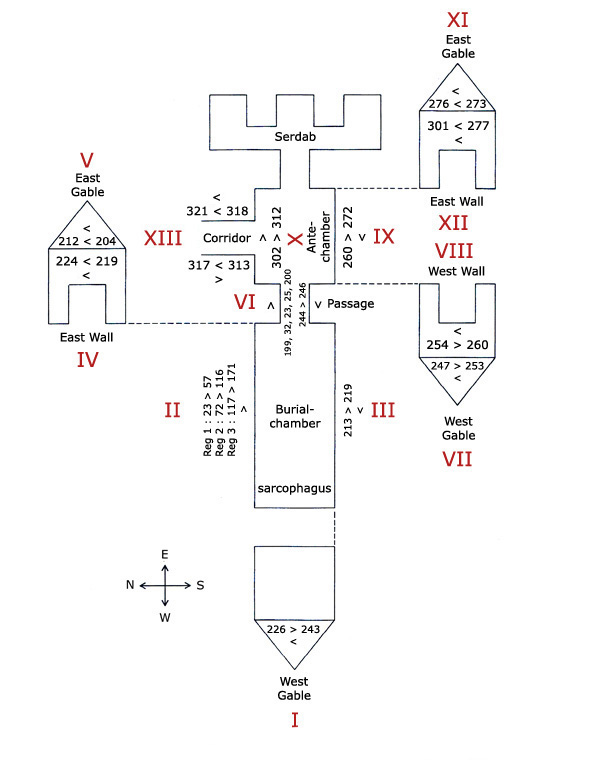
"<" or ">" between numbers = sequence of the
text
"<" from right to left (facing right) or ">" from left to right (facing left)
Unas Tomb in Detail
|