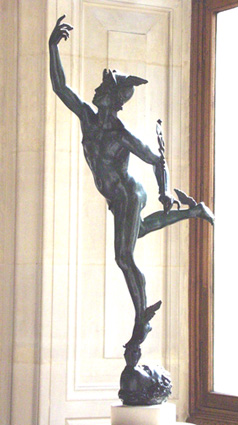
Hermes the
Egyptian
Section 2
Alexandro-Egyptian Hellenism & Hermetism
by Wim van den Dungen
Introduction
Section 1
the influence of Egyptian thought on
Thales, Anaximander & Pythagoras
1
Egypt between the end of the New Kingdom and the rise of Naukratis.
-
1.1 The political situation in the
Third Intermediate Period.
-
1.2 A
few remarks concerning the Late Period.
-
1.3 Greek
trade, recontacting & settling in Egypt.
2 Greece
before Pharaoh Amasis.
-
2.1
Short
history of Ancient Greece.
-
2.2
The invention of the "phoinikeïa" for both vowels
& consonants.
-
2.3 Archaic
Greek literature, religion & architecture.
3
Memphite thought and the birth of Greek philosophy.
-
3.1
The origin of Greek philosophy : Thales, Anaximander
& the colonizations.
-
3.2
The Stela of Pharaoh Shabaka and Greek philosophy.
-
3.3
Pythagoras of Samos : the
mystery of the holy & sacred decad.
-
3.4
The Greek pyramidion or the completion of Ancient thought.
Section 2
Alexandro-Egyptian Hellenism & Hermetism
4
The Greeks in Egypt.
-
4.1 Egyptian civilization
after the New Kingdom.
-
4.2 The
Ptolemaic Empire
-
4.3
Elements of the pattern of exchange between Egyptian and Greek culture.
-
4.4
Religious syncretism & stellar fatalism.
5
The Alexandrian "religio mentis" called "Hermetism".
-
5.1 Formative
elements of Hermetism.
-
5.2
"Nous" and the Hellenization of the divine triads.
-
5.3 The
influence of Alexandrian Hermetism.
-
5.4 Crucial
differences between Hermes and Christ.
4
The Greeks in Egypt.
4.1 Egyptian civilization
before and after Alexander the Great.
►
the Third Intermediate Period
"The
history of Egypt's contact with the outside world is above all concerned with
power and prestige. In the earliest commercial links between the Egyptians and
their neighbours in Africa and the Near East, the principal motivation appears
to have been to obtain rare or exotic materials and products that could serve to
bolster the power base of the individuals or groups concerned." -
Shaw,
2000, p.329.
The "golden" age and "renaissance era" of Ancient Egyptian
civilization (ca.1539 - 1075), in which a renewed theology of Pharaoh had been
combined with imperial internationalism, came to a close with the death of
Ramesses XI (ca.1104 -1075 BCE) and a clear division between the North (Tanis) & the South
(Thebes) of Egypt. With this split, the end of the Egyptian kingdoms (Archaic,
Old, Middle & New) had eventuated, for in the period that followed, Pharaoh (a
divine power of powers) would become an
administrative principle & hierarchy wielded by those in charge, whether
they be foreigners (Libyans, Nubians, Persians, Greeks or Romans), or, for that
matter, native Egyptians.
Theologically, at the close of the New Kingdom, "Amun is king" ruled, and so Egypt was a
theocracy (headed by the military). In the period which followed, the so-called Third Intermediate
Period (ca. 1075 - 664 BCE), southern Nubia and
the eastern desert were lost again (as well as the "Asiatic" northern regions).
At the end of the Third Intermediate Period, and for the first time since 3000 BCE, Egypt lost its
independence.
The last Pharaoh of the New Kingdom, Ramesses XI, had been
unable to halt the internal collapse of the kingdom, which had already filled
the relatively long reign of Ramesses IX (ca. 1127 - 1108 BCE). Tomb robberies
(in the Theban necropolis) were now discovered at Karnak. Famine, conflicts and
military dictatorship were the outcome of this degeneration. The native pharaonic
scheme, with its solar myth, theology, monumental ceremonialism, philosophy,
economy, art, science, administration, etc. initiated ca. 3000 BCE, had ended.
It had only been interrupted two times, covering 5 centuries.
But in no way did this demise herald the end of Egyptian civilization, for its
cultural form was flexible enough to assimilate new deities, ideas & practices
(cf. New Kingdom multi-culturalism versus Old Kingdom isolationism). Meanwhile,
the native Egyptians identified their venerable traditions foremost with their
priesthood. This had become all powerful in the XXth Dynasty : Amun was Pharaoh
and ruled by oracular decree revealed to the high priest : the first seer.
Secondly, they cherished the Pharaonic institutions (foreign rulers posing as
Egyptian Pharaohs).
Dynasty XXI, founded by Pharaoh Smendes (ca. 1075 - 1044 BCE), formally
maintained the unity of the Two Lands as it was in the Ramesside era. But his origins are obscure,
as is the history of these rulers. Smendes was
related by marriage to the royal family and founded the dynasty in the North (Tanis).
There, as well as in southern
Thebes, Amun theology & divination reigned (the name of Amun was even written in a
cartouche), but in practice, the Thebaid was ruled by the chief general and high priest of Amun
(military theocracy). At the inception of the Third Intermediate Period, the
most prominent military commander was chief general Herihor, who assumed the
title of high priest of Amun, and, on occasion, the titles and trappings of
Pharaoh (although the temporal authority of the Pharaoh of Tanis was formally
recognized through Egypt) ...
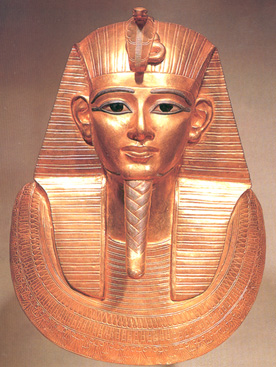
funerary mask of Psusennes I
XXIth Dynasty - Cairo Museum
The daughter of Tanite Psusennes I (ca. 1040 - 990 BCE), called Maatkare, was the first
"Divine Adoratice" or "god's wife", i.e. the spouse of
Amun-Re, the king of the gods. She inaugurated a "dynasty" of 12
Divine Adoratices, ruling the "domain of the Divine Adoratrice" at
Thebes, until the Persian invasion of 525 BCE. From the XXIII Dynasty onward, the status of the
"god's wife" began to approach that of Pharaoh himself, and in the
XXVth Dynasty these woman appeared in greater prominence on monuments, with their names
written in royal cartouches. They could even celebrate the Sed-festival, only
attested for Pharaoh ! All this points to a radically changed conception of
kingship, which became a political function (safeguarding unity) deprived of its
former "religious" grandeur and importance (Pharaoh as "son of
Re", living in Maat). Indeed, all was in the hands of Amun and Amun's wife
was able to divine the god's wish and will ... Psusennes II (ca. 960 - 945 BCE)
lost his power to the Libyan tribal chiefs, used by the Tanite kings as military
leaders.
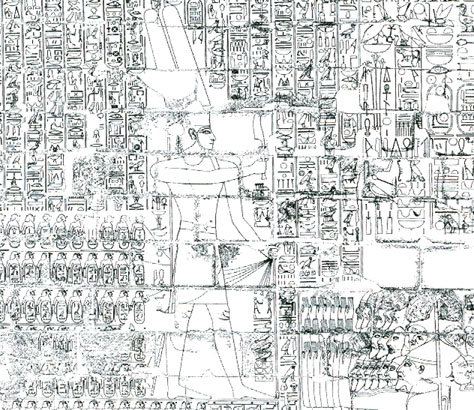
triumphal relief of Shoshenq I
XXIIth Dynasty - Bubastite Portal at Karnak
With Dynasty XXII ("Bubastids" or "Libyan"), founded by the Libyan Shoshenq I
(ca. 945 - 924 BCE), Egypt came under the rule of its former "Aziatic"
enemies. However, these Libyans had been
assimilating Egyptian culture and customs for several generations, and
the royal house of Bubastid did not differ much from Egyptian kingship, although Thebes hesitated.
After the reign of Osorkon II (ca. 874 - 850 BCE), a steady decline set in. In
Dynasty XXIII (ca. 818 - 715 BCE), the house of Bubastids split into two
branches, and came to an end in Dynasty XXIV (ca. 725 - 712 BCE).
In the middle of the 8th century BCE, a new political power appeared in the
extreme South (South of Nubia). It had for some generations been building up an important kingdom from
their center at Napata at the 4th cataract. These "Ethiopians"
(actually Upper Nubians) felt to be Egyptians in culture
and religion (they worshipped Amun and had strong ties with Thebes). The first king of this Kushite kingdom was
Kashta, who initiated Dynasty XXV, or "Ethiopian", characterized by
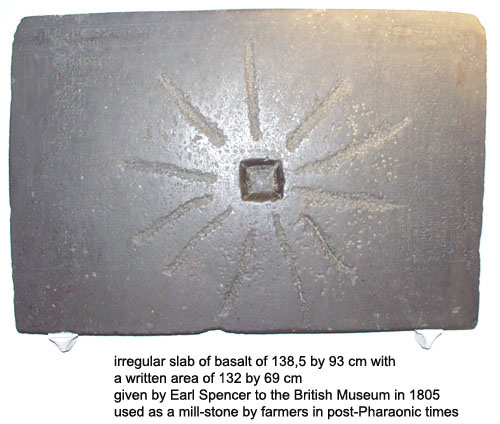
the revival of archaic Old Kingdom forms (cf.
Shabaka
Stone - cf. picture) and the return of the traditional funerary practices. Indeed, because
they possessed the gold-reserves of Nubia, they were able to adorn impoverished
Egypt with formidable wealth. A short-lived revival of the "old forms" took
place.
Piye (ca. 740 - 713 BCE), probably Kashta's eldest son, was crowned in the temple of Amun at
Gebel Barkal (the traditional frontier between Upper Egypt and Lower Nubia), as "Horus,
Mighty Bull, arising in Napata". He went to Thebes to be acknowledged
there. After having consolidated his position in Upper Egypt, Piye returned to
Napata (cf. "Victory Stela" at Gebel Barkal).
At the same time, in Lower Egypt, a future
opponent, the Libyan Tefnakhte (XXIVth Dynasty) ruled the entire western Delta, with as capital Sais (city of the
goddess Neit, one of the patrons of kingship). Near Sais were also the cities of
Pe and Dep (Buto), of mythological importance since the earliest periods of Egyptian history,
and cult centre of the serpent goddess Wadjet, the uræus protecting Pharaoh's
forehead (cf. the Single Eye of Atum).
When the rulers of Thebes asked for help, Piye's armies moved northwards. When
he sent messengers ahead to Memphis with offers of peace, they closed the gates
for him and sent out an army against him. Piye returned
victoriously to Napata, contenting himself with the formal recognition of his
power over Egypt, and never went to Egypt again. But the anarchic disunity of the many
petty Delta states remained unchanged.
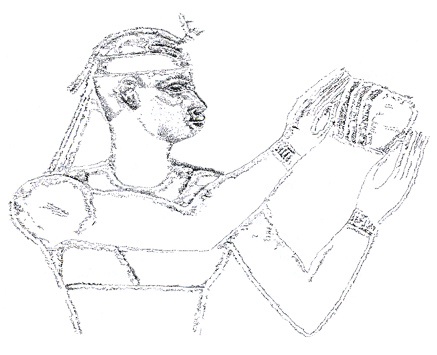
portrait
of Pharaoh Shabaka
from the naos he erected in the temple of Esna
Shabaka (ca. 712 - 698 BC), this
black African "Ethiopian", also a son of Kashta, was the first Kushite
king to reunite Egypt by defeating the
monarchy of Sais and establishing himself in Egypt. Shabaka, who figures in Graeco-Roman sources as a semi-legendary figure, settled
the renewed conflicts between Kush and Sais and was crowned Pharaoh in Egypt,
with his Residence and new seat of government in Memphis, the Old Kingdom
capital. Pharaoh Shabaka modeled
himself and his rule upon the Old Kingdom and represents the last attempt made
to restore the traditional Pharaonic principle, embodied in the
Memphite &
Heliopolitan
theologies : Pharaoh is the balance of the Two Lands, the mythical and divine
mediator between his father Atum and creation. The Ethiopians could come to
Egypt "from the South" as the mythical "Followers of Horus", and unity the Two
Lands. This attempt at recapitulation failed. Egypt would soon loose its
independence ...
The first Assyrian king who turned against Egypt -that had so often supported
the small states of Palestine against this powerful new world order- was Esarhaddon (ca.
681 - 669 BCE). For him, the Delta states were natural allies, for -in his view-
they had
reluctantly accepted the rule of the Ethiopians. Between 667 and 666 BCE, his
successor Assurbanipal conquered Egypt (Thebes was sacked in 663 BCE) and this
Assyrian king placed Pharaoh Necho I (ca. 672 - 664) on the throne of Egypt.
With him, the Late Period was initiated.
►
the Late Period
For the next six centuries (664 - 30 BCE), Egypt would be ruled by foreigners
without the demise of its priesthood and Pharaonic institutions. The latter
would go first, namely when Octavian takes Alexandria and Egypt becomes a Roman
province (1 or 3 August 30 BCE) ... In Egypt, the traditional worship was
forbidden by the Christian emperor Theodosius (347 - 395 CE) and the temples
were officially closed. But the ancient rituals persevered, for statues of
deities were worshipped in private houses as late as the sixth century CE (Kamil,
2002). Between 30 BCE and 642 CE, Egypt was ruled by the Romans and the
Byzantines, before it became Islamic as it still is today.
The XXVIth or "Saite" Dynasty (664 - 525 BCE) installed by Assurbanipal, allowed
for the resurgence of Egypt's unity and power. Necho I was killed by the Nubians
in 664 BCE and his son Psammetichus I (664 - 610 BCE) was an able statesman. He
was trusted by the Assyrians and left alone by the Ethiopians. Because the
Assyrians could not maintain their military presence in Egypt, he was able to
reunite Egypt.
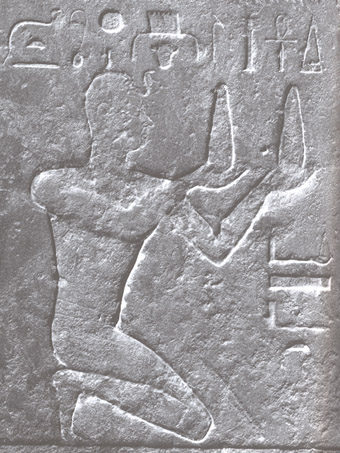
Psammetichus I engaged in
ritual activity
XXVth Dynasty - British Museum
The Saite Dynasty sought to maintain the great heritage of
the Egyptian past. Ancient works were copied and mortuary cults were revived.
Demotic became the accepted form of cursive script in the royal chanceries.
These Pharaohs focused on keeping Egypt's frontiers secure, and moved far into
Asia, even further than the New Kingdom rulers Thutmose I and III. When Cyrus
the Great of Persia ascended the throne in 559 BCE, leaving Pharaoh Ahmose II or
Amasis (570 - 526 BCE) with no other option than to cultivate close relations
with Greek states to prepare Egypt for the Persian invasion of 525, which led to
the defeat and capture of Psammetichus III (526 - 525) by Cambyses (who died in
522 BCE). The latter had assumed the forms of Egyptian kingship and showed a
deep respect for native Egyptian religion (he buried an Apis bull with all the
ancient rituals).
Before and after the Assyrian conquest, Dynastic
Rule was characterized by a revival of archaic Egyptian forms.
Hence, when the Greeks arrived in Egypt, they did not find the Solar Imperialism
of the New Kingdom, but nevertheless encountered a fully developed, operational
and living Egyptian Pharaonic cultural form.
Under Persian rule (525 - 404 BCE), Egypt became a satrapy of the Persian
Empire. The Persians left the Egyptian administration in place, but some of
their rulers, like Xerxes (486 - 465 BCE) disregarded temple privilege. When Darius II died (404 BCE), a Libyan, Amyrtaios of Sais, led
an uprising and again Egypt would again enjoy a period of independence
under "native" rulers.
A second Persian invasion (343 BCE) ended these short
Dynasties (XXVIII, XXIX & XXX, between 404 - 343 BCE). With Alexander the
Great (332 BCE), Egypt came under Macedonian rule. In 305, the Ptolemaic Empire
was initiated (it ended in 30 BCE).
►
Summarizing Greece/Egypt chronology (all dates BCE) :
-
ca.2600
: Neolithic Crete :
first sporadic contacts with Old Kingdom Egypt (Dynasty IV) ;
-
ca.1700 : neopalatial Minoan
Crete : Mediterranean network of artistic and iconographic exchange,
communication between Minoan high culture and Egypt (XIIIth Dynasty) ;
-
ca.1530 : Hyksos ruins in
Minoan style (Avaris) are used by Pharaoh Ahmose I ;
-
ca. 670
: Pharaoh Psammetichus
I initiated the study of Greek, employed Greek mercenaries against the
Assyrians, set up a camp that stayed in the western Delta and allowed the
Miletians to found Naukratis
;
-
570 : under Pharaoh Ahmose II
(Amasis) the Greeks were allowed to travel beyond the western Delta -
Naukratis became an
exclusive Greek trading centre complete with Greek temples. He cultivated close relations with Greek states to help him against the
impending Persian onslaught ;
-
525 : Egypt a satrapy of the
Persia empire, start of more pronounced Greek immigration to Egypt ;
-
332 : Egypt invaded &
plundered by the Macedonians ;
-
305 : Egypt ruled by Greek
Ptolemaic Pharaohs ;
-
30 : death of Queen Cleopatra, the
last Egyptian ruler.
4.2. The Ptolemaic empire
►
the grand vision of Alexander the Great
|
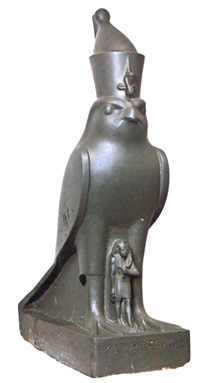
statue of Horus and Nectanebo
II
XXXth Dynasty - Metropolitan Museum of Art
|
With Pharaoh Nectanebo I (380 - 362 BCE), the last native dynasty began.
The
monarchs of this XXXth Dynasty (from Tanis to Elephantine & Philae) ruled over a
unified Egypt, erected monuments & donated to the temples. Pharaoh Teos,
the successor of Nectanebo I, imitated the dazzling XVIIIth Dynasty.
In 343 BCE,
the Persian Artaxerxes III made the last native Pharaoh, Nectanebo II flee to Nubia.
The situation remained very unstable until Alexander the Great (356 - 323 BCE)
entered Egypt in 332 BCE and had himself crowned Pharaoh in the temple of Ptah
at Memphis. |
In choosing Memphis as the setting for his coronation, Alexander underlined the
perennial nature of Pharaoh, associating himself with the foundation of the
united state and emulating Old Kingdom tradition (an archaic style fashionable
since the Ethiopian XXVth Dynasty). All the Ptolemies would be crowned in
Memphis. A strong co-operation existed between the priesthood of Ptah,
representing the Egyptian priesthood as a whole, and the Greek rulers. Alexander
sacrificed to Apis and he thereby set another precedent which would be followed
by the Ptolemies. His personal belief in his own divine, superhuman nature
harmonized with the concept of Pharaoh as the son of god.
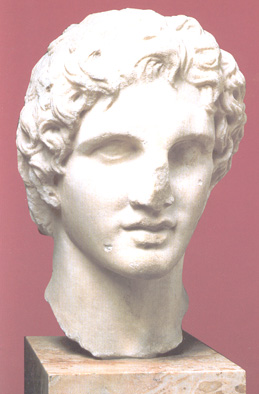
Alexander the Great as a youth
Acropolis Museum - Athens
Alexander's great design was the idea that all peoples were to be subjugated for
the formation of a new world order (had he understood his teacher Aristotle ?).
The east-Mediterranean empire he had founded up to this point could be completed
with the integration of Egypt. The pharaonic system provided a suitable
framework, established for millennia. He ended the ten years of much detested
Persian rule and presented himself as a new Pharaoh, carrying out the ritual
required for the transmission of power as the son or the nominal son of the
deceased and equally legitimate predecessor (Alexander accepted as ritual father
Nectanebo II). His throne name was : "the one whom Re chose, beloved of Amun".
"The prospect of establishing this kind of ideological
link to Nectanebo II appeared very promising owing to the latter's reputation as
a favourite of the gods ; it was a distinction conferred upon him because of the
achievements of his building programme, his devotion to animal cults, the gifts
of the land he made to temples, his programme for the restoration of cult
statues and the foundation of naoi, but above all because of his
surprising victory over the Persian Great King in 350." -
Hölbl,
2001, p.78.
In 331 BCE, Alexander founded the city of Alexandria on the isthmus between the
ocean and Lake Mariut (traditionally celebrated on the 7th of April). Earlier
that year, he had visited the oracle of Amun-Re in the Siwah oasis to seek
confirmation of his rule and divine nature. In Greek though, the oracle was
known as "Zeus Ammon", an offshoot of the Theban Amun, and honored in all of
Greece, with a temple in Macedonian Aphytis (Chalkidike). The Egyptian priests
identified him with Amun, the king of the gods. We know that in Siwah, Alexander
was told that he was the son of Zeus = Amun, and thus Pharaoh. He was led into
the holy of holies, faced the cult statue alone and asked the deity his
questions. Only a Pharaoh was entitled to do so. He returned to Memphis and
sacrificed to "Zeus Basileus" or "Amun, king of the gods". He had three fathers
: Philip II (actual), Nectanebo II (ritual) and Zeus-Ammon (spiritual). In the
spring of 331 BCE, Alexander left Memphis on his famous final campaign of conquest.
►
the demise of the Argead kingdom
On the 10th of June 323 BCE, Alexander the Great dies in Babylon amid hectic
preparations. On his deathbed he asks to be buried in the Ammoneion of Siwah.
With the death of this autocrat, an enormous empire lost its leadership. In the
division of the satrapies (cf. the settlement of Babylon of 323 BCE), Ptolemy,
born in 367/6 as the son of a certain Lagos and a commander in Alexander's army,
was allotted the best share, namely Egypt. He proposed to break with the Argead
kingdom of Alexander and divide the empire in loosely united satrap-states that
would occasionally supra-regional resolutions. This was rejected and a
triumvirate took over the government until Alexander's unborn son was born (by
Roxane). Regents were appointed.
This settlement did not last and the "War of the Successors" broke out.
Unitarians and separatists confronted each other. The Hellenistic world was
divided in three great kingdoms : Macedon, the Seleucid empire (Syria and
Mesopotamia) and the domain of the Ptolemies. Ptolemy's ambition to carve out
his own kingdom made him support the major political forces in the Greek world
(Epirus, Aetolian & Achaeon leagues, Athens, Sparta). Between 323 and 306,
Ptolemy ruled as satrap, and annexed Syria and Phoenicia (319/18). In the summer
of 306 BCE, the regent of Macedon, Antigonos, became the first to assume the
title of "king" ("basileus"). In the late summer of that year, Ptolemy was in
turn acclaimed king by his own army. The other regents, Seleukos, Kassandros and
Lysimachos quickly followed his example. Instead of united kingdoms, Alexander's
kingdom had been divided in opposing states ...
Alexander the Great (332 - 323)
Philip Arrhidaeus (323 - 317)
Alexander IV (317 - 310)
►
Ptolemy Basileus as Pharaoh Ptolemy I Soter
Following Antigonos' attempted invasion of Egypt at the end of 306 BCE (he had
laid claim to the entire kingdom of Alexander the Great), Ptolemy the Satrap
chose for his coronation feast the next anniversary of Alexander's death. On the
12th of January 304, his reign as Pharaoh Ptolemy I Soter began, with an eagle
as his personal emblem. He had able counselors and took their advice.
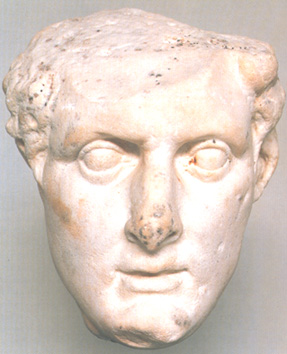
head of a statue of Ptolemy I
Soter
Fayyum - ca.280 BCE - Copenhagen
On the basis of military might, Ptolemy I expanded his domain. He appropriated
Cyrene, occupied southern Syria, seized Cyprus and moved to the Aegean Islands,
with garrisons on the Greek mainland (no Pharaoh had gone so far before ...).
But in Egypt, his foremost concern was to gain acceptance from the native
Egyptians. In this, religious policies and royal ideology played an important
part. No major socio-economical changes to the realities of Egyptian societies
were introduced. In 311 (two decades after the foundation of the city by
Alexander), the transfer of the royal residence to Alexandria was reported as
complete (cf. Satrap Stele).
"... this city became the Ptolemaic capital and was
vigoursly exploited from the beginning of the period as the major showcase for
Ptolemaic wealth and splendour and by the same token as the most significant
non-military means by which the Ptolemies could vie with and surpass their
rivals. It quickly became the most spectacular city in the Hellenistic world."
-
Shaw,
2000, p.404.
Alexandria was the home of the body of Alexander, the lighthouse on the east end
of Pharos island and the Mouseion. The latter, conceived along the lines of
Plato's & Aristotle's schools at Athens, had a walk (peripatos), an arcade
(exedera), a library and a shrine to the Muses (mouseion). From these seven
Greek goddesses, all artistic, philosophical and scientific inspiration was
supposed to come. It was a centre of research and instruction and would make
Alexandria under the Ptolemies the centre of Greek culture. Ptolemy I's master
librarian Demetrius of Phalerum dispatched searchers all over the Greek world to
obtain texts. His work took shape ca.300 BCE and when he died, fifteen years
later, the Mouseion was already the gathering place of the elite of Hellenic
culture. At the end of the efforts of the Ptolemies, the library held no fewer
than 700.000 volumes.
Ptolemy I explicitly associated himself with Alexander. He made the deification
of the Ptolemaic dynasty a state matter. The particular characteristics of the
Alexandrian "Basileus" (king and savior-god) made him elevate Alexander the
Great to the level of a state god. The priest at the head of this purely Greek
cult was made the highest priest in the land, who was named directly after the
king in dating formulae (in Greek, Demotic and hieroglyphic decrees & documents
made by the priests).
Hence, in the Ptolemaic empire, one has to make distinction between the personal
figure of the "basileus" (rooted in the supranational kingship or imperialism of
Alexander) and the honors of the ancient Egyptian Pharaoh, bound to territory,
nation & religion. Ptolemy I offered to Maat, but he also paid tribute to his
own roots by deifying himself. He had tried to safeguard the supranational
level, but had failed. Instead, he founded his own dynasty, lasting for three
centuries.
In the winter of 283-2, Ptolemy I died at the age of 84, but Ptolemy II was
already co-ruler and crowned in 282 BCE. He established a four-yearly festival
called the "Ptolemaieia", to honor his father and the Ptolemaic dynasty he
founded (with a military might powerfully expressed on the spectator by 57.600
infantry and 23.200 cavalry). From the time of Ptolemy II, we find the claim
that the king belonged to a sacred family ("hiera oikia"), initiated by
Alexander. Descent from Heracles, Dionysus, Zeus and Amun played an important
role in Ptolemaic propaganda. In this family a recurrent full brother - sister
marriage became usage, although it was not consistent (cf. Zeus and Hera, Osiris
and Isis). In the late third and early second centuries, only two foreign
provinces were left : Cyrenaica and Cyprus, for which character deficiencies of
Ptolemy IV were deemed responsible. Dynastic schism, the fury of the Alexandrian
mob, and the deterioration of the political situation outside Alexandria
facilitated the elevation of able Egyptians, closing the gap between Greeks and
Egyptians. Egyptians attained the rank of provincial governor (strategos) or
governor-general (epistrategos). Strikes, flight, brigandage, attacks on
villages, despoliation of temples and frequent recourse to the temples' right of
asylum were other signs of the long decline.
"Uprisings by these people might easily be construed as
nationalistic, given the close congruence between economic status and ethnic
origin, and we can be confident that they acquired that dimension explicitly
from time to time, but at the most fundamental level the uprisings were those of
the oppressed against the establishment regarded as responsible for that
oppression, and that establishment could just as easily be perceived as the
Egyptian priesthood and their temples as Graeco-Macedonian officialdom." -
Shaw,
2000, p.420.
The Ptolemaic empire was the background of the genesis of a Graeco-Egyptian
consciousness, more specifically, an Alexandro-Egyptian subculture.
|
THE PTOLEMAIC DYNASTY
beginning and golden age :
Ptolemy I Soter (304 - 284)
Ptolemy II Philadelphus (284 - 246)
Ptolemy III Euergetes I (246 - 221)
change and decline :
Ptolemy IV Philopator (221 - 205)
Ptolemy V Epiphanes (225 - 180)
Ptolemy VI Philometor (180 - 145)
under Roman shadow :
Ptolemy VII Neos Philopator (145)
Ptolemy VIII Euergetes II (170 - 116)
Ptolemy IX Soter II (116 - 107)
Ptolemy X Alexander I (107 - 88)
Ptolemy IX Soter II (88 - 80)
Ptolemy XI Alexander II (80)
the final period :
Ptolemy XII Neos Dionysos Auletes (80 - 51)
Cleopatra VII Philopator (51 - 30)
Ptolemy XIII (51 - 47)
Ptolemy XIV (47 - 44)
Ptolemy XV Caesarion (44 - 30)
|
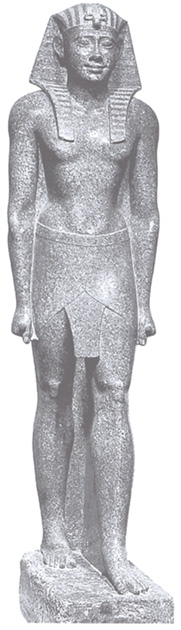
statue of Ptolemy II
Philadelphus
ca.260 BCE - Vatican
|
After the fall of Alexandria, Egypt became a Roman province, but with a singular
status. Its governor Octavian would be recognized as a living god by the Egyptian
priesthood and assume the attributes of an Egyptian deity & Pharaoh. Egypt was
Octavian's personal property, and for centuries was to remain a direct vassal of
the emperor of Rome, while keeping its national character intact. Octavian took
away the land of the priesthood, but thenceforth they received salaries and were
showered with honors. No unauthorized senator could set foot on Egyptian soil
and no Egyptian who was not Alexandrian could become a Roman citizen. The
official language remained Greek. When emperor Diocletian (284 - 305 CE)
attempted to reform the empire, Egypt had declined in importance and was
weakened by the continual draining of its resources. The Ancient Egyptian
artistic canon was either lost or misunderstood.
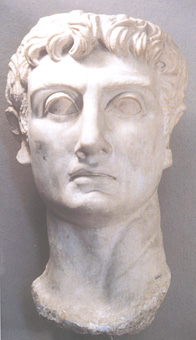
head of statue of Augustus
ca. 50 CE - Alexandria
|
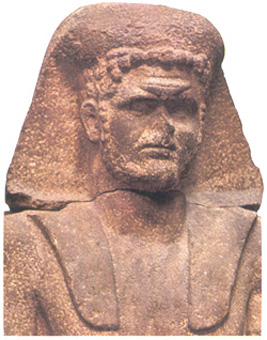
statue of
Caracalla
Cairo Museum
|
At the
partition of the Roman empire (395 CE), Egypt was
attributed to the Eastern empire (Byzantium). The ability to read hieroglyphs
would soon be lost, and the general persecution of Paganism by Christianity
begun (with small islands of the ancient traditions surviving until Islam took over).
4.3
Elements of the pattern of exchange between Egyptian and Greek culture.
The native Egyptian priests and scribes were the pre-eminent repositories and exponents of
Pharaonic Egyptian culture, a role in which they were particularly successful in
the Ptolemaic empire. They were the intellectual elite and had been since the
late New Kingdom, when the role of Pharaoh had changed by identifying Amun with
Pharaoh. Indeed, in the Third Intermediary Period, the position of the
priesthood of Thebes was legitimized by the importance of the oracle of Amun in
state affairs and with the general tendency (at work in New Kingdom
wisdom teachings like the instructions for life of
Amenemope) to consider the will of the gods as the final answer in all
fundamental political & moral questions (instead of one's adherence to Maat as
reflected in the Old Kingdom
teachings of Ptahhotep).
Because of this new belief, divination (or the means to divine the will of the
gods) was elevated to the rank of an official state office. Small nods of
specially prepared statues, or seemingly random movements of the bark of the
deity during festive processions were enough to divine a simple "yes" or a "no"
answer. Divination by dream delineation was a common temple activity. Priests
talking through statues was another, more elaborate technique, used for
important visitors, such as maybe Basileus Alexander the Great.
He visited the oracle of Zeus-Ammon because the Amun priesthood of Thebes had
retained its "oracular" aura. But as a Macedonian, Alexander did not go to
Thebes (the home of Amun since the Middle Kingdom) to seek native legitimation.
He sought legitimation by Greeks & Egyptian deities alike and his syncretism
(reflected in the choice for Zeus-Ammon of Siwah) would become one of the
characteristics of Ptolemaic culture. So he moved to Memphis, the Old Kingdom
capital, and was crowned Pharaoh by the priesthood of Ptah. Hence, of all
Egyptian priests and scribes, the priesthood of Ptah would become the most
powerful native group of intellectuals. Furthermore, the priesthood was virtually
undiluted by Greek blood and absorbed in its own tradition. After the collapse
of the Great Empire, Ptolemy I could dispense with a god who was also at home in
Greece and Macedon. Zeus-Ammon would not play the role intended for him by
Alexander. Instead, Pharaoh Ptolemy I Soter initiated the state cult of Serapis,
the Hellenized Egyptian Osiris-Hapi, worshipped by Greeks who had already
settled in Memphis ...
Two images reflect the ambivalence of the pattern of exchange between native
Egyptian traditions (Pharaoh, priesthood, united Egypt) and the Macedonian way
of life. On the one hand, there is the slightly disdainful smile on the face of
the Egyptian priests mentioned by Plato (Timaeus, 22b), and this coupled
with their infuriating reserve, esoterism and mystification (compared with that
of their Greek conquerors, theirs was a very old culture). On the other hand,
there was the corrupt conduct of Kleomenes of Naukratis (promoted to satrap
after Alexander left Egypt in 331 BCE) of whom it is said that he threatened to
close the temples in order to be dissuaded by bribes, or Dio Chrysostom, who
regarded Egypt as a mere "appendage" of Alexandria, as well as the Greek papyri,
in which Egyptian priests that knew no Greek, were called "unlettered".
Indeed, the Greeks were proud of their culture and had good reasons to be, for
Greek thought had introduced the
rational mode of
cognition, and its dialogal, linear and critical approach. The teachings of
Plato and Aristotle had become "academic" and a new way of perceiving human
freedom was in place. Hellenism deeply influenced all peoples it touched. The
discovery of rationality was too tremendous to be grown over again by the
multiplicities of ante-rational thought.
"Greek immigrants, and the more urban and educated among
their descendants, often persevered in Greek ways of thought and behaviour. They
spoke their own language, keeping it free even of loan-words, and exploiting its
flexibility, consciously or not, to disguise the uniqueness of their adopted
land, bequeathing us in the process 'pyramids', 'obelisks', 'sphinxes' and
'labyrinths'." -
Fowden,
1986, p.17.
To the outsider, these Greeks were "Egyptians", but they themselves stuck to
their own kith and kin. The priesthood of Alexander also points in that
direction : the high priest of Ptah was the pontiff of the Egyptian priesthood as
a whole, but above him stood the priest of Alexander, who was the high priest of
the Ptolemaic empire and mentioned next to the Greek Pharaoh. It was this purely
Greek priesthood that religiously formalized the deification of the Ptolemaic
dynasty after the model of Alexandrian kingship (a supranational empire headed
by a god-king).
So both native and immigrant cultures were proud of their traditions and were
able to safeguard them despite the numerous fertile interactions between the institutional
tradition of Pharaonic kingship (and its illustrious ancestral lineage deemed to
end with Pharaoh Nectanebo II) and the linearizing mentality of warlike
Greeks, taken by the Hellenistic rational ideal of supranationality (a world order
is an abstraction of the idea of power). From
the start, Ptolemy had more in mind than Egypt alone. At the death of Alexander,
he had advanced the idea of a supranational council (the first united nations),
but this proposal had been rejected. Ptolemy wanted to keep the Great Empire.
As none other, Ptolemy realized that the
Pharaonic system would enable a dynasty to survive the death of its founder. His
annexations beyond the wildest Egyptian dreams confirmed this "strong king". He
understood (as Alexander before him) that by gifts to the temples, erecting
monuments and ensuring dignified royal administration (as well as preserve his
military might), he would have the intellectual, ante-rational elite of Egypt on
his side and benefit from the perennial agricultural fruits of the "black land",
as well as from the preserved scientific and artistic canons, expressed in
multi-layered, contextual, proto-rational thoughts & practices. Native Egyptians loathed the Persian rule and welcomed a new Pharaoh
who would restore and maintain the old traditions. The blur between the human
and the divine in Ptolemy's Macedonian mind (cf. the figure of the hero in Greek
religion) blended in with the divine nature of Egyptian kingship confirmed by
triumphant victories (Pharaoh being
the incarnation of Horus the Elder as well as the son of Atum-Re, the
Heliopolitan god of creation).
"The principal quality of the Ptolemaic kingship, inspired
as it was by Hellenistic ideology, consisted of a charismatic invincibility
which was upheld by the gods and which had to be proven if recognition by the
kingdom's subjects was to be secured. This was essentially different from the
sovereignty of the ancient Egyptian pharaoh, since the latter's invincibility,
affirmed in his role as the victorious Horus, was principally understood in
cultic and mythic terms. (...) In the heyday of Ptolemaic rule, the relationship
between king and subjects had not yet been stifled by the bureaucratic structure
; the many petitions directed to the king, which have survived from that time
indicate that the king was recognized as the source of justice and as a direct
partner in a dialogue." -
Wilkinson,
2001, p.91.
Although both communities were necessarily in touch but maintained their own
identities, no native Egyptian could rise on the social ladder without absorbing
Greek language, culture & manners of the politically dominant Greeks. So, among
numerous Egyptians belonging to the elite, bilingualism became increasingly
common. But, most members of this Egyptian elite were not prone to study and
practice Greek ways.
On the other side of the equation, only a very small number of Greeks learned Egyptian (namely those that
wanted direct access to the temple inscriptions). The Greeks took the initiative
in comparing their gods with the native Egyptian deities. Purely
Greek divinities were exceptional (the Nile had no Olympus) and Greek syncretism
obvious (Serapis was a hybrid deity). Despite these Greek efforts, the native Egyptian system proved resistant to such
conceptual "merging" (the Greeks had a rational religion but no old religious
traditions, the Egyptian had a perennial cult but no rationality).
From the time of Ptolemy I, the Greeks tried to bring Greek and Egyptian
peoples in one religious sphere (even Alexander had been respectful of both
Theban and Memphite manifestations of the godhead - cf. the Egyptian
henotheist system of religion). In the Serapeum (the necropolis district of
the Apis bulls - "serapeum" refers to the ground structure of the "House of
Oserapis") Greeks, who were already settled in Memphis,
worshipped a god in the form of the sacred bull of Memphis, called Osiris-Apis
(in Greek "Oserapis"). This deity was Hellenized as "Serapis" or
"Sarapis" and used by Ptolemy I Soter to
cement Greek religion with native Egyptian worship. In Greek mythology, the bull
represented Zeus, the
father of Alexander (son of Zeus = son of Ammon). But in Egypt, the Apis bull cult went back to the beginning of
the Dynastic Period (ca. 3000 BCE - it is mentioned on the Palermo Stone) and
represented Ptah, the god of Memphis, the fashioner of creation, the balance of
the "Two Lands" (namely kingship) and the patron of the arts and of creativity.
Precisely the set of attributes needed to maintain stability in the native
population. The worship of the sacred bull of Memphis in his post mortem form
(Osarapis : after death, the Apis bull becomes the god Osiris) existed prior to
Ptolemy I Soter's decision to promote Serapis.
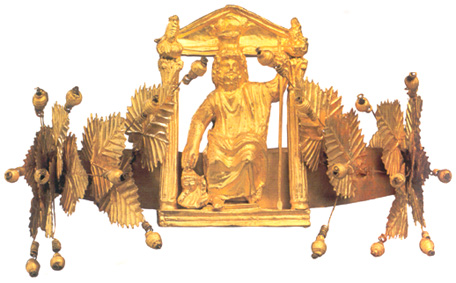
diadem with Serapis
wearing a kalathos crown
Roman Period (Hadrian) - Cairo Museum
The Serapis cult is another powerful image of the mode of interaction between
the natives and the Greeks. As Fowden mentions, in the Serapeum of Alexandria
(the second necropolis for Apis bulls), Serapis was treated as a Greek god and
worshipped in a temple built by Ptolemy III. This was a mainly Greek structure,
while its Roman successor was Corinthian. The Serapeum was adorned with Egyptian
objects, including a couple of statues of third-century Memphite priests. But,
it is very likely that the priesthood and their rituals were largely Greek. But
in the original Serapeum of Memphis :
"... priesthood and ritual, remained as Egyptian as ever,
and in that the Greek community in Memphis, and (with some exceptions) their
compatriots who came from afar to visit the sanctuary, were content to
acquiesce." -
Fowden,
1986, p.21.
One may conclude, as does Fowden, that "genuine cultural fusion" between, on the
one hand, native Egyptian religion & philosophy and, on the other hand, Greek
rationality, both scientific & philosophical, most likely took place in the
"educated native milieu". The origin of Alexandro-Egyptian culture (of a genuine
merge) is thus to be found in the relatively small upper classes of the native
priesthood & administrators (open to the impact of Greek thought and different
from the large majority of natives that did not adopt Greek beliefs and
practices) as well as in the very limited number of Greeks that egyptianized. As
only ca.10% of the total population was literate (Davies,
1995, p.27), we may conclude that the original "niche" of this emergent new
Graeco-Egyptian consciousness (infusing fertile traditions with rationality) was
rather small in number. Was it potent enough to initiate a new
Alexandro-Egyptian cultural form, including a religious system, a philosophy, a
ceremonial order as well as a vast number of popular magical practices, namely
Hermetism ?
4.4 Religious syncretism
& stellar fatalism.
►
syncretism as a political tool
Serapis was associated with Isis, to whom Alexander the Great had dedicated a
temple in Alexandria. This divine pair was linked with the divine royal couple,
Serapis to Pharaoh, Isis to the queen. With these linear equations, the Greeks introduced
dual-natured syncretic deities, corresponding to the two-fold aspect of the
Ptolemaic rulers, both Basileus and Pharaoh. They deified themselves in the
process. The dynastic cult was the political device with which the Ptolemies
legitimized their rule : for the ruling classes Ptolemy I was Basileus, a divine
person in Alexandrian style, for the natives he was Pharaoh, son of Re, Egypt
personified.
|
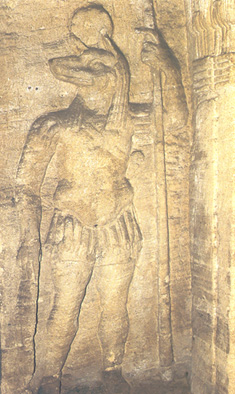
Anubis as a Roman in the sarcophagus
room of the hypogaeum - Roman period - first centuries CE -
Alexandria
|
Ptolemaic kingship had to be upheld by the gods, and
hence the Greek rulers worshipped
Greek, Egyptian and Graeco-Egyptian deities.
Cultic syncretism is best evidenced in the Hellenized parts of
Egypt, such as Alexandria (and the Fayyum) and was initiated by the
Greek rulers.
The principle continued to be applied until the Roman period, when
it ran against the canon of Egyptian art and involved a grotesque
putting together of disparate elements, like the use of Roman
vestments ... |
In
general, the native Egyptian remained loyal to the venerable cultic forms (preferably
going back to the Old Kingdom) and religious syncretism is an
ambiguous process :
"Although it presupposes the interaction of at least two
religious cultures, interest in this process may fluctuate widely among
different categories of worshippers, and produce an extremely uneven effect on
their conception of the gods involved, and on the way in which they worship
those gods."
Fowden,
1986, p.19.
As we know that both groups tended to keep to their own, it is unlikely that
syncretic deities as Serapis were worshipped by native Egyptians without
thinking of Osiris (as Amun might have been praised by a few exceptional Greeks,
but never without considering Zeus). In many ways, syncretism downgrades the
specificity of each archetype. In Ptolemaic Egypt, it was a diplomatic way for
the ruler to honor both sides.
►
fatalism and the movement of the stars : "Aegyptus imago
sit caeli"
Next to the traditional Egyptian religious forms (recapitulating Old Kingdom canons), and
the particularities of the ideology of the Greek Basileus, we must stress the
further development of a trend which started in the Late New Kingdom. It
consisted in attributing less importance to worldly success (position in the
Pharaonic state) and more to the inward man and his realization of modesty in
the face of reality. This
regrouping of values made the new ideal man humble before godhead. He realized that
everything was decreed by god's will. Maat was still the divine order which
governed the world, but, living according to Maat, was no longer described in
terms of material rewards or position in society, but as the humility of man
toward the omnipotent will of god. Worship was thus a way to please god, a
sacrifice made to make the personal will coincide with the divine will (with
magic the opposite was aimed at, namely influence over the divine will by
assuming it).
Under Persian rule, Babylonian stellar science (astronomy plus astrology) came
to Egypt. The Babylonians had a sexagesimal place-value system, which allowed
for complex astronomical calculations, in particular with fractions (in Egyptian
mathematics, only unit fractions were used). Hence, the will of the gods could
be inferred by predicting and understanding celestial events. This astral
religion had two sides : a technical one involving measurement (astronomy) and
an "oracular", "prophetic" one dealing with inter-subjective meaning
(astrology).
The distinction between astrology and astronomy is thus fairly simple, but has
been blurred by the modern academia under the pressure of their prejudices and
ignorance in the matter, as Popper, Feyerabend and other philosophers of science
have pointed out. Astronomy, on the one hand, measures celestial phenomena in
all possible ways and tries to advance an organized system of the universe and
everything related to it. Because astronomy is measurement, it has no need of
symbolical references beyond those necessary to allow for mathematics (like
"point", "small time interval", "infinite" and others). Astronomy presents
the syntax of the universe. Astrology, on the other hand, attributes
inter-subjective meaning to certain celestial phenomena, such as planets, Lunar
tides and the daily diurnal/nocturnal arc. Hence, astrology always symbolizes
the measurements, and therefore presents the semantic of the universe, the
meaning of the universe "for me".
That astronomical phenomena had mythologically significance, had not been new to
the Egyptians. The linking of the Nile flood with the rising of Sirius, the
Sothic year, the Lunar tides, the heliacal decans, the hours, the calendars and
the integral relationship in late Egyptian religion between the stars and the
gods mentioned by Plutarch in his On Isis and Osiris, are manifestations
of the stellar semantic used by the priesthood. In fact, the stars are an
important part of the funerary ideology of Pharaoh.
Decans adorn IXth & Xth Dynasty (cf. 2160 - 1980 BCE) sarcophagi, which shows
the antiquity of this astronomical division based on mythological & religious
reasons, i.e. a semantic aimed at attributing inter-subjective meaning to
objective events.
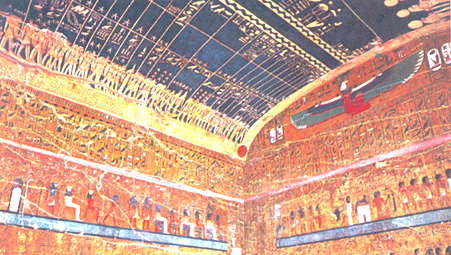
tomb of Seti I - ceiling
with decans
XIXth Dynasty - Luxor - valley of the kings
But
the idea that the movements of these seven planets (or deities : Sun, Moon,
Mercury, Venus, Mars, Jupiter, Saturn) could be associated with
a semantic allowing for predictions in individual royal affairs (like
birth & death), was foreign to Egyptian astrology. In his Commentary on
the Timaeus (Diehl - 3.151), Proclus (412 - 485 CE) wrote that Theophrastus
(ca. 372 - 280 BCE) had said that his Chaldaean contemporaries had a theory
predicting every event in the life and death of a human being, rather than just
general, collective effects, such as good and bad weather.
For the evidence of the image of Ptolemaic Egypt as the home of Greek astrology,
we need to realize that in the aftermath of Alexander's conquest, Greeks settled
in Persia and their migration to Egypt brought Chaldaean astrology to Alexandria
(and from there to Rome). Another interesting marker is the fact that only
trained intellectuals were able to calculate the position of the planets.
Astrology had no tools without astronomy.
Greek philosophy since Pythagoras had been stressing the geometrical,
architectonic features of the universe (cf. Thales and Anaximander). The orderly
rhythm of the seven sacred planetary orbits had been projected on the musical
intervals of the string, to show the rationale of the numeric correspondences
between the higher and the lower, the larger and the smaller. That somehow the
movements of the planets translated (reflected), in numerical terms, the will of
the deities, must have been appealing and in accord with the linearizing and
rationalizing nature of Greek thought (cf. the grand formula or "idea of
ideas"). Astronomical predictions were legendary (cf. Thales and the eclipse).
The decisive development from Babylonian omen-literature to Greek astrology
proper, took thus place in Ptolemaic Egypt, and started in the third century
BCE. The merging of, on the one hand, Egyptian stellar religion, Persian
astronomy and Chaldaean astrology with, on the other hand, Alexandrian geometry,
developed Greek astronomy (at work since the days of the Pre-Socratic) and
initiated Graeco-Roman astrology, the first historical manifestation of what is
now called "Western astrology". The reasons for this merging are also religious
: instead of dubious oracles (whispers made by priests in the secret chamber
above the sanctuary ?), the will of the gods could be "calculated" and
"predicted" ... this meant a linearization of the oracular and the mysterious.
What started in ancient Ur as a system of celestial signs & omens
(using as measuring-rod the unequal sidereal zodiac, i.e. a "belt of
animals" 2 times 8° wide, imagined behind the apparent course of the Sun and of
an unequal constellational length), became a Persian system of
attributing dynamical meaning to the positions of planets and stars, moving
against the background of stellar constellations, but this time catalogued by
means of 12 segments of
30° (the equal sidereal zodiac, still in use in Hindu astrology).
Under the influence of Alexandrian mathematics, the constellational standard of measurement of the
Babylonian or Chaldaean system (the sidereal zodiac, both unequal and equal) was replaced by
the tropical standard, referring to the apparent (but illusionary) path of the Sun around the
Earth (and no longer to the stars). By dividing this ecliptic in 12 tropical
signs of 30°, starting at the eastern intersection of the celestial equator and
the ecliptic (the vernal point of 0°Aries), Greek astrologers switched from a
stellar to a planetary reference-system. Ideal standard relationships (0°, 60°,
90°, 120° & 180° - cf. Pythagoras' theory on musical ratio's and Euclid on
angles) between these planets were given dynamical purposes.
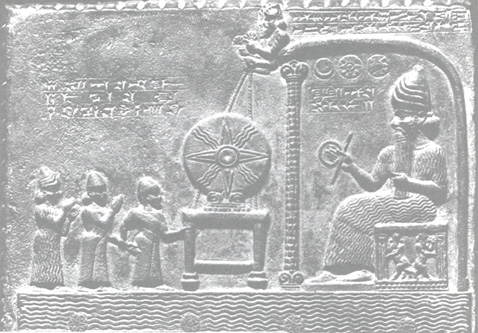
Babylonian tablet with
disk of the Sun between its deity and mortals
Sun temple of Sippar - 9th BCE - British Museum
Moreover, besides diving the ecliptic
in 12 equal parts, they also divided the local horizon in 12, thus positioning
the same planet in a different local segment or "house" for every significant
geographical change (the time factor being constant). Just
as the vernal point started the tropical zodiac, the ascendant was the border
(or cusp) of the first house. This eastern intersection of the celestial horizon
with the ecliptic was the rising point of the local horizon, and deemed very
significant to determine character and fate of any native or the outcome of any
event, while 0°Aries provided the same initiative on a ecliptic scale (cf. the
harmony or reflection of the general macro cosmos in every specific micro cosmos).
In the
Ptolemaic empire, astrology became prominent and fused with the existing
fatalistic tendencies to become a stellar fatalism. This same happened on a
larger scale, for late Hellenism was a period of great insecurity and doubt.
That the misfortunes of fate could be predicted was too good to be true. All depended on the will of
the gods, but that will could be read in the sky. Moreover, the planets were
conceived as the physical manifestations of the pantheon that ruled the affairs
of Earth. Not only prediction, but praise & prayer could be offered to change
the course of events (magic). These beliefs, belonging to the technical
Hermetica,
made astrology so popular in the Hellenistic age, prone to feelings of
alienation and the pressing impact of the deities fate and fortune.
The first historical reference to astrology from contemporary sources, comes
from Diodorus of Sicily, who wrote between 60 and 30 BCE. It is clear that for
him, Egypt was already quite some time the home of Greek astrology :
"The positions and arrangements of the stars, as well as their motion, have
always been the subject of careful observations among the Egyptians, if anywhere
in the world (...) they have observed with the utmost keenness the motion,
orbits and stoppings of each planet, as well as the influence of each of them on
the generations of all living things - the good and evil things, namely, of
which they are the cause. And while they often succeed in predicting to men the
events that will befall them in the course of their lives, not infrequently they
fortell destruction of the crops, or, on the other hand, abundant yields, and
pestilences (...) they have prior knowledge of earthquakes and floods, and the
risings of comets, and of all things which the ordinary man regards as quite
beyond finding out."
Diodorus : World History, 1.81
(translated by C.H.Oldfather).
Traditional astrology got recorded by
Claude Ptolemy (born towards the end of the first century CE) in his
Tetrabiblos & the Centiloquim. In Demotic papyri of the Roman
period, we find versions of texts going back to the mid-second century BCE. They
concern kings of Egypt and wars with Syria and Parthia. The earliest papyrus
horoscope concerns a birth in 10 BCE, while the first horoscope preserved in a
literary texts deals with a birth in 72 BCE.
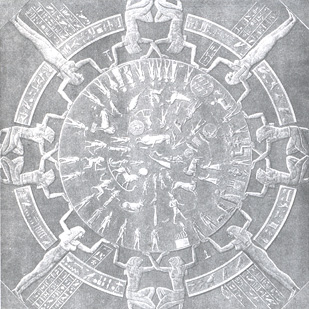
zodiac of Denderah
(eclipses, constellations, planets)
Ptolemaic Period - Hathor temple
The most interesting Ptolemaic
monumental piece called the "zodiac of Dendera", recording the event of
Ptolemy XII Neos Dionysos Auletes founding a new Hathor temple at Dendera (54 BCE). In fact, it is
the world's first monumental founding horoscope or "election horoscope".
"Are you then unaware, Asclepius, that Egypt is the copy of heaven, or, to be
more precise, the place where the operations, that govern and put to work the
celestial forces, are transferred and projected down here ? Even more so, if
truth is to be spoken, our land is the temple of the whole world."
Asclepius, 24.
Most theoretical works on astrology were Alexandrian, and often they credit
their authorship to the god Hermes Trismegistus or Asclepius. A second-century
source (Clement of Alexandria) still refers to forty-two books of Hermes ...
The discovery of the Nag Hammadi library, consisting of a collection of mainly
Gnostic texts in Coptic (i.e. the latest stage of the Egyptian language),
encouraged the view that the origins of Hermetic literature are to be found in
the fusion of Egyptian and Graeco-Alexandrian ways of thought.
"Another factor which encourages us to look on Hellenistic
Alexandria as the cradle of Greek astrology, is that it is clear that by the
mid-first century Egypt had acquired a reputation as such." -
Barton,
1994, p.30.
As part of the practical side of the Hellenistic astral religion, astrology
played an important part and would continue to do so. Clement of Alexandria
(ca.150 - 215 BCE) denied the Platonic idea that the planets had spirits that
moved them, but not that they influenced human affairs, although never outside
the Divine will. Even much later, Thomas of Aquinas (1225 - 1274) would accept
the influence of the "stars" on the physical body (the stars incline but do not
necessitate). The fundamental problem raised by Christian philosophy in this
context being the overall fatalistic undertones of traditional astrology (in
conflict with the dogma of free will and subsequent human responsibility) and
the Hermetical (and thus pagan) theoretical (ideological) superstructures it
implied. Indeed, astral religion provided initiations to circumvent the
necessities of planets & stars. It reemerged in the Renaissance, with a
spectacular return of astrology and its esoteric adjacent : magic and alchemy
(cf. Paracelsus' remark : "The wise command the stars."). The Hermetical
division between theoretical and popular, between philosophical and technical
(magical), remained a fundamental characteristic of these mystery traditions
started on Egyptian soil, in the intellectual milieu of the natives, allowing
for a slow Hellenization of Ancient Egyptian religious traditions, rituals &
philosophies.
The religious implications of astrology (based on the Hermetical postulate) are
tremendous : if this symbolical, inter-subjective sense is attributed and
confirmed, then it begs the question how to escape the idea that an intelligent
Architect created the universe ?
5
The Alexandrian "religio mentis" called "Hermetism".
5.1
Formative elements of Hermetism.
►
the Hermetical lament
"A time will come, when it will seem that in vain the
Egyptians have honoured their gods with pious mind and with assiduous service.
All their holy worship will fail inefficaciously, will be deprived of its fruit.
The gods leaving the Earth will go back to heaven ; they will abandon Egypt ;
this land, once the home of sacred liturgies, will be widowed of its gods and no
longer profit from their presence. Strangers will fill this country, and not
only will there no longer be care for religious observances, but, a yet more
painful thing, it will be laid down under so-called laws, under pain of
punishments, that all must abstain from acts of piety or cult towards the gods.
Then this very holy land, home of sanctuaries and temple, will be all covered
with tombs and the dead. O Egypt, Egypt, of your cults only fables will remain
and later, your children will no longer believe in them ; nothing will be left
but words carved in stone to tell of your pious exploits."
Asclepius, 24.
Petrie (1908) argued, from historical context, to identify the events described in this
lamentation as the crisis Egyptian religion had gone through during the second
Persian period (343 - 332 BCE). As the Hermetic texts also mention an Egyptian
Pharaoh, the terminus a quo would be the fled Nectanebo II, the "traditional" last
native king, used as a cultic father figure in the coronation of Alexander the
Great, and thus part of the legitimization of the Ptolemaic religious order
(with its Greek and Egyptian branches). For Petrie, at least some passages of
the Corpus Hermeticum had to refer to the Persian period. Moreover, as
this lament was in circulation before the Christian prohibition of paganism in
390 CE, it could only refer to the Persian plundering of temples and to the
demolishing of the defenses of major cities. If Petrie was right, the
traditional view, maintaining that Hermetism was a purely Greek phenomenon, was no
longer valid.
"... the presence of this passage within the Perfect
Discourse indicates a strain of passionate Egyptianism in the milieu which
produced and preserved it. It was a milieu that has been long and, so it seemed,
irreversibly Hellenized in its language and thought-patterns ; but that had
not made it a Greek milieu." -
Fowden,
1986, p.43-44
The prophesy returns in the Hermetical texts found in codex VI of the Nag
Hammadi library :
"For in the time when the gods have abandoned the land of
Egypt, and have fled upwards to heaven, then all Egyptians will die. And Egypt
will be made a desert by the gods and the Egyptians. And as for you, O River,
there will be a day when you will flow with blood more than water. And dead
bodies will be stacked higher than the dams. And he who is dead will not be
mourned as much as he who is alive."
Asclepius, 71 (Robinson,
1984, p.303).
►
pre-Hellenistic roots of Hermetism
Since the subordination of Egyptology to Indo-European studies in the 1880s, it
was considered normal that egyptologists had nothing to say about the Corpus
Hermeticum. This text belonged to the Greek heritage. But with the discovery
of the library of Nag Hammadi, in particular codex VI and its Hermetic texts in
Coptic, Egyptian connection could no longer be denied or made secondary.
The epithet "Thoth great, great, great" ("DHwtii aA, aA, aA") is found at Esna
in Upper Egypt from the early 3th century BCE (cf. the Ptolemaic "Hermes
trismegistos"), whereas the expression "Thoth the great, the great, the great"
("DHwtii pA aA, pA aA, pA aA") can be read in Demotic texts outside of Memphis,
and date from the early 2nd century BCE. Other writings have been found, that
suggest a link between Hermetism and the Hermopolitan cosmology (the Ogdoad is
mentioned in the Pyramid Texts of the Old Kingdom), whereas in the
Book of the Dead, Thoth was already an often-invoked deity.
The obvious Platonic elements in Hermetism (among others) are no reason to conclude that
Hermetism was no Hellenization of Egyptian theology, especially
that of Hermopolis and Memphis.
Already before the Greeks first interacted with Egypt (ca. 670 BCE), had the
particularities of late New Kingdom theology been invoked on the
Shabaka Stone and its
Memphite
theology, as discussed in
section one of this
paper. This XXVth Dynasty
(ca. 716 - 702 BCE)
stone copy of an important Ramesside papyrus scroll, contained thoughts which
looked remarkably like those developed in the contexts of the Platonic, Philonic
and Christian "logos". Regarding the Memphite theology, Breasted wrote more than
a century ago :
"The above conception of the world forms quite a sufficient basis for suggesting
that the later notions of nous and logos, hitherto supposed to
have been introduced into Egypt from abroad at a much later date, were present
at this early period. Thus the Greek tradition of the origin of their philosophy
in Egypt undoubtedly contains more of the truth than has in recent years been
conceded. (...) The habit, later so prevalent among the Greeks, of interpreting
philosophically the function and relations of the Egyptian gods (...) had
already begun in Egypt before the earliest Greek philosophers were born ..."
-
Breasted,
1901, p.54.
Although it is obvious that the Greeks initiated conceptual rationality, and
decontextualized ante-rational thought, their syllogism, or deductive scheme had
likely not enough practical, empirical experience to formulate enough minor
premises, so as to be able to deduce a lot of general, major premises, draw
valid conclusions and erect the Greek monument of science. Theirs was a young
nation. Their sciences lacked the depth offered by recorded history.
Nowhere in the world had words been more eternalized than in Egypt. Pharaoh and
his priesthood could delve in thousands of years of recorded experience. The
many "houses of life" contained texts which dealt with all important areas of
society and its interaction with nature. Because of their conservative,
canonical, verbal, scribal, practical & artistic approach, this ruling minority
had fashioned a proto-rational system, a storehouse of empirical relationships,
layered and rooted in pre-rationality & myth. This system would serve as minor
premises to the Greek scientists and their "theoria" (unknown to native
Egyptians). The Ptolemaic Greeks interacted with an Egyptian elite which was
highly cultured, self-aware, intelligent and wise. The Greeks never denied
this. They remembered that centuries before they ruled Egypt, Egyptian scribes
knew Greek (cf. Pharaoh Psammetichus I). Although the Egyptians had no "science"
in the Greek sense, they had perfected the proto-rational mode of cognition (as
a culture), while individuals as
Ptahhotep, the
authors of the Hymns to Amun or Pharaoh Akhenaten in his
Great Hymn to the Aten, stand out because of their
abstract and decontextualized flights of thought.
According to Stricker (1949), the Corpus
Hermeticum is a codification of the Egyptian religion. Ptolemy I Soter (304
- 282 BCE) and his son Ptolemy II Philadelphus (282 - 246 BCE) promised to
publish the secret literature of the three groups of citizens of Egypt : native
Egyptians, Greeks and Jews. Hermetism is the Greek version of a redaction of
Egyptian literature. Its form is Greek, but its contents is Egyptian (the
Septuagint being the equivalent Jewish redaction). On the other side of the
spectrum, father Festugière (1945) claims that
the Corpus contains extremely little Egyptian elements, except for the
context, the ideas expressed being those of popular Greek thought, a mixture of
Platonism, Aristotelism and Stoicism ... Both positions should be avoided.
A middle position would stress the emergence, under the first three Ptolemies,
of a Greek version of the Egyptian religion, a Graeco-Egyptian religion, and
this among the upper native classes. This Graeco-Egyptian religion would be based in Alexandria
and Memphis, and (at first) entail a strong emphasis on the native component. It emerged in the priestly scribal class and had its
focus on Thoth, who created the world by means of his divine words. For the Greek
Thoth was "Hermes, trismegistos", indicative of both his antiquity and
greatness.
Today we realize that, because of the importance of the native intellectual milieu in the
genesis of an Alexandro-Egyptian cultural form,
"Graeco-Egyptian religion turns out to be based on a profound imbalance, in
favour of the autochthonous, between its two constituent elements." (Fowden,
1986, p.19).
Zandee (1992, p.161) mentions a Hermetical text going back to the third
century BCE.
But, the Hellenization entailed by using the
Greek language and participating in the syncretic Alexandrian intellectual
climate (Mouseion and Serapeion), should not be underestimated, and makes
Stricker's proposals unlikely. The native Egyptians were proud of their
Hermopolitan & Memphite theologies (both
verbal & scribal), but eventually accepted to
incorporate elements in their Hermetism which were uncompromisingly un-Egyptian (for
example the popular Greek denial of the physical body).
"... when a soul has acquired no knowledge whatsoever of
the beings, nor of their nature, neither of the Good, but is totally blind, she
undergoes the violent quakes of the corporal passions. Then the unfortunate, for
having ignored herself, becomes the slave of the monsterous and perverse body,
she bears the body as a burden, she does not command, but she is commanded."
Corpus Hermeticum, X, 8.
Many other Greek themes to be found in the Corpus Hermeticum show that
Festugière was not completely wrong. In a study of
Zandee published in 1992, the Egyptian influence was confirmed, although
besides the negative view on the body, he also identified the depreciation of
the world, the celestial voyage of the soul (or mystical initiation - cf.
Mahé, 1992) and reincarnation as Hermetic
teachings not to be found in Ancient Egypt. To which should be added the
Hermetic version of the Greek mysteries and those magical techniques aimed at
changing the will of the gods. Indeed, the difference between
Egyptian initiation and Greek mysteries is
pertinent (the attitude of the worshipper as well as the responsiveness of the
deities differ).
The conclusion must be that the Corpus Hermeticum and the Graeco-Egyptian
religion of which it was the chief extant codification, was a spiritual way in
its own right. Alexandrian Hermetism was a mixture of Greek thought with genuine Egyptian
religious traditions, such as : the reverence for the
creative word, the magical power of divine statues,
the wisdom literature, the bi-sexual
nature of god, the one and the many, the
Sun as creator, the cosmos as an
ordered whole, etc. Moreover, also Jewish components and imagery are to be
noted.
►
the technical Hermetica
Eventually, the three pillars of Graeco-Egyptian Hermetism were recorded : the
technical or magical Hermetica (cf. Greek magical papyri), astrology (Claude
Ptolemy) and the philosophical Hermetica (treatises attributed to Hermes
Trismegistos). It has been
argued, that the technical side was rooted in perennial Egyptian traditions, such as
magic ("heka") and the "books of Thoth",
and that the philosophical Hermetica share certain features with the Egyptian
wisdom-discourses or instruction genre. It is probable that, at least
insofar as medicine & magic were concerned, this indeed was the case.
A room in which sacred books were stored, survives intact in the temple of Horus
at Edfu. Built between 237 and 57 BCE, the library dates from 140 to 124 BCE. On
its inner walls, we find a catalogue of books that were kept in the room. It is
divided in two sections, the first contains titles of mythological and
ceremonial interest, the second runs at follows :
"I bring you {Horus and his Ennead} caskets
containing excellent mysteries,
to wit the choicest of the emanations of Re :
Book of the temple-inventory.
Book of the threatening.
Book containing all the writings about the struggle.
Book of the plan of the temple.
Book of the guardians of the temple.
Specification for the painting of a wall.
Book of the protection of the body.
Book of the protection of the king in his house.
Spells for the averting of the evil eye.
Knowledge of the recurrence of the two stars.
Control over the recurrence of the stars.
Enumeration of all places, and knowledge of what is to be found in them.
All the protective formulae for the departure of Your Majesty from your temple
for your feasts."
Chassinat,
1928, 3.339-51.
In his Stromata, Clement of Alexandria published a similar list. In a
passage, he described a procession of Egyptian priests, each carrying the
symbols and books associated with his particular position. For Clement, the
thirty-six non-medical books of this collection, contained the whole philosophy
of the Egyptians (as expressed in their religion). In total, forty-two
treatises (clearly borrowed from somewhere else) are mentioned, and they are all
attributed to Hermes :
"(1) Hymns to the gods.
(2) Account of the king's life.
(3) The astrological books (4) :
(a) on the ordering of the fixed stars ;
(b) on the position of the sun, the moon and the five planets ;
(c) on the conjunctions and phases of the sun and the moon ;
(d) on the times when the stars rise.
(4) The hieroglyphic books (10), on cosmography and geography, Egypt and the
Nile, the construction of temples, the lands dedicated to the temples, and
provisions and utensils for the temples.
(5) Books on education and the art of sacrifice (10), dealing in particular with
sacrifices, first-fruits, hymns, prayers, processions and feasts.
(6) The hieratic books (10), on laws, the gods and the whole of priestly
training.
(7) The medical books (6) :
(a) on the construction of the body ;
(b) on diseases ;
(c) on organs ;
(d) on drugs ;
(e) on diseases of the eyes ;
(f) on the diseases of woman."
Clement of Alexandria : Stromata,
VI.4.35.2-3.
It is important to realize, that under the Ptolemies, Egypt's sacred learning
already suffered from sclerosis, although access to it was limited. The
major preoccupations of the Thoth-literature were magical, medicinal and
astrological. How deep did Alexandrian Hermetism delve into these books of Thoth
? Although Pharaonic magic was far more complex in terms of mythology, it is
clear that the technical Hermetica were influenced by these concepts, although
Babylonian influences were also present, especially in the case of native
astrology.
"... the evidence for substantial continuities between the
Egyptian priestly literature and the technical Hermetica is patchy, not
surprisingly in view of Egypt's successive exposure to Babylonian influences
(...) But Graeco-Egyptian magic, which was to a large extent conceived of a
Hermetic, can certainly be seen in terms of translation and interpretation of
native materials ; and the same can not be said of Hermetic alchemy and
astrology ..." -
Fowden,
1986, p.68.
►
the astral religion of Babylon :
astrology
Native astrology was un-Egyptian and Persian of origin. Before the Persians, Egyptian astrology was
mainly horary and agricultural, in tune with the liturgical calendar, the
passing of the hours, the calculation of the decans and with the Nile flood. The
gods as well as Pharaoh belonged to the stars and the importance of the Sun god
Re (and his secretary, the Moon god Thoth) was put into evidence in the whole of
Egypt (cf. the northern shaft in Khufu's Great Pyramid).
In ca.280 BCE, Berossus, priest of Marduk, presented
to king Antiochus I his Babylonaika, or treatise on Chaldaean astral
doctrine. The earliest individual horoscope dates from 410 BCE, whereas a
cuneiform tabled dated 523 BCE indicates the ability to calculate monthly
ephemerides for the Sun and Moon, the conjunctions of the planets and of the
planets with each other, and eclipses.
The Babylonian idea that individuals could be subject to stellar conditions
(genethialogical astrology) was
in conflict with the dignified status of the Egyptian deities, who's celestial,
enduring spirits abided in the light of the stars, in particular the
circumpolar, northern stars. But at the end of the New Kingdom, the oracular &
divinatory had become state preoccupations (cf. the oracle of Amun ruling
Egypt). In the Late Period of Egypt's history, this Persian idea of using the
movements of the planets to symbolize human fate in all its feathers and thus
predict the "will of the gods" in advance, found a willing ear, especially in
difficult times, when it seemed as if the gods had left Egypt. What would be
coming next ? Egyptian
priests studied Chaldaean astrology and under the Ptolemies the discipline
flourished.
These Hellenistic astrologers saw themselves as men of religion, priests of an
astral faith, using a sacred cult to rise above the seven planets that
rule fate and -reassured of the Divine nature of our mind- resist and curtail
the power of these "archons" of the created world. The traditional Greek
"evasion" from the cave was "mechanized" in a series of astral initiations
(from Earth, Moon, Mercury, Venus, Sun, Mars, Jupiter to Saturn associated with
the voces magicae and the harmony of the spheres). The need to
"escape" this world is clearly un-Egyptian (cf.
Discourse of a
Man with his Ba), whereas the commanding power of the magical word (but then
pulled to a cosmic level), was in accord with popular Egyptian
magic since the Middle Kingdom and had been purely Pharaonic in the Old Kingdom
(cf. Cannibal Hymn). Astrology was attributed to
Hermes, identified with the planet Mercury. Astrology became an integral
part of Hermetism, and acted as the cement between popular magic and the learned
Hermetica. Its vast role and importance has not yet been fully realized and
studies are lacking ...
"... it has become certain that the Hermetic Gnosis was routed in a secret
society in Alexandria, a sort of Masonic lodge, with certain rites like a kiss
of peace, a baptism of rebirth in the spirit and a sacred meal of the brethren.
It started with the astrologic lore contained in works like the Hermetic
Panaretos, of the second century before the beginning of the common era.
(...) Greeks, Egyptians, and Jews were members of the Hermetic lodge and
unanimously contributed their specific traditions to the common views. Christian
influences, however, are completely absent." -
Quispel,
1998, p.74.
►
the philosophical Hermetica
For Mahé, the allusions to "the god" and "the gods" in the Egyptian instruction
genre are an anticipation of the complex Hermetic God, both One and All.
However, this position is disputed, for we are dealing here with a syncretistic
culture whose elements were not easily separable. Indeed, the philosophical
Hermetica also refer to Jewish (Septuagint) and Greek sources (Plato,
Aristotle, the Stoics). Hence, these texts are not lineal descendants of
the Egyptian wisdom teachings.
Egyptian wisdom is ethical, social and engaged with life here and now. The
Hermetica are individualistic, theological, reflective, contemplative and invoke
the inner, mystical initiation or celestial voyage of the soul (in trance)
during life on Earth (cf. Dionysian and Orphic elements). Moreover, Hermetism is
ascetical and rejects matter and the world (cf. the influence of Greek
philosophy, Parmenides' two roads, Plato's two-world ontology and bi-polar
anthropology).
"... the Hellenized Egyptian wrote the Greek language, to whose expressiveness
he was sensitive, and thought in Greek categories, whose subtlety he exploited.
But once he had been moulded by that culture, he became first its bearer, then
its arbiter." -
Fowden,
1986, p.73.
Hermetism is not a "Sammelbecken" (heterogeneous doctrines), nor a single
synthesis, but an autonomous mode of discourse, a "way of Hermes" (Iamblichus),
more theological than philosophical (like Plotinus, who -compared to Plato- was
more religious than political) and foremost (in number) "technical". This Graeco-Egyptian
religion was influenced by three major players : the Greeks, the native
Egyptians and the Jews. In its mature stage, Hermetism manifested the religion
of the mind ("religio mentis") of Mediterranean Antiquity. Not unlike Spinoza's
"amor intellectualis Dei", Hermetism gave body to an intellectual love for the
One, albeit in modo antiquo, and never without magic, alchemy and
astrology.
The "gnosis" of Hermetism (the secret it shared through initiation) was an
ecstasy born out of cognitive activities, involving trance, contemplation,
ritual, music and astrology. In Hermetism, astrology served as the bridge
between the purely technical Hermetica -magic, medicine- and the theological &
philosophical Hermetica, who probably did not enjoy a wide circulation.
Astrology was concerned with the timing of events, both festive, initiatory or
individual.
"It is certain that the Hermetics had no cult, with priests, sacrifices,
processions and the like. But the texts suggest the existence of (small)
Hermetic 'communities', conventicles, groups or lodges, in which individual
experiences and insights were collectively celebrated with rituals, hymns and
prayers." -
Quispel, 1992/1994, p.15.
►
the historical phases of Hermetism
Three fundamental phases appear :
-
native
Hermopolitan theology : the perennial worship of the native
Egyptian Thoth centered in Hermopolis ("Hermoupolis Magna"). Although
the contents of this theology is only know from Ptolemaic sources,
"Khnum Khemenu", "the Eight town" (also called "Per-Djehuty", the
"house of Thoth") existed in the Vth Dynasty and was associated with
the Ogdoad or company of eight precreational gods (frog heads) &
goddesses (serpent-headed). A few of them were mentioned in the
Pyramid Texts, but the complete list is first mentioned in the
Middle Kingdom. These deities emerged from the Nun (the primordial,
undifferentiated ocean) and constituted the soul of Thoth. They may
also be understood as further characterizations of this dark,
unlimited realm of before creation : Amun and Amaunet (hiddenness),
Heh and Heket or Huh and Hauhet (eternity), Kek and Keket or Kuk and
Kauket (darkness), Nun and Nunet or Nun and Naunet (primordial chaos).
This dark, unlimited and eternal realm would return in Jewish qabalah
as the "negative existence" of the "Ain Soph". Hermopolitan theology
will provide the framework for Ptolemaic Hermetism.
-
historical
Hermetism : the identification of Thoth, "Thrice Greatest", with
Hermes Trismegistus, who, in his philosophical teachings, is Greek and
human (although Egyptian elements persist), but who assumed, in the
technical Hermetica, the cosmicity of the native Egyptian Thoth. The
technical Hermetica are attested under the Ptolemies, and the
existence of an Alexandrian multi-cultural Hermetic lodge in the first
century BCE is likely. The theo-philosophical sources are the 17
treatises of the Corpus Hermeticum, the Latin Asclepius,
the Armenian Hermetic Definitions and the Coptic Hermetica
found at Nag Hammadi, in particular The Eighth and the Ninth Sphere
(Codex VI.6), which all date from the first centuries CE. It is
possible to see Hermetism as a "gnosticism", but then one particular
to imperial Alexandrian culture, for the notion of an evil demiurge
(cf. Christian gnosticism) is not present. Constituted by Egyptian,
Greek and Jewish elements, Hermetism will influence Judaism (the
Merkabah mystics of the Jewish gnostics of Alexandria), Christianity
(Clement of Alexandria, the Greek Fathers, the "Orientale Lumen") and
Islam (the Hermetic star worshippers of Harran) ;
-
literary
Hermeticism : Renaissance Hermeticism produced a fictional
Trismegistus as the godhead of its esoteric concept of the world as an
organic whole, with an intimate sympathy between its material
(natural) and spiritual (supernatural) components. This view was
consistent with the
humanistic phase of modernism, which was followed by a
mechanization of the world and the "enlightenment" of the eighteenth
century. These new forces ousted all formative & final causes from
their physical inquiries, and reduced the four Aristotelian categories
of determination to the material & efficient causes. Astrology, magic
and alchemy were deemed scientifically backward & religiously suspect.
"Actio-in-distans" was impossible, and Paganism was Satanical. In
1666, Colbert evicts astrology from the Academy of Sciences (the
court-astrologer Morin de Villefranche had to take place behind a
curtain to note the hour of birth of the dauphin). In the nineteenth
century, under the influence of the morbid but exotical fancies of the
Romantics, Hermeticism became part of Rosicrucianism, Freemasonry,
Theosophy and generalized Egyptomania (cf. Golden Dawn, Thelemism,
Pyramidology, etc.). Today it returns as the ideological core of the
expanding New Age religion.
"True theology,
was, of course, Christian ; and true philosophy was Platonic. Ultimately, it
was argued, they were one : both were expressions of the primordial wisdom
tradition known as prisca theologia, which derived from Hermes and
Zoroaster and led up to Plato. Reconceptualized in the 16th century as
philosophia perennis, this theme of an ancient genealogy of divinely
inspired philosopher-sages became centrally important to the esoteric
tradition ; reconstructed by nineteenth-century occultists under the
influence of the 'oriental renaissance' and comparative religion, it was
finally adopted in the New Age movement." -
Hanegraaff,
1996, p.390.
5.2
"Nous" and the Hellenization of the divine triads.
►
the core teachings of Hermetism
Hermetic ontology distinguished between three spheres of being : God, the
world and man. These were sympathetically interlinked (X.22-23), allowing us
to glimpse His genius in these beauties (V.1-8), God is also conceived as the
creator of All rather than Himself the All (i.e. pan-en-theism instead of pantheism), and immanentism
is not exclusive. The Hermetist tried to rise from "episteme" towards
"gnosis", i.e. from knowledge about God to knowledge of Him
("cognoscere Deum / cognitia Dei"). God is best known and worshipped in the
absolute purity of silence (as the Pythagoreans had claimed, and the Ancient
Egyptians had stressed for millennia - cf.
Hymns to Amun).
Like Late New Kingdom Amun-theology, Hermetism was
henotheist, but in a
rational mode of cognition : the One God was deemed essentially hidden (cf.
the Nun) but manifest in "millions of appearances" (cf. Atum-Re and the
deities).
Hermes tells Tat (XIII), that "the tent" of the earthly body was formed by
the circle of the zodiac (XIII.12 & Ascl.35) and dominated by fate, who's
decrees, according to the astrologers, were unbreakable. The seven planets
represented the "perfect movements" of the deities, the unalterable "will of
the gods" as expressed in predictable astral phenomena. Magicians tried to
compel this will, while Hermetism did not try to resist fate, but
irreversibly moved beyond it. The existence of the deities was acknowledged
(they belonged to the order of creation and were the object of sacrifices
and processions as well as of the astrological septet), but the deities, Hermes and God
were situated in the eighth, ninth and tenth sphere The "eighth" involved
purification, self-knowledge and the direct experience of the "Nous" as "logos",
whereas in the "ninth" man was deified by assuming God's attributes,
as did Hermes, in
particular His Universal Mind, the Divine intellect, Nous or "soul of God"
(XII.9).
In Ancient Egypt, man and the pantheon had never been directly in touch.
Firstly, because the spirit of the deities remained for ever in the sky (the
light of the stars), and secondly because gods only converse with gods. The
only exception was Pharaoh, the mediator between mankind and the deities,
for he himself was the son of the creator god Re and daily returned, by
voice-offerings of truth & justice, the order of being back to its origin,
hereby sustaining creation and sealing the unity of the "Two Lands", namely
Egypt as "image of the world".
Man, the most glorious of God's creations, was animated by a Divine spark
and was therefore -in the depth of his being- truly Divine (I.2, I.30 &
XIII.14). In man, the divide between God and the world was bridged, and so
to awaken him to his own inner being, was the goal of Hermetic initiation &
ritual. Ignorance crippled man (VII), and this is overcome by helping him to
understand his true nature, bringing him to know God and discovering his own
Divinity (X.9). The crucial choice is therefore a choice between the
"material" world (ruled by fate) and the "spiritual" Perfect Man, between
the corporeal and the incorporeal. The attainment of self-knowledge
(exposure to the true self) is described in terms of "rebirth" (palingenesia
- XIII), viewed as a bursting into a new plane of existence, namely the
"Ogdoadic nature", previously unsuspected and potential.
Palingenesia liberates the soul and is a reversal of physical birth (which
imprisoned the soul in the body). This spiritual birth leads (thanks to the
presence of a spiritual master and an initiatory father/son-relationship)
to the soul's perfection through the knowledge of God, a "baptism in
intellect" (IV.3-4). In the process of purification and self-knowledge,
traditional rituals may have been used, but the higher mysteries (the
Hermetic initiation proper) involved a "mental" or "spiritual" sacrifice
(I.31), the offering of hymns of praise and thanksgiving. The ritual and the
noetic were thus integrated.
Indeed, the "nous", Divine intellect or "soul" of God, binds together the
hierarchy of God, the world (of the deities, minerals, plants & animals) and
Man. In particular, "nous" is the way of the human soul to free itself from
the snares of the flesh and be illuminated by the "light" of the "gnosis",
for indeed, God is experienced as light. A "good nous" will be able to
repel the assaults of the world. The spiritual master becomes a
personification of this Divine intellect. The master becomes one with the
Divine "nous" (I am Mind) in the initiation of his disciple. In Hermetism,
this "nous" is personified by Hermes Trismegistus, the Universal Mind of the
"highest Power".
►
the Hermetic Divine triad
In Ancient Egyptian theology, divine triads were used to express the divine
family-unit, usually composed out of Pharaoh (the son) and a divine couple
(father & mother), legitimizing his rule as divine king. Pharaoh Akhenaten
had introduced a monotheistic triad (exclusive and against all other
deities) : Aten, Akhenaten and Nefertiti. In Heliopolis, the original triad
was Atum, Shu and Tefnut, in Memphis, Ptah, Sekhmet and Nefertem emerged,
whereas Thebes worshipped Amun, Mut and Khonsu. The trinity naturally
developed into three or one ennead.
In Hermetic triad reads as :
-
God, the Unbegotten One, the
essence of being, the Father of All - the "Decad" ;
-
Nous, the First Intellect,
the Self-Begotten One, the Mind of God - the "Ennead" ;
-
Logos, the "son"
from "nous", the Begotten One above the Seven Archons -
the "Ogdoad".
The One Entity or God (the "Tenth") is known to Its creation as the One Mind
or Hermes which contains
the "noetic" root of every individual thing that exists (cf. Plato, Spinoza). This Divine Mind
(the attributes or names of the nameless God) allows all things to
be sympathetic transformations (adaptations, modi) of God. Hermetism is
initiatory because it wants to elevate the soul to the level of its true
nature. Palingenesia is an ascension while alive. It implies more
than just a confrontation with the gods (as in Ancient Egypt), but a true
interaction between Perfect Man and -thanks to the Presence of Mind- God.
This interaction leads to a total emergence of the Divine spark in Man and
hence to his deification (finally being completely his own Divine self and
thus himself "a god", a being permanently realizing the Enneadic nature
(XIII.3,10 & 14). This highest state may be attained in the afterlife,
although the Ogdoadic nature may be realized while alive on Earth.
"Man is a Divine being, not to be compared with the other earthly beings,
but with those who are called gods, up in the heavens. Rather, if one must
dare to speak the truth, man truly is established above even these
gods, or at least fully their equal. After all, none of the celestial gods
will leave the heavenly frontiers and descend to earth ; yet man ascends
even into heavens, and measured them, and knows their heights and depths,
and everything else about them he learns with exactitude, and, supreme
marvel, he even has no need to leave the earth to establish himself upon
high, so far does his power extend ! We must thus dare to say : earthly
man is a mortal god, the celestial God is an immortal man. And so it is
through these two, the world and man, that all things exist ; but they
were all created by the One."
Corpus Hermeticum, X.24-25.
The Hermetic triad
can be traced back to Egyptian sources :
-
the one god alone, pre-existing
before creation as the primordial ocean of Nun ;
-
the self-creative creator (in
the form of Atum-Re), emerging out of the Nun (hatching out of his
egg) as the origin of everything and the "father of the gods ;
-
the unique "son of god" or
Pharaoh, who mediates between the realm of the deities (sky) and the
realm of humans (earth).
It is clear that 10
dimensions, ontological layers, strata or realms are postulated :
supernatural Divine triad (agennetos, autogennetos, gennetos) and Seven natural "powers of fate" or "archons".
Hermetism is a gnosticism because it claims that knowledge of God is
possible and that to know God one has to merge with Universal Mind,
conveying a "special" light, causing a private and inner illumination. The
purified soul is absorbed into God. Hermetism is a "way of immortality"
(X.7). But as an Alexandro-Egyptian gnosticism, Hermetism did not
introduce "evil" in the archons : God our Father is good and His creation
(including His deities) is beautiful, the crucial moral choice is up to
the individual. As the archons or governors are the deities of Ancient
Egypt (and not the Jewish Yahweh reinterpreted by Christian gnostics as
Basilides and Valentinus to be a cruel and evil god of creation),
Hermetism is the first henotheism in harmony with the conceptual
rationality of Hellenism. It has been called a "pagan monotheism" because
Hermetism strives to let the Divine triad dwell in and destroy the chains
to liberate the soul and incarnate the Perfect Man, the Begotten One, who
comes from the Nous and thus from God. In the Discourse on the Eighth
and the Ninth we find :
"For from thee, the unbegotten one, the begotten one
came into being. The birth of the self-begotten one is through thee,
giving birth to all begotten things that exists." -
Robinson,
1984, p.294.
The Hermetic Divine triad is modalistic and subordinates the hierarchy of
being. God (10) is the first and ultimate level of existence, the One
existing for Unity alone (the absolute in its absoluteness). God (the
incomprehensible, unrevealable and unknowable Father) is unborn, the
Logos autogenes and the "son of Nous" born. What this is
can not be said (cf. apophatism : absolute silence, no tales). Hermes (9)
is self-begotten (not created or generated by God) and is the "soul" of
God, the mode of God's holding together His creation by Universal Mind
(nous) and Word (logos). The Begotten One, again a level lower, has no
power of self-generation, and is part of the process of time and space
(this "son" is made by Hermes as master, teacher and father). This level
of the Perfect(ed) Human beings is higher than the deities (or at least
equal to them).
The Seven Archons, ruling fate and subordinated to
supernatural command, are beautiful and good (demons may exists, but there
is no evil god). That evil exists at all is due to man's nature and his
slavish prostrations before his physical passions & vices. Clouding his
true nature, these evils cause ignorance and make man subject to the fatal
blows of the blind planetary forces, measured by astrologers and
manipulated by magicians. On their own, both astrologers and magi fail to
reach the Hermetic goal of life : "gnosis" or an inner awakening in the
light of God's Mind, i.e. an entrance in the supernatural strata of being
(the Ogdoad, which borders the natural world, and the Ennead). Resisting fate binds one to
fate. Only the Divine light of "gnosis" allows the soul to move beyond
nature and abide in the supernatural. Here, fate has no hold, for
the gods never leave their heaven, and, as Paracelsus would claim
centuries earlier : The wise command the stars !
5.3 The influence of Alexandrian Hermetism.
►
Paul's mystical experiences
The Old Testament mentions no celestial voyage. The prophet kept
his feet on the ground and contemplated. Spiritual ascensions in or out of
the physical body (trance ?, vision quest ?) were truly Hellenistic and
typical for the Hermetic gnosis, which unfolded in steps. Jewish Merkabah
gnosis was Alexandrian of origin. The Eighth and the Ninth Sphere
(Codex VI,6 of the Nag Hammadi library, rendered in English by
Robinson) is probably the oldest Hermetic
treatise (composed under the late Ptolemies ?). It has little or no traces
of Jewish influence and describes the Graeco-Egyptian Hermetical
initiation.
"{O my Father}, yesterday you promised me that you
would bring my mind into the eighth and afterwards you would bring me into
the ninth. You said that this is the order of the tradition." -
Robinson,
1984, p.292.
The Seven planetary governors form the Hebdomad. Apparently Hermetism is a
"higher" mystery, for the "lower" purifications were already completed at
the start of the Hermetic initiation. The Ogdoad is the realm of the
realized Perfect Man, the gods & goddesses and the fixed stars. Man may
realize his Ogdoadic nature while alive. The Ennead represents the
spiritual realm of the Divine Nous, Hermes Himself as autogenes.
Absorption into this sphere is never permanent, except after physical
death. The Decad, or God Himself, is unknowable.
"When he had finishing praising he shouted :
'Father Trismegistus ! What shall I say ? We have received this light. And
I myself see this same vision in you. And I see the eight and the souls
that are in it and the angels singing a hymn to the ninth and its powers.
And I see Him who has power of them all, creating those that are in the
spirit.'
'It is advantageous from now on that we keep silence in a reverent
posture. Do not speak about the vision from now on. It is proper to {sing
a hymn} to the Father until the day to quit the body.'" -
Robinson,
1984, p.295-296.
If the Hebdomad is called the "first heaven", then the Ennead is the
"third" heaven. It is this voyage to the third heaven which turns the
Pharisee Saul of Tarsus into the Christian Paul, the apostle of the
gentiles and (together with Peter), the foundation of Christianity. Paul
is reluctant to speak of his experiences, but does so when forced by his
audience.
"And I knew a man in Christ above fourteen years ago
(whether in the body, I cannot tell ; or whether out of the body, I cannot
tell : God knoweth) ; and such a man was caught up to the third heaven !
And I knew such a man (whether in the body, or out of the body, I cannot
tell : God knoweth) ; how he was caught up into paradise, and heard
unspeakable words, which it is not lawful for a man to utter."
2 Corinthians, 12.2-4.
Even fourteen years after this major experience, Paul language is still
stumbling regarding the matter, so deep has it touched him. The reference
to the paradoxal state of his physical body is typical for
trance-experiences. It can also be found at the beginning of the
Poimandros :
"One day, when I had begun to think about the things
that are, and my thoughts had soared high aloft, while my bodily senses
had been put under strain by sleep - yet not such sleep as that of man
weighed down by fullness of food or by bodily weariness ..."
Poimandres or first treatise, I.1.
In the ninth sphere (the third heaven), Paul has the same celestial
encounters as the "son" initiated by Hermes Trismegistus and is also bound
to un-saying regarding it. Two times Paul invokes "God knoweth" in the
same suggestive way as the Hermetic who claims :
"... it is right before God that we keep silent
about what is hidden." -
Robinson,
1984, p.295.
The apostle Luke tells us about Paul's spiritual realization :
"As Saul was coming near the city of Damascus,
suddenly a light from the sky flashed around him."
Acts, 9:3
In that light, Paul and the men who were traveling with him, heard the
voice of Jesus the Christ, but his companions could not see anyone. Paul
fell down and the experience was so devastating that he saw nothing for
three days.
"Tat.
'Father, you have given me my fill of this good and most beautiful sight ;
and my mind's eye is almost blinded by the splendour of the vision.'
Hermes.
'Nay, the vision of the Good is not a thing of fire, as are the Sun's rays
; it does not blaze down upon us and force us to close our eyes ; it
shines forth much or little, according as he who gazes on it is able to
receive the inflow of the incorporeal radiance. It is more penetrating
that visible light in its descent upon us ; but it cannot harm us ; it is
full of all immortal life. Even those who are able to imbibe somewhat more
than others of that vision are again and again sunk in blind sleep by the
body ; but when they have been released from the body, then they attain to
full fruition of that most lovely sight ...'"
Corpus Hermeticum, X.4-6
The Ennead was the Hermetic experience of Hermes Autogenes, who bordered
the Decad or God Himself. And the light of Paul's "third heaven" ? In the
Divine light that touched him, he saw and heard Jesus the Christ as the
"glory" ("kabod") of God the Father. Hermes had been described as the
"soul" of God.
"... there was something that looked like a throne
made of sapphire, and sitting on the throne was a figure that looked like
a human being. The figure seemed to be shining like bronze in the middle
of a fire. It shone all over with a bright light that had in it all the
colors of the rainbow. This was the dazzling light that shows the
presence of the Lord."
Ezekiel, 1:26-28.
Instead of believing that the glory of God was the "second God" or "logos"
(cf. Philo of Alexandria and the Gospel of John), Paul identified
the "kabod" with Jesus the Christ. According to Paul, Christ was the
eternal "anthropos" (1 Corinthians 15:45-49), the glory of God, who
came down from heaven and fully incarnated in Jesus of Nazareth. Christ,
the logos of the Father, revealed Himself in Jesus. Both Hermes and Christ
have a cosmic role, in that they hold creation together. Both are "human"
and "Divine" (godmen). And in the same way as the Hermetist receives the
Divine Nous, so did Paul receive the "spirit from Christ".
Could Paul have been directly influenced by the Hermetic lodge ? This can
not be answered. But we may conclude that the Hermetic teachings clarify
these dark corners of Paul's thought ...
►
John's gnosticism
In the "gnostic" fourth gospel (ca. 100 CE), we read :
"In the beginning the Word already existed ; the
Word was with God, and the Word was God. From the very beginning the Word
was with God. Through him God made all things ; not one thing in all
creation was made without him. The Word was the source of life, and this
life brought light to humanity. The light shines in the darkness, and the
darkness had never put it out."
John, 1:1-5.
This "Word" is "Christ" or the "logos", the creative utterance of God
Himself. As His only Son, the Word receives the glory of the Father. The
Word incarnated in the humanity of Jesus of Nazareth, so that Christ,
being fully united with His humanity, could baptized with the Holy Spirit.
The Memphite theology (ca. 700 BCE) starts with
the following words :
"There comes into
being in (with) the mind, {something} as the image of Atum.
There comes into being by the tongue, {something} as the image
of Atum.
Ptah is the very great, who gives life to all the gods and their
doubles.
All of this in (with) this mind and by this tongue."
Memphis theology, line 53.
In the the Corpus Hermeticum we find :
"Because the demiurg has created the whole world not
with his hand but with the Word, conceive Him then as present and always
existing, who made it all being one-alone ..."
Corpus Hermeticum, IV.1.
In Hermetism, the demiurg or creator, namely the godman Hermes,
corresponded with the Ninth Sphere, the spiritual abode of the Divine Nous,
Autogenes. From the Light of this Divine Nous, the holy Word came forth,
and the Eight Sphere is called into being. This Word is the "Son of the
Light", "Son of Nous" or "Son of God".
|
LOGOS |
|
Hermetism |
The "logos" is a "holy word",
coming forth from the Light of the Divine Nous, the Ninth Sphere of
being, situated between the Decad of God Himself and the Ogdoad of
the blessed souls, fixed stars and the deities.
(1) Decad : God Himself ;
(2) Ennead : the Divine Mind, the godman Hermes ;
(3) Ogdoad : the Logos, or son of God ;
(4) Hebdomad : the Seven Governors of the world. |
Johannite
gnosticism |
The "logos" is Christ, the
unique Son of God the Father, who incarnated in Jesus and is
revealed by the Holy Spirit of the Father. Jesus Christ ascends to
the Father so that this Holy Spirit may descent upon the faithful.
(1) God the Father : God as principle ;
(2) God the Son : God as Word, Logos and Mind ;
(3) God the Spirit : God as Divine gift & comforter. |
In the Gospel of John, the
Hermetic "logos" is the gift of God by virtue of the Son, who is called the
Word. This gift is the grace of the Holy Spirit enabling the soul to partake in
the Divine life of the energies that radiate from the Divine Trinity. Try to see
the fundamental differences together with the family-likenesses between
Alexandrian gnosis and John's Christianity.
It goes without saying that Hermetism influenced the first Christian heretics
(second century CE). Hermes played a role in the gnosticism of Basilides and
Valentinus (cf.
Early
Christianity) and continued to patronize medicine, astrology and magic.
We know that the Corpus Hermeticum was read by
Tertullian, Cyprian & Augustine.They rejected its Paganism, but noticed some of
the similarities with their theology. For the bishop of Hippo, the "way of
Hermes", with its reverence and denial for the gods, was not the work of the
Holy Spirit, but of a spirit of lies ("spiritus fallax"), although he admits
that "... regarding the one, true God, the creator of the
world, he {Hermes} indeed says much that corresponds with the truth." (De
civitate Dei, VIII:23).
►
the gnosticism of Thomas
In December 1945, In Upper Egypt, some six miles north-east of the town of Nag Hammadi,
a remarkable discovery was made : a library consisting of twelve books, plus eight leaves
removed from a thirteenth book in Late Antiquity and placed inside the front cover of the
sixth book, was found in a jar at the foot of a desert cliff known as the Gebel et-Tarif
(below Luxor, near the village of Es-Sayyâd, the ancient Chenoboskion). Of these 13
codices or manuscripts, eleven were complete with their bindings, while of two only a few scattered
leaves were found. In total, these codices contained 52 texts.
Of the 52 tractates (13 codices), only 6 were already extant, either in the original Greek or
in Latin or Coptic translations. What a discovery ! These books had been translated one by one from the
original Greek into the Coptic dialect of Upper Egypt (Sahidic), probably in Edessa.
The library was written in two different Coptic dialects, and reflect the
handwriting styles of several scribes.
One of these texts, the Coptic
Gospel of Thomas
(II,2), had been translated from a Greek original of which only fragments had
been known. These texts were most probably buried as a result of the
thirty-ninth festal Easter letter of Archbishop Athanasius who condemned
heretics, mentioning the gospel of Jesus' twin brother by name. The head of the
Pachomian monasteries, Theodore, who had just succeeded Pachomius as head of the
monastery of Tabennisi, had the letter translated into Coptic and read
throughout the monasteries of Egypt to serve as a rule (in 367 CE). Probably
this library was buried to save it from destruction. Many of the Nag Hammadi
texts are pseudonymous.
Peuch (1950) showed that the Thomas-collection seems to be an anthology made from
texts disparate both in age & contents. The text is a compilation, a
miscellany gleaned from
previously written apocrypha (Doresse, 1986). It goes back to the early
Christian presence in Syria, especially in Edessa, were, between 30 & 75 CE,
Jewish apostles had preached the gospels. Because of the strong ties between
Syria and Egypt in the first centuries, it was translated into Egyptian, i.e.
Coptic. For Mach (1993), the Greek original was composed in the last quater of
the first century.
The "incipit" of the collection mentions "Didymus Jude Thomas". A
strong tradition attributes to him the role of special confidant of
Jesus, His twin and heir to his most secret teachings. It is he who is said to
be privileged to touch the "body of resurrection" of the "risen" Jesus. Ancient
Church historians mention Thomas as having preached to the Parthians and in
Persia. It was said that he was buried at Edessa. Thomas is credited with the
evangelization of "India", probably denoting Central Asia
In the canonical gospels, Thomas hardly appears
except in the Gospel of John. Thomas has been remembered as the apostle who does
not believe without physical proof, wishing to touch the body of the "risen"
Jesus (John, 20:24 - 29). Also in the apocryphal Acts of Thomas (§ 39) an
unnamed personage praises Thomas as the "Twin of Christ, apostle of the Most High,
initiated into the secret sayings of Christ and receiver of His secret oracles ..."
(77) Jesus said : "I am the Light that falls on all things. I am the All. From Me the
All has gone out and to Me the All came back. Cleave a piece of wood, and I am there. Lift
up a stone, and you will find Me there."
(80) Jesus said : "He who knew the world has mastered the body, but he who has
mastered the body is superior to the world."
(82) Jesus said : "Whoever is near Me is near the fire, and whoever who is far from
Me is far from the Kingdom."
(83) Jesus said : "Images are visible to man, and the light which is in them is
hidden in the image of the Light of the Father. He will reveal Himself and His image is
hidden by His light."
(84) Jesus said : "When you see your own likeness, you rejoice. But when
you see the
images of yourselves which came into being before you, which do not die nor become
visible, how much then will you be able to bear ?"
(111) Jesus said : "The heavens and the earth will be rolled up before you. And
whoever is living from the Living One will not see death." Jesus says this : "He
who finds himself, the world is not worthy of him."
(113) His disciples said to Him : "When will the Kingdom come ?" Jesus said :
"It does not come by expecting it. It will not be a matter of saying : 'See, it is
here !' or : 'Look, it is there !'. Rather, the Kingdom of the Father is spread over the
Earth and men do not see it."
(114) Simon Peter said to them : "Let Mary leave us, for women are not worthy of
life." Jesus said : "Look, I will guide her in order to make her male, so that
she too may become a living spirit like you males. For every female who will make herself
male will enter the Kingdom of Heaven."
Gospel of Thomas
►
the Christian Divine Trinity
The synod of ca. 220 bishops
(only a small fraction of the total episcopate) gathered by Constantine in Nicæ
in 325 CE had, in order to legitimize the imperial order, to canonize dogma's
pertaining to the nature of the founder of
Christianity : Who was Jesus the Christ ?
Regarding Jesus' true nature, a lot of conflicts had arisen between the Latin
position of Rome and the Greek bishops of the East. The Latin formula adopted
was :
"Credimus in unum Dominum nostrum Iesum Christum Dei, natum ex Patre unigenitum,
hoc est de substantia Patris, Deum ex Deo, lumen ex lumine, Deum verum de Deo vero, natum,
non factum, unius substantiae cum Padre ..."
Denzinger, H. : Enchiridion Symbolorum, 125 - 19th of June AD 325.
In the East, Christ's co-substantiality was never accepted by all, and permanent
schisms ensued. That the Son was "like" the Father ("homoiousion"), and somehow
subordinated to Him became the unorthodox Greek position. Here Hellenism was
still as work, for it seemed totally unlogical to attribute incarnational
qualities to the Word of God and continue to maintain that this Word was not
limited by this and thus "identical" to the impassible Father in the ontological
order of Divine things.
The godman Hermes and the godman Jesus the Christ were quite different. Although
both were human and Divine, Hermes was Autogenes. Christ did not create Himself,
for He was generated by the Father as His Word, Image and Masterplan.
Hermes and Christ integrate the "anthropos", the "archetype of humanity". In
both cases, humanity is truly raised to the Divine level. In Hermetism,
this was the "Ninth Sphere". But in Christianity, the idea of humanity is
Deified through the complete incarnation of the Divine "Son of God" in the human
Jesus of Nazareth. This unique and singular incarnation of the celestial Christ
in the earthly Jesus, eventually transformed the mortified mortal flesh of the
man Jesus into the unique glorious body of light of the resurrection of Jeus the
Christ. When Jesus the Christ left His apostles, He returned as the completed
Godman to the house of His Father, integrating humanity in the Divine Trinity,
making thus the Father cast His Holy Spirit upon those who were, are and will be
baptized in the Name of the Father, the Son and the Holy Spirit (early
Christians baptized in the Name of Jesus Christ only).
Co-substantiality and the incarnation of the Word define a definite departure
from the Hellenistic Divine triad. The orthodox Greek Fathers (ps.-Dionysius the
Areopagite, the Cappadocians) will finalize the Christian dogma of the Divine
Trinity in terms of mystical theology. Their approach is Christocentric and
ecclesiastical (communal). The generation of the Son is stressed, and the Latins
add that the Spirit also proceeds from the Son (cf. the "Filioque"). The role of
the Holy Spirit is not well understood and the gifts of the Spirit were and are
measured using canonical systems.
In Hellenism, the individual was able to realize the Ogdoad and glimpse
(thanks to his teacher) in the Ennead. The teacher (a man absorbed by Hermes)
was Hermes, the godman, autogenes. The teacher created Himself, becoming
Hermes by ontologically merging with the Ennead and thus becoming a god.
In Christianity, the mystical voyage (cf. Paul) never ends with an
identification with the Word. Neither is Logos unbegotten, on the contrary.
Christ is generated by the Father. The Word is revealed in the Spirit. The
orthodox Christian voyage ends in the Ogdoad (Holy Spirit), and the absorption
in the Ennead (Jesus the Christ) is deemed post-apocalyptic (cf. the New
Jerusalem).
► the influence
of Hermetism on Jewish Qabalah
In 332 BCE, Alexander the Great conquered Judah (the
Greek Judea), and this was the start of the rule of a succession of Hellenistic
dynasties until 152 BCE, when resistance led by the Maccabees, led to a
semi-independent state, to be conquered by the Romans a century later.
Under Macedonian rule, the Jews had adopted the Greek alphabetic system of
numeration, and the system was even introduced in the Temple (using letters to
indicate numerals). This influence of Greek culture only increased, and soon
their customs, ideas and language became common goods.
In Alexandria, there were more Jews than in Jerusalem itself. These Jews had a
relatively high level of education and Jewish literature in the third and second
centuries BCE demonstrates the extent to which Greek culture had been adapted by
this community, which, despite their open-minded culture, remained a closed
community.
The only tangible evidence of the project know as the "Septuagint" ("seventy")
can be approximately dated to the middle of the second century BCE. This project
involved the translation from Hebrew to Greek of the most influential books of
Jewish religious literature. Legend has is that Ptolemy Philadelphus delegated
this task to seventy-two separate translators, six from each of the twelve
tribes of Israel, and after seventy-two days each of them came up with identical
translations ...
The growing influence of the Jews in Alexandria made the tensions with the Greek
population increase, and in the first century, anti-Semitism reached a high
point with the local Jews being treated in a brutal and bloody manner. In Judea,
the second failed Jewish revolt (132 - 135 BCE), made emperor Hadrian expell all
Jews from Jerusalem on pain of death, renaming the city Aelia Capitolina ...
We know that numerous sects and schools arose from the Alexandrian mixture
during the Graeco-Roman rules. The most important individual in the development
of the Hebrew qabalah, resulting from a merger of Hebrew mysticism, Platonism
and Pythagorism, was Philo Judaeus (ca.30 BCE - 45 CE). Philo of Alexandria was
the leader of a large Jewish community at Alexandria and he was the first to
apply Greek traditions to Hebrew scriptures. He hardly knew Hebrew and
considered the Greek Septuagint as of Divine inspiration. He was
acquainted with arithmology, attibuting numers to letters to gain access to a
deeper level of meaning (cf. gematria). This isopsephy was used to interprete
the Torah and gematria first appears in the rabbinic literature of the
second century CE.
We should realize that most of the Old Testament's texts date from the Persian
Period, i.e. between the exile to Babylon, following the sack of Jerusalem in
587 BCE (destruction of the first Temple) to the conquest of Alexander (332
BCE). Even the Pentateuch (the five books of Moses) show traces of major
revision during this period (the latest texts date from the third and second
centuries BCE).
"Of the large number of Hebrew sacred writings, the canon
of books that were eventually selected for the Hebrew Bible, or 'Old Testament',
as the Christians later called it, was only established after the fall of
Jerusalem to the Romans in 70 CE, by surviving rabbis at Jamnia who were anxious
to preserve their religion from the catastrophe of the failed Jewish revolt."
-
Barry,
1999, p.175.
It is therefore possible to argue that the translation of the Hebrew books into
Greek caused the development of the Hebrew qabalah, since the Hellenistic
alphabetical symbolism did not exist before the Greeks. The correspondences set
forth in qabalah (or Jewish gnosis) were, at best, and adaptation to the Hebrew
alphabet of the existing Greek practice already many centuries old. The Merkabah
mystics too, can be traced back to Alexandria and the Hellenistic celestial
voyages of the soul.
Considering recent evidence, there is no reason to support Scholem's attempt to
split off the role of the alphabet in the Sepher Yetzirah, the earliest
surviving qabalistic work, from the acknowledged Greek influences. Scholem
concluded in the Encyclopaedia Judaica, that this work was written by a
devout Jew endeavoring the "Judaize" non-Jewish gnostic and Pythagorean
speculations.
"... it is sufficient to note that Hebrew Qabalist
doctrines reached their pinnacle of importance in Judaism in Europe during the
Middle Ages. Consequentely they also had a huge influence on Western magical
tradition, which drew heavily on Jewish esoteric lore, and as a source for the
inner gnosis of orthodox Christian thought." -
Barry,
1999, p.185.
Regarding Christian mysticism, it should also be noted
that under the influence of the high days of
Cistercian spirituality
(XI - XIIIth century), Hermetism reached Europe as part of the "Orientale Lumen"
(cf. Willem of St.Thierry).
► the influence
of Hermetism on Sufism
"Those
who have believed, those who follow the Jewish religion, the Christians, and the
Sabians, and anyone who will have believed in ALLAH and the last day and will
have done works of righteousness, all of them receive their wage from their
Lord, and no fear shall be on them, neither shall they sorrow. "
Koran, 2:62.
"Surely
those who believe, the Jews, the Sabians, and those Christians who
believe in ALLAH and the last day, and those who do works of righteousness,
no fear
shall be on them, neither shall they sorrow."
Koran, 5:69
"On the
day of resurrection, ALLAH shall distinguish between the true believers, the
Jews, the Sabians, the Christians, the Magians and the idolaters. ALLAH is
witness
over everything."
Koran, 22:17.
Who were these Sabians (or Sabeans) ? Maimonides described them in the 12th
century as worshippers of the stars :
"... they consider the stars as deities, and the sun as
the chief deity. They believe that all the seven stars are gods, but the two
luminaries are greater than all the rest. They say distinctly that the sun
governs the world, both that which is above and that which is below ; these are
exactely their expressions. (...) All the Sabeans thus believe in the eternity
of the Universe, the heavens being in their opinion God."
Moses Maimonides : Moreh Nebukim (Guide for the Perplexed), part
III, chapter XXIX.
In a later version of the synthesis of alchemical Hermetism, known as the
Tabula Smaragdina (ca. first century CE), we understand why Maimonides added
: "these are exactely their expressions" :
"1. Truly, without
deceit, certain and most veritable :
2. That which is Below corresponds to that which is Above, and that
which is Above corresponds to that which is Below, to accomplish the
miracles of the One Entity.
3. And just as all things come from the One
Entity, through the
mediation of its One Mind,
so do all created things originate from this One Entity through
transformation.
4. Its father is the Sun. Its mother the
Moon. The Wind carries it
in its belly. Its nurse is the Earth. The origin of all the
perfections of the world is here. Its force is entire, if it is
converted into Earth.
5. Separate Earth from Fire, the subtle from the gross, gently and
with great ingenuity. It rises from Earth to Heaven and descends
again to Earth, thereby receiving the force of both
things superior & inferior. In this way, you shall obtain the
glory of the whole world and thereby all obscurity shall fly away from
you.
6. This is a force, strong with all forces, for it overcomes every
subtle thing and penetrates every solid thing.
7. In this way the world was created.
8. From this will come many admirable applications, the means of
which is in this.
9. Therefore I am called Hermes Trismegistus, having the three parts
of the philosophy of the whole world.
10. What I have said of the operation of the Sun is finished."
Emerald Table,
attributed to Hermes Trismegistus.
Twenty-five miles southeast of the city of Urfa in Turkey, once called Edessa,
lie the ruins of the city of Harran, founded in the early second millenium BCE,
which, at its height, had 20.000 inhabitants, and Sin, the Moon god, as its
protecting deity. The oracles of these star gazers were sought by succeeding
generations of Semites, Persians, Greeks and Romans. Divination through
celestial phenomena was just one aspect of Harranian prophesy, for incubation
and haruspicy (divination by the entrails of sacrificed animals) were even more
popular during the Babylonian and Assyrian periods. The Persian rule started
with Cyrus in the sixth century BCE and continued until the arrival of Alexander
the Great in 331 BCE, who probably never visited Harran, but left a Macedonian
military colony.
After the coming of the Greeks, and although its past had guaranteed Harran a
place in a great variety of contemporary accounts, its history became
increasingly dominated by the importance of Edessa in the Hellenistic, Roman and
Byzantine eras. The sources tell little about the "old faith" of Harran, but
they do confirm the continuing power of the oracle of the Moon god and the
persistence of its typical astral religion. At the end of the fourth century CE,
Harran was still pagan and no mention is made of a bishop from that city until
361 CE, when Barsai, the prelate of Harran, was ordained bishop of Edessa. But
he did not chose to reside in Harran, for his Harranians lacked interest in
Christianity ...
It took three centuries (1 - 300 CE), to diffuse the original Hermetic tradition
from Alexandria to the intellectual circles of the Near East. This process went
hand in hand with the final redaction of the philosophical Hermetica. Bar Daysan
of Edessa (154 - 222 BCE) has been seen as one of the most important links in
the chain of transmission of Hermetism to the Near East.
Drijvers (1970) showed that the soteriology,
cosmology, anthropology and theology of Bar Daysan are consistent with the
Hermetic world view as expressed in the Poimandres. But, Harranian
beliefs were not exclusively derived from Hermetic sources, for other influences
were also present. By the time of the Muslim conquest, Babylonian, Assyrian,
Jewish, Greek, Graeco-Egyptian and Roman religion as well as Syriac Christianity
had made their interpretation of Harranian religion, rooted in the worship of
the stars, i.e. astrology raised to the level of a religion of its own.
In the Hastings Encylopaedia of Religion and Ethics, Margoliouth (1913)
offered evidence for the identification of the Harranian pagans as the Sabians
of the Koran. For this author (and in conflict with previous
etymologies), the name "sabiah" was derived from the verb "sba", signifying "to
desire", pointing to the fact that the Harranians desired to know God !
The Sabians of Harran were a gnostic sect, with a particular ritual and
structure, founded by some person or persons. In Traces of the Past,
Biruni (ca.1050 CE), describes a variety of "Sabians", living in India, Central
Asia, Turkey and Syria. These peoples were called "Sabians", because they shared
a number of beliefs which may be categorized as Hermetic. The Harranians were
thus understood to be the remnant of the Sabians of Egypt. The Sabeans of the
Koran were the worshippers of the Divine Nous, the Alexandro-Egyptian
Hermetic gnostics. They too received a sacred scripture attesting the unity and
singularity of God, namely a corpus of Hermetic texts.
"Sabian, then, is a synonym for gnostic. Given this
definition, the stories found in certain Muslim authors connecting Sabian
beliefs with those of the Egyptians, the references to Hermes, Enos, Seth and
the Agathodaimon, the supposed pilgrimages of Sabians to the pyramids and the
secret rituals and prayers would all make sense in the context of this defintion
of Sabian." -
Green,
1992, p.110.
The Sabian tradition entered Islam through the branches of the "Shi'at 'Ali",
the Shiites of Islam. In the mid-ninth century and even in the time of Ma'mun,
Muslim authors identified Hermes with Idris (or Elias) or Enoch, mentioned in
the Koran. The latter was the grandson of Adam, and founder of the arts
and sciences, gnosis ("hikmah") and philosophy ("falsafah"). Later, the
"greatest teacher" and "seal of universal sainthood", Ibn al-'Arabî (1165 -
1240) wrote about Idris-Hermes (note the reference to the Hebdomad and the
identification of the "way and word of Idris" with the "intellect" above the
lower soul) :
"He resides at the heart of the seven celestial bodies,
which is the sun. (...) Thus he became an intellect without any lust, retaining
no link with the strivings of the lower soul. In him God was transcendent, so
that he had half the gnosis of God. That is because the intellect, by itself,
absorbing knowledge in its own way, knows only according to what is transcendent
and nothing of the immanent."
Ibn al-'Arabî : The Bezels of Wisdom (Fusûs al-hikam), chapter
XXII (translated by Burckhardt).
An extremist Shiite offshoot, the so-called "Brethren of Purity", which probably
saw the light in Basra in the 10th century, filtered their vision through
Hermetic & gnostic perceptions. They defined the "perfect man" as of
"East Persian derivation Arabic in faith, of Iraqi, that
is Babylonian education, a Hebrew in astuteness, a disciple of Christ in
conduct, as pious as the Syrian monk, a Greek in the individual sciences, an
Indian in the interpretation of all mysteries, but lastly and especially, a Sufi
in his spiritual life." (p.189). Sh'ite Sufism was the gateway to all
gnostic traditions, as Corbin (Alone with the Alone, 1969) showed.
And all these spiritual outlooks were perceived to have come together at Harran.
►
the influence of Hermetism on the European
Renaissance
Parts of the teachings of Alexandrian Hermetism got
incorporated in the Christian theologies of Paul, John and the monastics (cf.
the Nag Hammadi cache). The latter contemplative branch of the Roman Church stretched
out from Egypt (4th century) to Ireland (9th century) and influenced the
Cistercian movement and its mystics. The qabalah was directly influenced by
Greek number symbolism and Alexandrian astral science. Lastly, via Harran,
Hermetism was placed on the sacred map of Islam.
"The mystical powers of Hermes exerted
themselves far beyond the pagan world of late antiquity, transmuting medieval
Christian and Islamic understanding of the relationship between rational
knowledge and revelation."
Green,
1992, p.85.
Around 1460 CE, a Greek manuscript from Macedonia arrived at Florence. Cosimo
de' Medici was fascinated and asked his expert Plato-translator Marsilio Ficino
(1433 - 1499) to look into the texts and promptly translate them, a work the
latter terminated in a few months. Ficino too considered them as of extreme
importance. The Latin version of the Corpus Hermeticum was very
influential, especially the first treatise, circulating in many copies before it
was published in 1471. According to Ficino, Plato had been influenced by Hermes
via Pythagoras (he was convinced that Hermes was a contemporary of Moses). For
Ficino, these books were of a Divine origin. In them, Hermes claimed
every individual could be illuminated by the Divine Nous.
With Ficino's translation & comments, Hermeticism was born, i.e. a European,
literary version of (a series of quasi-fictions about) the "way of Hermes",
triggering Western esotericism, alchemy, Rosicrucianism, Freemasonery, Theosophy
and the New Age movement, with its astrology, magic and alchemy (this is not
Hermetism but Hermeticism). When
Hermeticism began, nobody could read Egyptian and check whether this Greek
revelation indeed contained important Ancient Egyptian components, such as the
creation of the world by Divine speech (Ptah), Self-creation (Atum & autogenesis), the many
deities and the One (Amun). Nobody suspected these texts were part of a
Graeco-Egyptian initiatoric mystery religion, which placed strong emphasis on
native Egyptian religious themes and which had started in the native intellectual
milieu of the Ptolemaic empire, to end as the multi-cultural Hermetic lodges of
Alexandria, accepting Greeks, Egyptians and Jews alike. Until recently, it was
accepted Hermetism was a Greek phenomenon, and its Egyptian setting
merely a literary framework with no bearing on the Greek subject (as one would play
a Greek tragedy wearing Egyptian clothes). This is not the case, for the
Hermetic keys are
rooted in Ancient Egyptian spirituality.
With the decline of the organic & sympathetic mentality regarding the world, and
the elimination of final causes in scientific thinking, a mechanisation of
thought ensued, rejecting
the Hermetic postulate (so above as below) as
retarded (material and efficient causes were deemed exclusive). Mid-19th
century, under the spell of the romantic exotism, Hermeticism became part of the occult perspective on reality,
the so-called "Western Tradition". Only recently, can the
true meaning of Hermetism been appreciated and linked with its historical
context, namely Egypt & Alexandria. The fact Hermetism was an initiatoric
mystery religion being probably the most interesting discovery.
5.4
Crucial differences between Hermes and Christ.
In the Homiliae (XVI, 16) of ps.-Clement, Petrus affirms the Father
is unbegotten and the Son begotten, which is not the same as unbegotten or
self-begotten. Christ, the second Person of the Holy Trinity is begotten from
the Father, whereas Hermes is Autogenes, begotten by Himself (cf. the Ancient
Egyptian Sun god Atum-Re and Hellenistic individualism). Both Christ and Hermes
do integrate humanity, the latter as the Greek "idea tou anthropou", the Divine
Nous personified as Hermes, and the former as the humanity of Christ as a
deified nature. For what is deified in Christ (is not His Divine nature) but His
human nature, assumed in its fullness by the Divine Person of the Son of
God. In contrast, Hermes is his own creator ("causa sui"), and as such detached
from the Decad. By making the Son begotten, the independent status of the Divine
mind or Logos within the Trinity is eliminated.
Christ assumed the fullness of our human nature by incarnating in the human
Jesus. The Word of God came down from the "third heaven" (the Ennead of Hermes)
and took on moral flesh in the person of Jesus of Nazareth. Christ assimilated
the historical dimension of humanity into His Divine Person, and this
"kenosis" or Divine humiliation (the Son reduced to a slave without ceasing to
be fully God) is the redemption brought. Before His
resurrection, Jesus the Christ possessed in His humanity two poles : (a) the perfect and Deified
nature of His sin-free humanity, and (b) the corruptible nature to which He
kenotically submitted to free humanity of its own material nature, its sin and
the humiliation of death.
Incarnation and kenosis are the outstanding differences between the
Judeo-Christian conception of God and the various Hellenistic noetic traditions.
That God would become a man, be humiliated and die on the cross, was considered
to be totally absurd (cf. Tertullian's "credo quia absurdum est"). Next to these
stumbling-blocks, "creatio ex nihilo" is rather a minor issue (in the Greek
concept, there is a necessary "pyramidal" continuity from the One to the many,
whereas in the Judeo-Christian model, God has no need of creation, which is His
gift).
With God's assumption of history (His Word becoming human flesh), a radically
new theological perspective was born. The (hebdomadic) laws of the world would
no longer have to be followed to outlive them (Judaism) or ogdoadically
transcend them (Hermetism). With the incarnation of the Word of God, the
Lawgiver Himself stepped into this sublunar world, proof of the immense love of
God for humanity (made after and towards His image). The Enneadic Being had an
ineffable descent, and become a man of sorrows (cf. Isaiah, 63:3),
bringing the "Kingdom of the Father" to this world ! The old laws of the world
were abrogated by the incarnation of Christ in Jesus. This incarnation did not
aim at a divine king (Egypt), a particular nation (Israel) or an elite (Gnosticism), for the Word of
God incarnated and lived among us, so that the whole of humanity without
distinction may be saved and baptized in the Name of Jesus the Christ, our Lord.
To Egyptians, Greeks and Jews, such an incarnational (kenotic) theology was a
joke. This sheds light on the harshness of the persecution of Christian by the
Romans, as well as on the fanaticism of the anti-Pagan & anti-heretical zeal of
the Roman Church. With Christianity, the Olympic & caesarian view on the Divine
was cast aside. For the first time in the spiritual history of humanity, being a
human being sufficed to relate to God.
|